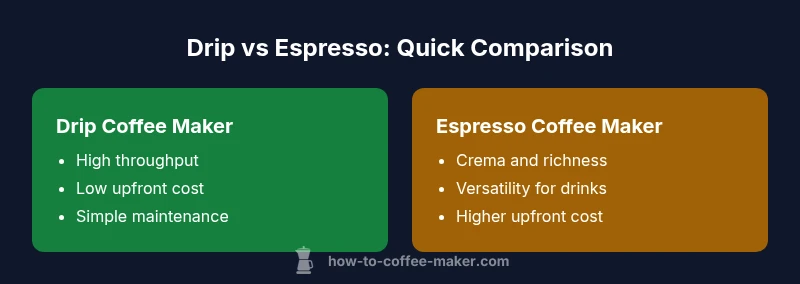
Drip vs Espresso Coffee Makers: A Side-by-Side Guide
Compare drip and espresso coffee makers to decide which brewer fits your routine, budget, and taste. This BrewGuide Pro analysis covers speed, flavor, maintenance, and value for home brewers.


Bottom line: a drip coffee maker delivers reliable, large-batch brews at low cost, with minimal setup. An espresso coffee maker yields rich, concentrated shots and café-style drinks, often with faster pull times. If you want everyday coffee with simple operation and high throughput, choose a drip model; if you crave authentic espresso and versatility, choose an espresso maker.
Understanding the Core Distinctions
When weighing a drip and espresso coffee maker setup, the most obvious difference is the brew method and intended output. Drip machines rely on gravity to pull hot water through ground coffee held in a filter, producing larger volumes of clean, consistent coffee. Espresso machines, on the other hand, force hot water through finely ground coffee at high pressure, creating concentrated shots with crema. For home users, this distinction informs everything from flavor, speed, and maintenance to upfront cost and counter space. BrewGuide Pro emphasizes aligning your purchase with your daily cadence, preferred flavors, and willingness to manage equipment. In practice, your decision centers on whether you value volume and ease (drip) or intensity and versatility (espresso).
Brewing Principles and Flavor Profiles
The core difference between the two systems lies in extraction. Drip brewing emphasizes clarity and consistency, highlighting a bright, clean flavor profile suitable for milder roasts and everyday coffee. Espresso extraction emphasizes body, crema, and intense flavor notes, especially with darker roasts and precise grind settings. A drip machine typically uses a medium grind and a coarser basket, while an espresso setup uses a fine grind and a pressurized filter. Temperature stability, pre-infusion, and water quality influence both, but the espresso path rewards precise control of pressure (usually around 9 bars) and shot timing. For most households, the choice hinges on whether you want broad coffee options or a café-style experience at home.
Throughput, Speed, and Footprint
Drip setups shine in throughput: multiple cups in one cycle with minimal user involvement. They are often compact for basic models and scale up to larger carafes for households that drink coffee by the pot. Espresso machines typically trade volume for speed and intensity; a single shot takes roughly 25-30 seconds, with many machines offering back-to-back pulls. Footprint varies by model, but espresso units—especially multi-boiler or semi-automatic prototypes—tocket more counter space and require more routine management. If space is tight and you value morning speed, a drip brewer usually wins.
Maintenance, Descale Needs, and Longevity
Maintenance needs diverge after the purchase. Drip machines usually require simple, routine cleaning, filter replacement (paper or reusable), and occasional descaling. Espresso machines demand more frequent attention: portafilter organization, grinder calibration, group head maintenance, and periodic boiler inspections. Descale cycles for both are essential to maintain flavor and efficiency, but espresso systems benefit more from regular backflushing and seasonal inspections. BrewGuide Pro notes that the long-term durability of both types depends on water quality, hardware materials, and upkeep discipline.
Cost of Ownership: Upfront, Operating, and Repairs
Pricing for drip machines spans budget to premium, with many solid performers in the mid-range. Espresso machines can be significantly more expensive upfront, especially if you add a quality grinder and accessories. Ongoing costs include replacement filters, descaling solutions, and potential repairs or part replacements. While drip models offer lower initial investments and predictable running costs, espresso gear can deliver higher value for those who prioritize espresso-based beverages and customization over time. Relative to flavor options and drink variety, choose the tier that matches your anticipated usage and maintenance willingness.
Options for Hybrid Models and Flexibility
Hybrid or multi-function machines attempt to bridge the gap, offering built-in grinders, single-serve options, and programmable profiles. While convenient, hybrids can compromise flavor clarity or espresso crema quality if pushed beyond their intended design. If your routine includes both drip and espresso drinks, a well-chosen combination—such as a dedicated espresso machine paired with a reliable drip brewer—often yields better long-term results than a single hybrid unit. Consider your typical weekend or weekday routines, and whether intensity or volume dominates your mornings.
Practical Buying Scenarios: Which to Pick?
- If your goal is daily coffee for a larger household with minimal fuss, a drip coffee maker is typically the better fit due to simplicity and capacity. It supports low-cost servings and reliable consistency across many cups.
- If you prize espresso shots, café-style drinks, and the flexibility to customize grind size, pressure, and shot timing, an espresso machine will be the better long-term investment. It’s especially appealing for households with roasters or an interest in specialty drinks.
- For kitchens with limited counter space or a tight budget, consider a compact drip model or a compact espresso machine that prioritizes essential features.
How to Pair with Grinders and Water Care
A good grinder is as crucial as the brewer itself when pursuing the best flavor. For drip systems, a consistent medium grind equals predictable extraction. For espresso, the grind must be finely tuned to achieve crema and a balanced shot. Water quality matters, too: hardness and mineral content influence taste and equipment longevity. Invest in clean water and periodic mineral testing, plus a suitable scale to monitor dose accuracy. The right grinder and clean water help ensure you realize the full potential of your chosen brewing path.
Quick Buy Plan: A 4-Step Roadmap
- Define your daily volume and preferred drinks. If you drink multiple cups, a drip brewer supports higher output with lower effort.
- Assess your flavor goals. For a brighter, cleaner cup, drip is ideal; for dense, intense shots, espresso wins.
- Set a realistic budget. Drip machines tend to be cheaper upfront, while espresso gear (with grinder) demands more upfront investment.
- Plan maintenance. Allocate time for cleaning and descaling, especially if you live in hard-water regions. Finally, pick a model with solid service support and readily available parts.
Final Check: Getting the Right Accessories
Regardless of your choice, a good scale for dose accuracy, a reliable grinder, and a water filtration system can dramatically improve flavor and machine longevity. For most homes, starting with a proven drip model or a reputable espresso machine and grinder combo offers the best balance of flavor, cost, and maintenance ease. Consider trial brewing and dial-in sessions to settle on your preferred profile.
Comparison
| Feature | Drip Coffee Maker | Espresso Coffee Maker |
|---|---|---|
| Brewing Method | Gravity-based filtration with a filter | Pressure-extraction using high-pressure pump |
| Typical Output | 4-12 cups per brew (varies by model) | 1-2 shots per pull (per cycle) |
| Cost Range | Lower upfront cost for basic models | Higher upfront cost depending on features and grinder |
| Maintenance | Simple cleaning, regular filter changes | Frequent descaling and portafilter care |
| Space Footprint | Usually compact to large carafes; scalable | Can range from compact to larger due to pump and boiler |
| Flavor Focus | Clean, bright flavor with clarity | Rich, full-bodied, crema-rich profile |
| Best For | Daily coffee, high-volume mornings | Espresso drinks, versatility, café-style results |
Strengths
- Clear preference for single-brew style and reliability
- Drip brewers offer high throughput with simple operation
- Espresso machines provide café-style drinks and flavor control
- Lower energy usage on some drip models when idle
Downsides
- Espresso gear can be expensive and require more upkeep
- Drip brewers may lack authentic espresso depth for some users
- Espresso setups can require more counter space depending on model
Drip wins for value and volume; espresso wins for flavor and versatility
Choose drip if you want simple, reliable, high-output coffee at a lower cost. Choose espresso if you value crema, extraction control, and a broader range of drinks.
Questions & Answers
What is the primary difference between a drip coffee maker and an espresso machine?
Drip makers brew coffee by gravity through a filter, emphasizing volume and consistency. Espresso machines use high pressure to extract rich, concentrated shots with crema. The core trade-off is bulk throughput versus flavor intensity and drink versatility.
Drip brews are reliable and fast for many cups; espresso emphasizes crema and strong shots with more customization.
Can you get espresso-like coffee from a drip machine?
A drip machine cannot replicate true espresso pressure and crema. You can approximate stronger flavor using a finer grind and higher brew strength, but the experience will differ from a true espresso shot.
Drip brews won’t equal true espresso, but you can intensify flavor with grind and brew settings.
Are hybrid machines worth it for a mixed workflow?
Hybrid machines offer convenience but often compromise on crema quality or flavor clarity. They work best if you value one-button convenience over perfect espresso or a wide range of specialty drinks.
Hybrid machines are convenient, but may not deliver perfect espresso or the clean drip you want.
What should I consider when buying on a budget?
Assess daily volume, prioritize required features, and look for reliable warranties. A solid drip model tends to deliver more coffee per dollar, while a budget espresso setup may require a grinder and accessories that increase total cost.
With budget in mind, drip is often the safer starter choice for value and reliability.
Do I need separate grinders for each system?
For true espresso, a dedicated, consistent grinder improves shot quality. Drip coffee can tolerate a standard grinder, though consistency matters for flavor. Separate grinders are common when you want optimal results across both methods.
Espresso benefits from a good grinder; drip can use the same grinder if dialed in properly.
What maintenance schedule is recommended?
Follow manufacturer guidelines, descaling as needed based on water hardness, and clean grinders and portafilters regularly. Regular routines prevent flavor drift and extend machine life.
Descale when your water is hard and clean components regularly.
Key Takeaways
- Identify your daily cup count before choosing
- Drip excels in speed and volume; espresso excels in flavor depth
- Maintenance effort scales with gear complexity
- Hybrid devices exist but may compromise quality
- Pair your brewer with an appropriate grinder and water care