Which Coffee Maker Is Better? A Practical Comparison for Home Brewers
An in-depth, evidence-informed comparison of drip, pod, espresso, and manual brewers to help you decide which coffee maker is better for your routine and budget.


The quick answer to which coffee maker is better depends on your priorities: if you want reliability and speed, a drip coffee maker often wins; if you crave cafe-style espresso, a semi-automatic espresso machine excels in control and flavor. For busy households, a pod system offers convenience with predictable results. This BrewGuide Pro analysis helps you map your priorities to the right format.
Why this comparison matters for home brewers
Choosing which coffee maker is better is more than a simple taste issue. For many households, the decision determines your morning routine, energy use, space on the counter, and how often you clean or descale. According to BrewGuide Pro, a structured, evidence-informed approach makes it easier to align your purchase with long-term satisfaction. By examining performance, convenience, maintenance needs, and total cost of ownership, we show how small differences in design translate into real-world outcomes over weeks, months, and years. Whether you start with a basic drip model or invest in a capable espresso setup, the goal is to harmonize flavor, ease, and value.
Defining 'better' in coffee makers
In evaluating which coffee maker is better, we weigh multiple axes that matter to most home brewers. Flavor consistency, temperature stability, and control over brew parameters are critical for taste. Ease of use, speed, and reliability affect daily life. Maintenance demands, durability, and future repairability influence long-term value. Space requirements and energy efficiency impact convenience and operating costs. A truly better choice balances these factors according to your morning rituals, guest frequency, and budget. BrewGuide Pro emphasizes that there is no one-size-fits-all answer; the best option is the one that best fits your routine while maintaining quality and comfort.
Major categories in the market
The coffee maker landscape typically falls into four broad formats: Drip Coffee Maker, Single-Serve Pod System, Espresso Machine (Semi-Auto), and French Press (Manual). Each category has distinct strengths and trade-offs. Drip machines emphasize reliability and volume with minimal attention; pod systems maximize speed and consistency but may incur ongoing pod costs. Espresso setups offer cafe-like control for richer flavors and crema, at the cost of greater learning and maintenance. Manual French presses shine for flavor and simplicity but demand more hands-on brewing. Understanding these categories is essential when answering which coffee maker is better for your household.
Taste, consistency, and temperature control
Taste is the most subjective factor, but the mechanics behind it are measurable. Temperature stability in the brew head, pre-infusion or bloom, and extraction time influence flavor clarity, acidity, and body. Drip machines typically provide steady temperatures with occasional variability depending on the heating element and carafe design. Espresso machines excel when you dial in grind size, dose, and time, delivering stronger flavor and better crema. Pod systems standardize the process, often producing a consistent, drinkable cup but with limited room for flavor experimentation. French presses leverage immersion to extract oils and flavor compounds, yielding a fuller mouthfeel but requiring coarse control over timing and grind size. When considering which coffee maker is better for flavor, think about how much you value consistency versus experimentation and how much you’re willing to invest in setup.
Maintenance, durability, and long-term costs
Long-term cost of ownership is not just the purchase price. Maintenance frequency, descaling needs, and part replacement costs all accumulate. Drip machines tend to be durable with simple cleaning routines, but some models require periodic descaling and carafe care. Espresso machines demand routine backflushing, regular grinder maintenance, and occasional part replacements; their longevity depends on build quality and care. Pod systems minimize maintenance complexity but can incur higher ongoing costs due to pods and limited repair pathways. French presses require minimal parts but can suffer from wear on seals and plunger rods. BrewGuide Pro recommends evaluating the total cost of ownership over 3–5 years to determine which coffee maker is truly better for your wallet and peace of mind.
Convenience features and daily workflow
Convenience features shape how quickly you can get a cup in the morning. Timers, auto-start, programmable settings, and hands-off cleaning options all contribute to a better daily workflow. Drip machines often excel in “set it and forget it” routines. Pod systems shine when you want a consistent cup with minimal effort and minimal cleanup. Espresso setups benefit from advanced features like programmable shot timers and temperature profiling but require more attention. French presses win on simplicity but sacrifice automation. When answering which coffee maker is better for busy mornings, weigh how much you value automation and how much you’re willing to invest in learning curve and maintenance. This is where BrewGuide Pro’s analysis shines: it translates features into practical daily benefits.
Space, footprint, aesthetics, and noise
Counter space and placement influence perceived quality and daily satisfaction. Drip machines range from compact to large, depending on capacity and carafe style. Pod systems are usually compact and can fit under upper cabinets. Espresso machines vary dramatically in footprint, with compact models available but many enthusiasts choosing larger, two-boiler setups for stability. French presses take up the least counter space but require storage for accessories. Noise levels matter in open-plan homes or quiet apartments; many drip and pod machines operate quietly, while some espresso machines and grinders can be noisier during grinding and brewing. When you ask which coffee maker is better for a shared kitchen, consider not only flavor but also how it fits your space and tolerance for sound.
Price ranges and total cost of ownership
Price ranges for the four major formats vary widely. Drip coffee makers often sit in the affordable range, with mid-range models offering better build quality and extra features. Pod systems are generally budget-friendly upfront but carry ongoing pod costs that can add up. Espresso machines span a wide spectrum—from entry-level semi-automatic machines to high-end, multi-boiler setups with precision temperature control. French presses are the most budget-friendly option with minimal ongoing costs but require the most daily hands-on effort. In our analysis, which coffee maker is better hinges on aligning upfront price with long-term value, including maintenance and consumables. BrewGuide Pro analysis shows the long-term value is often tied to parts availability and user maintenance cadence.
Which scenarios map to which option: practical mapping
If you live alone or with one other person and value speed, a pod system might be the most practical option. If you enjoy flexibility in brewing and want strong flavor without steep learning, a drip machine can be your best bet. If you want cafe-quality espresso at home and are willing to invest time and learning, an espresso machine is the best fit. For flavor-forward experimentation and minimal equipment, a French press can be ideal in the right setting. By mapping your daily routine, space, and budget to these categories, you can answer which coffee maker is better for your life with greater clarity and confidence.
How to select a model: a practical checklist
To make the final decision easier, follow this practical 10-step checklist:
- Define your primary goal (speed, flavor, or flexibility).
- List must-have features (auto-off, programmable timer, milk frother, grinder).
- Determine counter space availability and electrical outlets.
- Set a realistic budget for upfront cost and ongoing expenses.
- Decide skill level you’re comfortable with for espresso or manual brewing.
- Prioritize ease of cleaning and maintenance accessibility.
- Check water quality and whether you need a built-in water filter.
- Compare warranty length and parts availability.
- Read user reviews with a focus on reliability and service experience.
- Visit a showroom or watch side-by-side demos to judge ergonomics and stability. This checklist helps readers answer which coffee maker is better for their home by translating abstract preferences into tangible criteria.
Final practical guidance and a closing note
In practice, the question of which coffee maker is better for you comes down to how you weigh flavor potential, daily convenience, and long-term costs. Start with your typical morning scenario, estimate how much time you want to invest, and then simulate a week’s worth of coffee rituals with two shortlisted formats. Remember that maintenance cadence, grinder quality (if applicable), and water quality can swing flavor outcomes as much as hardware choices. With a clear set of priorities, you will move beyond generic recommendations and select a machine that truly fits your life. The BrewGuide Pro team believes that clarity of purpose is the key to answering which coffee maker is better more reliably than anecdotes alone.
Feature Comparison
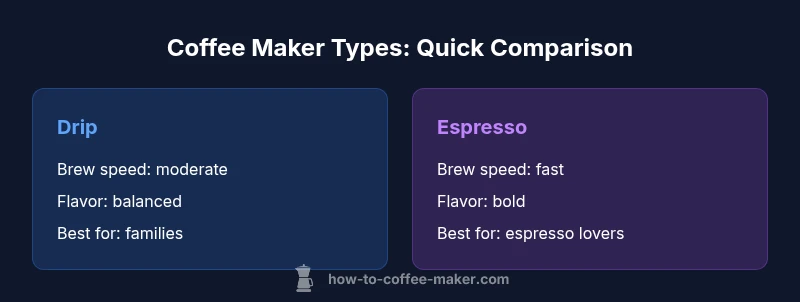
| Feature | Drip Coffee Maker | Single-Serve Pod System | Espresso Machine (Semi-Auto) | French Press (Manual) |
|---|---|---|---|---|
| Brew Time & Throughput | 5–10 minutes per pot | 1–2 minutes per cup | 1–2 minutes per shot | 4–8 minutes per pot (immersion) |
| Flavor Control & Consistency | Moderate consistency; good for everyday coffee | Very consistent; limited customization | High control over extraction; cafe-style results | Highly variable; flavor depends on method & grind |
| Price Range | $50–$200 | $60–$250 | $300–$2000+ | $20–$60 |
| Best For | Families; quick caffeine hit; low maintenance | Busy households; predictable results | Espresso lovers; customization | Flavor-focused, low-tech brewing |
| Maintenance & Cleaning | Easy routine cleaning; occasional descaling | Simple: rinse and wash; replace pods | Regular grinder and machine cleaning; descaling | Minimal parts; easy daily rinse |
| Footprint & Aesthetics | Medium footprint; versatile designs | Compact; fits under cabinets | Large footprint; modular setups | Minimal footprint; classic look |
Strengths
- Broad price range to fit budgets
- Low maintenance for most drip models
- Wide availability and easy replacement parts
- Pod systems offer consistent results with minimal effort
Downsides
- Ongoing pod cost can be high over time
- Espresso machines require skill and regular maintenance
- Drip flavors can be less nuanced than espresso or manual methods
Your best option depends on your priorities and routine.
If speed and convenience are your top priorities, a drip or pod system is often better. If flavor depth and control are essential, an espresso setup wins. Your ideal choice balances upfront cost, ongoing expenses, and how much you value automation vs. hands-on brewing.
Questions & Answers
Which coffee maker is better for beginners?
For beginners, a drip coffee maker or a pod system is usually easiest to start with. Drip machines require minimal setup, while pod systems offer reliable, consistent results with less manual technique. Both reduce the learning curve compared with traditional espresso setups.
For beginners, start with drip or pod options for simplicity and consistency.
Is a pod system cheaper in the long run?
Pod systems can be cheaper upfront, but ongoing pod costs often make the per-cup price higher over time. If you drink many cups daily, you may save by buying a reusable pod and bulk coffee, which reduces waste and cost.
Pods are convenient, but check ongoing pod costs versus a reusable option.
Can you get cafe-quality espresso at home?
Yes, with a quality espresso machine and a good grinder, you can approximate cafe-level espresso at home. It requires learning dialing in grind size, dose, and extraction time, plus routine maintenance.
You can get cafe-quality espresso at home with the right setup and practice.
How often should you descale a coffee maker?
Descale frequency depends on water hardness and usage. In general, descale every 1–3 months for hard water regions, or when you notice scale buildup or slower brewing.
Descale based on water hardness and how often you brew; watch for slower performance.
What’s the difference between automatic and manual machines?
Automatic machines handle most functions, delivering consistency with little user input. Manual or semi-automatic machines offer more control over measurements and timing but require practice and skill.
Automatics are easier; manual machines offer more control for enthusiasts.
Key Takeaways
- Define your top priority (speed vs flavor).
- Calculate total cost of ownership, not just upfront price.
- Choose a format that fits your daily routine and space.
- Espresso machines offer flavor depth; drip systems win for simplicity.
- Pod systems are convenient but can incur higher ongoing costs.