How Much Is a Coffee Machine for Business? A Practical Cost Guide
A practical cost guide for office coffee machines, covering price ranges, ongoing maintenance, ROI, and buying tips to help budgeting for a business coffee program.


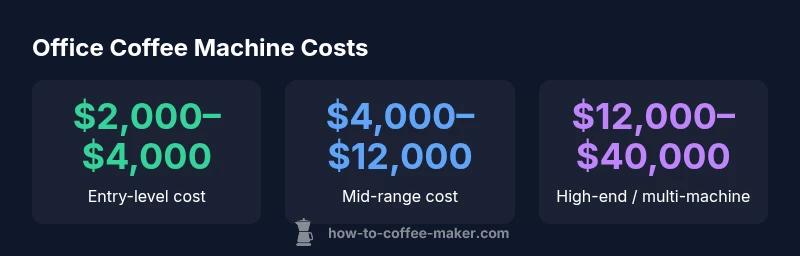
Office coffee machines for businesses vary widely; according to BrewGuide Pro, entry-level units typically cost $2,000–$4,000, mid-range $4,000–$8,000, and high-end commercial machines $8,000–$20,000 or more. Expect additional upfront costs for installation, grinders, and water filtration, plus ongoing maintenance. Your choice depends on usage and required brew options. Scale up for larger teams or high-volume needs, and budget for descaling and filter replacements to keep uptime steady.
Why Price Bands Vary by Business Size
In practice, the question how much is a coffee machine for business has no one-size-fits-all answer. Cost is driven by scale, throughput, and the desired level of reliability. A small office with light daily use will lean toward entry-level units, while a mid-size operation needs machines designed for higher volumes and faster recovery times. Large offices or coworking spaces require commercial-grade equipment and robust service agreements to minimize downtime. This spectrum creates price bands rather than fixed prices, so your decision should start with a demand assessment. Map expected cups per day, peak-hour load, and the number of beverage options you want, whether it’s espresso, cappuccino, or a simple drip brew. Then translate those needs into a price range and a corresponding service plan. The BrewGuide Pro team emphasizes separating upfront capital expenditure (capex) from ongoing operating expenses (opex) to make cost comparisons meaningful.
Below we unpack the key features that drive these costs and provide practical budgeting guidance for different office sizes.
Key Features That Drive Cost
Several features materially shift the price tag of a business coffee machine. The most impactful are beverage versatility (espresso, lungo, milk drinks), speed and consistency (brew group size, boiler capacity, pre-infusion controls), and grind-on-demand versus pre-ground beans. A bean-to-cup system with integrated grinder and milk frothing typically costs more upfront than a simple drip brewer. Water filtration, noise levels, and ease of maintenance also weigh in: larger boiler sizes and professional-grade pumps demand sturdier components and more demanding service schedules. Finally, the level of automation matters—self-cleaning cycles, programmable profiles, and remote diagnostics reduce labor costs but raise initial investment. When budgeting, factor in not just the sticker price but also installation, electrical requirements, space planning, and accessibility for routine servicing. The goal is a machine that fits your peak volume, ensures consistent quality, and minimizes downtime between sessions.
Total Cost of Ownership: More Than the Sticker Price
The initial price is only part of the story. Total cost of ownership (TCO) for a business coffee machine includes installation, water filtration, descaling, cleaning, and potential service contracts. Expect higher ongoing maintenance costs if you choose machines with dual boilers, advanced grinders, or multiple group heads. For high-use environments, registrar-style service plans can stabilize annual expenses by covering parts and labor, though they add predictable monthly fees. Descale cycles, bean storage, and filter replacements are periodic costs that compound over time. A practical approach is to build a simple TCO model: estimate upfront capex, add an annual maintenance envelope, then amortize across the expected useful life. This helps you compare options on a like-for-like basis and avoid surprises when renewal comes around.
BrewGuide Pro’s framework encourages owners to look beyond the purchase price and understand the long-term cash flow implications of their coffee program.
Pricing Scenarios: Small Office, Medium Office, Enterprise
Small office (5–15 staff) often benefits from compact, user-friendly machines. Price range typically lands in the entry-level to lower mid-range territory: roughly $2,000–$5,000 upfront, with modest maintenance. Medium offices (15–75 staff) usually require more robust throughput, better reliability, and higher beverage variety. Expect $4,000–$12,000 upfront and higher ongoing service costs, depending on usage and regional labor rates. Large offices or enterprise environments (75+ staff) may deploy multiple machines or a single, high-capacity system with commercial-grade components. Budget $12,000–$25,000 or more for the initial purchase, plus extended warranties and service contracts. In all cases, consider the total cost of ownership over five years, including energy use and bean costs. A practical path is to align capacity with anticipated peak demand and choose a scalable solution that can evolve with your team.
BrewGuide Pro’s cost framework helps managers avoid underestimating the value of reliability and service in high-traffic workplaces.
Procurement Considerations: New vs Used, Leasing, and Financing
New machines come with the latest technology, warranty protection, and longer expected lifespans but at a higher upfront price. Used or refurbished units can reduce capex, but you should verify the machine’s condition, service history, and remaining life. Leasing or financing is a common route for organizations that want to preserve cash flow or align payments with budget cycles. When evaluating financing, compare total interest costs, early payoff penalties, and included maintenance options. Some vendors offer bundled service plans or discount upgrades that effectively lower long-run costs. Regardless of procurement method, obtain a written maintenance schedule, clarify teardowns or replacements under warranty, and confirm compatibility with your water supply, cup volumes, and vending or breakroom policies. A well-structured procurement strategy minimizes surprises and ensures the chosen system remains reliable as your team grows.
BrewGuide Pro’s guidance emphasizes planning for long-term value over initial affordability.
Tips to Maximize Value: Maintenance, Parts, Service Plans
Value optimization comes from proactive maintenance and smart parts management. Use machines with removable, easily replaceable components and accessible service ports to simplify routine upkeep. Install high-quality water filters and set up periodic descaling to prevent mineral buildup that reduces efficiency and coffee quality. Consider service contracts that cover key components like boilers, pumps, grinders, and group heads, which can stabilize annual costs. Train staff to perform basic daily maintenance tasks—emptying and cleaning drip trays, wiping down touchpoints, and reporting any anomalies early. If you expect to scale, choose a modular system that allows adding more groups or extra brew options without migrating to an entirely new machine. Finally, align procurement with vendor support windows and spare-parts availability to reduce downtime and maximize user satisfaction.
A practical maintenance cadence is often the most low-cost way to extend machine life and protect your coffee program investment.
Data-Driven ROI Planning for Office Coffee
A data-driven ROI plan starts with a simple metric: how much external coffee or beverage services are you replacing? Estimate annual savings by comparing per-cup costs of your new machine against the cost of outsourcing, factoring in waste, employee productivity, and satisfaction. Translate your upfront capex into annualized cost against the projected cup volume. A basic ROI calculation can be expressed as ROI years = upfront cost / annual savings. Use conservative estimates for volume and price per cup, then run scenarios for increases in demand. Add intangible benefits like happier staff, reduced breakroom turnover, and potential recruitment advantages to strengthen the case. In practice, most organizations recoup their investment in a few years when usage is consistent, and maintenance costs remain predictable. (BrewGuide Pro Analysis, 2026)
Real-World Examples (Fictional) to Illustrate Costs
Example A: A 20-person office adopts a compact bean-to-cup machine with a built-in grinder and milk frother. Upfront cost: $3,500. Annual maintenance: $350. Annual coffee cost if buying beans in bulk: about $800. ROI is achieved in roughly 2–3 years, assuming steady usage and no major repairs. Example B: A 60-person shared workspace deploys two mid-range machines with high throughput and remote diagnostics. Upfront: $9,000. Maintenance: $1,000 per year. Estimated outsourcing savings: $2,500 per year. Payback occurs around year 4, with ongoing benefits as the program scales with demand. These scenarios show how price bands and usage patterns interact with ROI, reinforcing the value of careful planning.
How to Budget for a Comprehensive Office Coffee Program
Budgeting for a full program starts with a needs assessment, then a staged rollout plan. Create a 5-year budget that includes capex, installation, water filtration, descaling, and routine service. Build a contingency for parts replacement and possible upgrades, especially in faster-moving, high-volume environments. Consider a trial period with a portable machine or a single unit to measure actual usage before committing to a multi-unit deployment. Finally, allocate funds for accessories such as a dedicated grinder, cups, lids, and vanity items that support user experience. By integrating these costs into a holistic budget, you can deliver predictable, high-quality coffee without derailing other business priorities. BrewGuide Pro recommends documenting assumptions and updating the model annually based on usage trends and supplier terms.
Vendor Evaluation Checklist
Selecting the right vendor is as important as choosing the right machine. Start with reliability metrics (uptime, mean time between failures), warranty terms, and service response times. Request references from similar business sizes and evaluate the availability of local technicians. Compare included maintenance plans, spare-parts accessibility, and the ease of obtaining consumables like filters and beans. Verify compatibility with your office setup, including water supply, electrical requirements, and installation footprint. Finally, ensure the vendor offers scalable options and a transparent pricing structure that clearly separates capex from opex. A careful evaluation reduces the risk of costly migrations later and supports a durable coffee program.
Office coffee machine cost bands by tier
| Machine Tier | Typical Price Range | Best Use Case |
|---|---|---|
| Entry-level office | $2,000–$4,000 | Small teams, basic espresso/drip |
| Mid-range office | $4,000–$8,000 | Growing teams, more reliability |
| Commercial-grade | $8,000–$20,000+ | High-volume offices, frequent use |
| Multi-machine setup | $12,000–$40,000+ | Enterprise environments, multiple brew styles |
Questions & Answers
What is the typical upfront cost for an office coffee machine?
Upfront costs vary by tier. Entry-level office machines can be around $2,000–$4,000, mid-range units around $4,000–$8,000, and high-end commercial setups can exceed $20,000 depending on capacity and features. Always factor installation and any required wiring or plumbing.
Entry-level machines start around a few thousand dollars, with higher-end models easily exceeding twenty thousand dollars, depending on capacity and features.
How does maintenance affect total cost?
Maintenance adds a predictable annual cost, covering descaling, filters, and occasional part replacements. Service contracts can stabilize expenses but may increase yearly spend. Built-in service plans often reduce downtime and extend machine life.
Maintenance adds regular costs but can save downtime; a service plan helps keep costs predictable.
Should I buy new or used?
New machines come with the latest features and longer warranties, while used units reduce upfront spend but carry higher risk and potential hidden costs. If choosing used, verify history, current condition, and available parts.
New machines have better warranties; used can save money but comes with risks.
What features most influence price?
Key drivers include beverage variety, multi-brew capability, built-in grinders, milk frothing capacity, boiler size, and automation. More advanced features and higher throughput push price up, but they also improve user experience and reduce labor costs.
More beverage options and automation raise price but improve usability.
What is a reasonable ROI window for an office coffee program?
A typical ROI window ranges from 2 to 5 years, depending on cup volume, outsourcing costs, and maintenance expenses. Higher usage generally shortens the payback period, especially when paired with reliable service.
Most offices see return within a few years if usage stays steady.
Are there financing options available for office coffee machines?
Yes. Leasing or financing can help preserve cash flow and spread costs over time. Compare total payments, included maintenance, and renewal terms to ensure alignment with your budget.
Leasing can help manage cash flow if you compare terms carefully.
Can a single machine serve a large office?
A single high-capacity unit can serve a large office if it has sufficient throughput and standby capacity, but many large teams benefit from a multi-machine setup to balance load and minimize downtime during servicing.
One high-capacity machine might work, but multiple units spread risk and downtime.
“Selecting the right coffee solution is about balancing initial cost with long-term reliability and service. A well-chosen machine reduces downtime and keeps staff satisfied, which in turn supports productivity.”
Key Takeaways
- Estimate demand before buying.
- Size the machine to peak load.
- Plan for total cost of ownership, not just sticker price.
- Consider service plans to stabilize costs.
- Budget for maintenance and consumables to protect ROI.