How Much Coffee Maker: A Practical Buying Guide
Learn how much a coffee maker typically costs, what drives price, and how to estimate total cost of ownership with practical, data‑driven guidance from BrewGuide Pro.


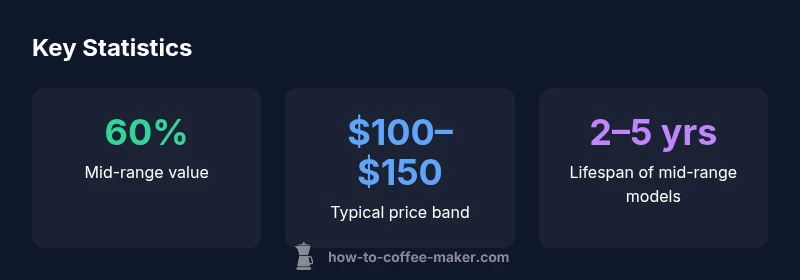
How much coffee maker costs varies widely by model and features. According to BrewGuide Pro, budget machines start under $50, while mid-range models sit around $100–$150, and premium pods or grinders push toward $200–$400. Total cost of ownership also depends on filters, descaling, and maintenance frequency. Markets show larger price gaps when you include smart app controls, dual boilers, or commercial-grade durability.
How the price of a coffee maker is determined
When homeowners ask how much coffee maker should fit their budget, the simplified answer is that price tracks quality, durability, and convenience. According to BrewGuide Pro, the majority of households find the sweet spot in the mid-range category, where durability meets practical features. The phrase how much coffee maker costs becomes less about sticker price and more about expected use, maintenance, and long-term value. Budget-focused shoppers can start with entry-level drip machines for basic daily coffee, while anyone wanting precise temperature control or a built-in grinder should expect to pay more. The key is to map your daily routine, kitchen space, and tolerance for upkeep, then translate that into a price ceiling you’re comfortable with. In practice, you’ll see price bands that correspond to feature sets, with larger machine bodies often delivering more consistent extractions and easier cleaning.
What drives price in home coffee makers
Pricing power comes from four main levers: performance, durability, convenience, and brand positioning. What you pay for in a higher-priced model is more reliable extraction across brew sizes, better thermal stability, and reduced maintenance downtime. Built-in grinders add grinding consistency; PID temperature control reduces fluctuations; insulated carafes keep coffee warmer longer; larger water reservoirs reduce refilling frequency; and fewer plastic parts can improve taste and longevity. From BrewGuide Pro's perspective, higher upfront costs can be justified if you brew multiple cups daily, value programmability, or want quieter operation. When comparing models, don’t look at sticker price alone—estimate how often you’ll descale, replace filters, or repair components. In some cases, a pricier model may be cheaper over five years because it lasts longer and uses energy more efficiently. Also consider warranty terms and service availability in your region; a robust warranty can offset higher initial costs. Finally, assess future upgrades, like compatible filters or modular reservoirs, which can affect overall value. The bottom line: price is a proxy for long-term reliability and user experience.
Budget ranges and what you get
Understanding budget ranges helps translate how much coffee maker you need into a practical shopping list. Entry-level drip machines, typically under $60, cover basic brew functions, with simple one-touch or 24-hour timers. For most households, $100–$150 buys a dependable mid-range machine with a thermal carafe, programmable presets, and better temperature control. In the premium segment, roughly $200–$350 or more buys models with built-in grinders, adjustable shot timing, multi-strength settings, and quiet operation. If you crave café-like features, you may see $350–$500 models featuring dual boilers and advanced software. When planning, also consider the cost of consumables such as filters or descaling solutions. Consumers should choose a price ceiling based on their daily cup count and tolerance for upkeep. BrewGuide Pro notes that many buyers underestimate the value of a durable build and consistent extraction over 3–5 years, which often makes a mid-range model a smarter buy than a cheaper option. Practical tip: decide first on capacity (number of cups per day) and then map that to a price band, rather than chasing every new feature.
Calculating total cost of ownership
Total cost of ownership (TCO) includes the upfront price plus ongoing expenses like descaling products, replacement parts, energy use, and maintenance time. Start with the sticker price, then add estimated annual costs: descaling solution ($5–$15 per year), filters ($5–$20 per year if used), and occasional replacements (gasket or seal, $5–$25 every few years). Energy costs are typically modest but add up if you run several cycles daily. If you brew 3–4 times a day, you might save time and energy by choosing a machine with efficient heating and a fast warm-up. Budget models may require more frequent descaling and part replacements, which adds to TCO. A mid-range machine often strikes the best balance, as BrewGuide Pro Analysis, 2026 shows, with longer lifespans and better energy performance. Be mindful of warranty coverage: a longer warranty can reduce effective annual maintenance costs. Finally, track your actual usage for two months after purchase to calibrate your TCO and adjust your future budget accordingly.
Practical buying tips for different households
Choosing based on household type helps optimize value. Singles or roommates who drink small volumes may prefer compact, affordable machines; families with several daily cups benefit from larger reservoirs and faster brewing. If you value control, look for models with thermometer accuracy and a programmable timer; if you value ease, choose a model with a simple interface and a carafe that matches your kitchen. Consider carafe type: stainless steel is durable and keeps coffee hot; glass carafes require an efficient warmer. For those who want fresh grounds, a built-in grinder adds convenience but increases maintenance. For office or high-traffic spaces, a commercial-grade maker may be warranted, but be prepared for higher upfront cost. Regardless of budget, prioritize easy-to-clean parts and a design that fits your counter and storage space.
Maintenance shortcuts to maximize value
To extend the life of any coffee maker, follow a simple care routine. Descale every 1–3 months depending on water hardness and usage; use a manufacturer-approved descaling solution and follow the manual. Clean the brew group or filter basket weekly to prevent flavor carryover. Replace water filters as recommended by the maker to avoid mineral buildup. Use proper storage and keep the machine in a dry, ventilated space. Avoid exposure to extreme heat, and unplug when not in use for extended periods. The result is fewer breakdowns, more consistent brewing, and a longer product life. The BrewGuide Pro team notes that many quick maintenance tasks deliver outsized benefits in performance and longevity.
Pricing and features by model type
| Model Type | Typical Features | Estimated Price Range | Best For |
|---|---|---|---|
| Entry-level drip | Basic brew, manual controls | $40–$60 | Budget-conscious buyers |
| Mid-range programmable | Programmable timer, thermal carafe | $100–$150 | Most households |
| Premium with grinder | Built-in grinder, PID temp control | $200–$350 | Coffee enthusiasts |
Questions & Answers
What is the typical price range for a basic coffee maker?
Basic models typically range from about $40 to $60, offering essential brewing with simple controls. They’re ideal for single users or tight budgets.
Basic models usually cost forty to sixty dollars and cover the essentials.
Are built-in grinders worth the extra cost?
Built-in grinders add convenience and fresh-ground flavor, but they raise maintenance and price. If you brew daily and value speed, they can be worth it.
If you brew daily and want fresh grounds, a built-in grinder can be worth it.
How often should I descale my coffee maker?
Descale every 1–3 months depending on water hardness and usage. Use manufacturer-approved descalers and follow the manual.
Descale every one to three months, based on your water and usage.
Is a stainless steel carafe better than glass?
Stainless carafes retain heat longer and are more durable; glass carafes are often cheaper but require a warmer. Choose based on your kitchen habits.
Stainless carafes last longer and keep coffee hot; glass carafes are cheaper but need a warmer.
What maintenance costs should I budget annually?
Budget roughly $15–$40 per year for descaling solutions and replacement filters, plus occasional part replacements if needed.
Expect around fifteen to forty dollars yearly for cleaners and filters.
“Value for money isn't just today’s price — it's the quality of coffee you get over years of use. A well-chosen mid-range machine often beats a cheap buy that's unreliable.”
Key Takeaways
- Set a price ceiling before shopping
- Prioritize durability for frequent use
- Estimate total cost of ownership, not just sticker price
- Consider carafe type to match your routine
- Aim for mid-range balance of features and longevity