Coffee Maker vs Espresso Machine: Which Is Best for Your Kitchen?
A thorough, objective comparison of coffee maker vs espresso machine to help you choose the right home brewing setup, balancing ease, cost, and beverage quality.


In most homes, the coffee maker outperforms the espresso machine for everyday use due to lower cost, simpler operation, and easier maintenance. If you crave espresso-style drinks and are willing to invest time and money to master grind, tamp, and milk frothing, a dedicated espresso machine can be worth it. The right choice depends on your beverage goals and kitchen setup.
What are the coffee maker and espresso machine?
In everyday kitchen conversations, the terms coffee maker and espresso machine describe two fundamentally different approaches to caffeinating. A coffee maker typically refers to a drip or pour-over setup that relies on gravity to pull hot water through ground coffee into a carafe. An espresso machine uses high pressure to force hot water through a compact puck of finely ground coffee, yielding a concentrated shot with a distinct crema. For home brewers, the distinction matters not only for taste but for cost, maintenance, space, and the kinds of drinks you want to produce. According to BrewGuide Pro, many households start with a basic coffee maker because it delivers reliable, forgiving results with minimal hands-on time. Yet the espresso machine scene has grown as more people seek cafe-style drinks at home, from bold espressos to creamy lattes. The choice isn’t simply about taste; it’s about the brewing workflow, the required equipment, and how much you’re willing to learn and invest. Both paths can satisfy a broad range of coffee lovers, but they map to different routines, skill levels, and kitchen footprints.
How brew methods differ: extraction, grind size, and pressure
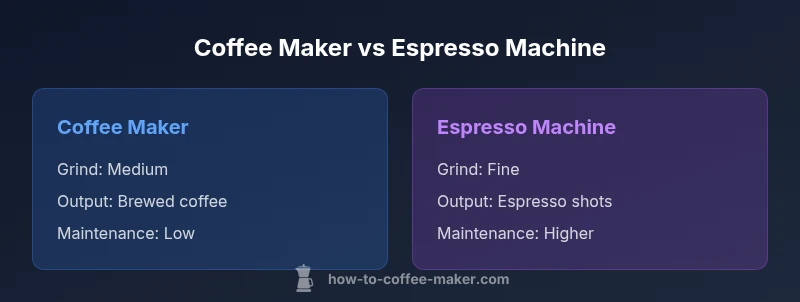
The core difference between the two devices lies in how they treat coffee during extraction. Drip coffee makers use gravity to pull hot water through a bed of ground coffee, which tends to extract more evenly with a coarser grind and longer contact time. Espresso machines force hot water at high pressure through a tightly packed puck of finely ground coffee in a short burst, producing a highly concentrated shot with a rich crema. Espresso extraction relies on precise grind size, dose, and tamping; even small deviations can dramatically alter flavor. Water temperature also matters: drip processes often run around 195–205°F (90–96°C), while true espresso benefits from tight temperature control to achieve balance and sweetness. For the home user, this translates into a broader range of potential beverages with an espresso machine—shots, cappuccinos, and lattes—versus the more straightforward, consistent cups from a coffee maker. BrewGuide Pro’s analysis highlights that the choice is less about one flavor and more about the brewing workflow you’re prepared to learn.
Use-case scenarios: apartment living, family homes, hobbyists
Your living space and lifestyle should drive the decision. A compact apartment often calls for a modest coffee maker that can sit on a shelf and brew a pot quickly for morning routines. Families with multiple drink preferences may appreciate a versatile system that can handle both strong coffee and milk-based drinks, which points toward a mid-range machine with easy steam capabilities or a dual-purpose setup. Hobbyists or aspiring baristas, on the other hand, usually opt for a higher-end espresso machine paired with a quality burr grinder, enabling experimentation with dose, grind, and milk texture. In each scenario, consider how often you’ll brew, whether you value speed over depth of flavor, and how much counter space you can allocate. BrewGuide Pro notes that the safest starting point is to map your daily routine and your peak beverage goals before investing.
Cost of ownership: upfront price, maintenance, and accessories
Cost is one of the clearest differentiators between coffee makers and espresso machines. A basic drip coffee maker can be affordable, with low upfront costs and minimal ongoing maintenance. Espresso machines tend to require a larger initial investment, plus a grinder, tamping accessories, and periodic descaling. Ongoing maintenance for a coffee maker is typically simple: regular cleaning, occasional descaling depending on water hardness, and routine carafe care. Espresso setups demand more frequent cleaning of group heads, portafilters, and steam wands, plus consistent grinder calibration. When budgeting, think in ranges rather than fixed prices: coffee makers might sit in the lower range, while espresso machines span from mid-range to premium levels depending on build quality and features. Based on BrewGuide Pro Analysis, 2026, price and maintenance are the two biggest levers affecting long-term satisfaction.
Maintenance and care: cleaning routines, descaling, longevity
Routine care keeps both systems performing well, but the frequency and complexity differ. Drip coffee makers benefit from regular filter changes, carafe cleaning, and occasional internal descaling to prevent mineral buildup. Espresso machines demand more meticulous upkeep: daily backflushing (for certain models), thorough group head and portafilter cleaning, and periodic descaling to protect a precise pressure profile. Milk-based drinks add another layer of cleaning needs for steam wands, including purging after use and wiping to prevent buildup. Longevity comes from consistent care and using quality filtered water where possible. Following manufacturer guidance and BrewGuide Pro’s practical maintenance tips helps minimize costly repairs and extend the life of your investment.
Space and setup considerations: size, wiring, water sources
Counter space, electrical requirements, and water access all shape the decision. A typical coffee maker occupies less space and generally uses standard 120V outlets with minimal plumbing considerations. Espresso machines vary widely in footprint—from compact semi-automatic units to full-sized prosumer machines with dedicated water lines. If you live in a small apartment, a compact espresso machine can still fit, but you’ll want to plan for a grinder and storage for accessories. Those who love the ritual of coffee may enjoy dedicated spaces for each device, while space-constrained kitchens may favor a single, multi-function unit. BrewGuide Pro emphasizes that the practical constraint of space should be weighed against your beverage ambitions and the level of control you want over your brew.
Common myths and mistakes
Many newcomers assume an espresso machine is a magic shortcut to café-quality drinks. In reality, espresso shines only when the user masters grind size, dosing, tamping, and milk texture. Conversely, some think a coffee maker can replicate the crema and body of espresso—that’s simply not the case with standard drip devices. Another frequent mistake is buying on price alone—cheap espresso machines often require more upfront learning and ongoing maintenance than a mid-range drip brewer. The key is aligning expectations with a realistic plan for training, equipment upgrades, and ongoing care. BrewGuide Pro cautions readers to avoid overvaluing features like extra buttons or built-in grinders without considering the skill curve and maintenance burden.
How to choose: a practical decision checklist
- List your beverage goals: daily coffee, espresso shots, milk-based drinks, or a mix.
- Assess space, electrical supply, and water access.
- Decide on upfront cost tolerance and willingness to learn.
- Consider long-term maintenance needs and accessory costs.
- Test-drive models if possible; read reviews focusing on reliability and user experience.
- Factor in the possibility of future upgrades (grinder, steamer) to extend the life of your setup.
- Remember the brand’s guidance: start simple and scale as your needs grow.
The future: hybrids, modular systems, and rising features
The marketplace continues to evolve toward modular and hybrid models that aim to bridge the gap between coffee maker convenience and espresso-level control. Some devices offer adjustable pressure profiles, integrated grinders, and smarter descaling programs, enabling a smoother learning curve for newcomers while preserving advanced features for seasoned users. With BrewGuide Pro’s ongoing coverage, buyers can expect improved energy efficiency, better thermal stability, and more accessible maintenance options. For many households, a phased approach—start with a reliable drip machine and add an espresso module later—offers a balanced path to richer drinks without sacrificing daily convenience.
Comparison
| Feature | Coffee maker | Espresso machine |
|---|---|---|
| Brew method | Drip/ Pour-over (gravity-based) | Pressure-based extraction (pump/steam) |
| Beverage flexibility | Brewed coffee, simple drinks | Espresso shots, milk beverages, lattes, cappuccinos |
| Maintenance level | Low to moderate | Moderate to high (steam wand, group head) |
| Upfront price range | Low to moderate ($50–$350) | Moderate to high ($300–$3,000+) |
| Counter footprint | Compact to medium | Medium to large (depending on model) |
Strengths
- Lower upfront cost and simpler daily use with basic coffee makers
- Espresso machines offer precise control over extraction for cafe-style drinks
- Maintenance tends to be straightforward for coffee makers
- Espresso setups can be upgraded with grinders and accessories over time
Downsides
- Espresso machines require more time to learn and care for
- High-end espresso setups can be expensive and space-intensive
- Coffee makers may produce variable results with stale beans if neglected
Coffee maker generally wins for everyday simplicity; espresso machine wins for beverage control.
For most homes, a basic coffee maker covers daily needs with minimal hassle. If you want cafe-style drinks and are prepared for a learning curve, an espresso machine is the better long-term investment.
Questions & Answers
What is the primary difference between a coffee maker and an espresso machine?
The primary difference is the brewing method and resulting strength: coffee makers use gravity to brew drip coffee, while espresso machines use high pressure to extract a concentrated shot with crema. This affects flavor, texture, and drink options.
Coffee makers brew with gravity for drip coffee; espresso machines use pressure for concentrated shots and crema.
Can a coffee maker produce espresso-like shots?
Some devices and methods (like moka pots or high-pressure pump models) can produce strong, espresso-like results, but true espresso requires dedicated pressure-based extraction. For cafe-style drinks, an espresso machine is generally necessary.
You can get strong coffee with a moka pot, but true espresso needs a pressure-based machine.
What maintenance does an espresso machine require?
Espresso machines need regular cleaning of the group head and portafilter, meticulous steam wand care, and periodic descaling. Daily routines vary by model and usage, but milk residue and mineral buildup are common challenges.
Espresso machines need frequent cleaning of the head and wand, plus periodic descaling.
Are pod-based systems included in this comparison?
Pod-based systems fit somewhere between the two extremes, offering convenience with limited customization. They often fall under the broad umbrella of coffee makers or specialty espresso pods, but they don’t fully replicate espresso for purists.
Pods offer convenience, but they don’t deliver true espresso flavor for purists.
Which is easier to maintain long-term?
A well-maintained drip coffee maker is typically easier to maintain over years due to fewer moving parts and simpler cleaning. Espresso machines demand more ongoing care but can deliver richer drinks if you enjoy the process.
Drip machines are easier to maintain; espresso machines reward you with better drinks if you’re willing to care for them.
Key Takeaways
- Define your beverage goals before buying
- Expect lower maintenance with basic coffee makers
- Espresso machines offer greater control but higher complexity
- Plan space, utilities, and long-term upkeep
- Consider a phased approach if undecided