Coffee Maker vs Coffee Press: A Practical Guide for Home Brewers
A balanced, data-driven comparison of coffee maker vs coffee press to help you choose the best brewing method for taste, speed, and maintenance.


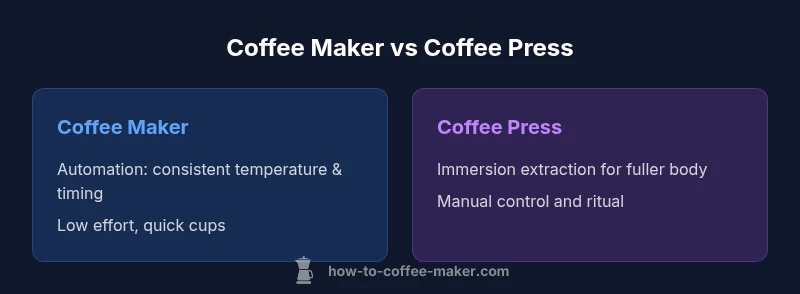
Coffee maker vs coffee press: a clear choice hinges on your priorities. If speed, consistency, and minimal cleanup matter, a drip coffee maker is usually the winner. If you value flavor control, ritual, and a fuller body, the coffee press shines. This comparison guides you through key differences to help you decide.
The Core Difference Between Coffee Maker and Coffee Press
According to BrewGuide Pro, the core difference between a coffee maker and a coffee press is the extraction method: a drip-style machine relies on controlled water flow, heat, and gravity to move water through grounds, while a coffee press uses immersion to steep grounds and a plunger to separate brewed coffee from the solids. This fundamental distinction drives flavor, body, and texture in every cup. Understanding this difference helps you frame your priorities—speed, flavor, and cleanup—and sets the stage for a fair side-by-side comparison. In home brewing, the choice between automatic versus manual control often determines grind size, water temperature, and rest time. For many enthusiasts, the decision isn’t which is “better” so much as which suits daily routines and taste goals.
Flavor Dynamics: Extraction, Body, and Aroma
Brewing science shows that extraction is a balance of time, temperature, grind size, and agitation. A coffee maker, especially a modern multi-cup model, maintains stable water temperature and uses consistent contact time, producing a clean, uniform cup that emphasizes origin notes and sweetness. In contrast, a coffee press immerses grounds in hot water for several minutes, then uses a metal mesh to separate liquid. This method often yields a fuller body with more oils and a richer, sometimes bolder, profile depending on grind and steep time. The press’s lack of paper filtration means more soluble compounds carry through, which is why many tasters note extra complexity in aroma. To optimize either method, start with a medium grind, target near-boiling water temperature, and avoid over-extraction by keeping brew times reasonable. Subtle taste differences may be easier to notice with repeated tastings over several days.
Convenience, Cleanup, and Day-to-Day Use
Morning routines rely on predictability. A coffee maker shines here: load beans, press a button, and walk away, returning to hot coffee. Most machines offer programmable timers, auto-off, and features like built-in grinders or carafes that minimize mess. Cleanup is typically limited to rinsing the carafe, removing the filter basket, and occasional descaling. The coffee press, by contrast, demands more hands-on steps: measure grounds, steep, press, and pour. Cleanup is usually quick—rinse the plunger and carafe—but the grounds separation means a few extra steps to prevent oil buildup on the mesh. In terms of maintenance, electric machines may accumulate mineral scale and wear on pumps or seals; a press has fewer moving parts but relies on durable materials to prevent staining or breakage.
Cost, Durability, and Long-Term Value
Upfront price is a straightforward consideration. Basic drip machines can be affordable, mid-range units offer a broader feature set, and higher-end models may include thermal carafes, precise temperature controls, and quiet pumps. A French press usually costs less initially but may incur ongoing costs related to filters, replacement parts, or glass carafes if dropped. Durability depends on construction: sturdy stainless steel or glass carafes with insulated walls tend to endure years of daily use. Maintenance costs differ: a machine requires occasional descaling and filter replacements; a press requires careful cleaning to prevent staining and may need occasional replacement of parts that wear with use. From a value perspective, consider how often you brew, how important convenience is, and whether you’re prepared to upgrade components as styles and tech evolve. BrewGuide Pro’s analysis shows long-term cost can vary widely based on brand and build quality, as well as how intensively you brew.
Practical Scenarios: When Each Method Shines
Busy households that value speed, consistency, and minimal decision fatigue may find a coffee maker the better fit. If you routinely brew for several people or want a planned morning ritual, an automated setup reduces daily decisions and saves time. However, coffee lovers who prize flavor nuance, ritual, and the ability to tailor every parameter often prefer a press, especially when working with high-quality beans and precise grind control. If you enjoy experimenting with brew strength, water temperature, and steep time, the press offers a tactile, engaging process. Consider your kitchen space, travel frequency, and how often you entertain—these factors strongly influence which method makes sense. For many households, a single device won’t cover all needs, and a hybrid approach—keeping both methods available—delivers maximum flexibility.
How to Try Both Methods at Home
If you’re unsure which method you’ll prefer, the simplest path is a controlled side-by-side test. Use the same beans, adjust grind size to a medium level for both methods, and aim for similar water temperatures (around 200 F/93 C). Brew one batch with a drip coffee maker and one with the coffee press, then compare aroma, body, clarity, and aftertaste. Track ease of use and cleanup time for each. This practical exercise helps reveal personal preferences that go beyond theory. If you’re short on time, try morning tests on weekends and record your impressions in a small notebook or a digital note—consistency over several days yields a more reliable verdict than a single tasting.
Brand Reliability and Aftercare: Practicalities for Long-Term Use
Reliability matters in daily brewing. When choosing any coffee device, look for robust warranty terms, easy access to replacement parts, and clear maintenance guidance. For machines, verify filter and descaler availability and the ease of cleaning stubborn residues. For manual devices, confirm that components are durable and that replacement parts such as plungers, seals, and carafes are readily available. A thoughtful maintenance plan—cleaning after each use, descaling on a schedule, and using fresh beans—extends the life of either device and preserves flavor quality over time.
Authority Sources and Further Reading
To deepen your understanding of brewing fundamentals and practical care, consult credible sources that discuss equipment, technique, and upkeep:
- https://extension.illinois.edu/ (University extension on home coffee brewing and care)
- https://www.ncausa.org/ (National Coffee Association: brewing basics)
- https://www.bbcgoodfood.com/howto/guide/how-to-brew-coffee (Major publication with brewing tips)
Comparison
| Feature | Coffee Maker | Coffee Press |
|---|---|---|
| Brew Time | Typically minutes (automatic) | Several minutes (immersion) |
| Flavor Profile | Clean, bright, consistent across cups | Fuller body with more oils and potential bold notes |
| Filtration | Usually paper/metal filters (varies by model) | Metal mesh filtration (no paper) |
| Cleanup Time | Often quick with dishwasher-safe parts | Rinse and wash plunger; simple but manual |
| Temperature Control | Precise, often programmable | Less precise; depends on brewing setup |
| Initial Cost | Moderate to high for feature-rich models | Low upfront cost |
| Long-Term Maintenance | Descaling costs and filter replacements | Fewer moving parts, but possible glass wear |
| Best For | Fast, consistent mornings, larger households | Flavor control, ritual, and bean variety |
Strengths
- Clear decision framework for choosing based on lifestyle
- Addresses flavor, convenience, and maintenance considerations
- Helpful for budgeting and long-term value
- Good for readers who want practical, actionable guidance
Downsides
- Does not resolve every unique setup (hybrid devices, coffee rituals beyond basics)
- Flavor is subjective; taste tests may still be needed
- Assumes access to multiple brewing methods for best outcome
Neither method is universally better; your choice should align with priorities.
If speed and convenience drive your mornings, the coffee maker is typically the better fit. If you value flavor nuance and ritual, the coffee press holds appeal. BrewGuide Pro’s framework helps you align your choice with daily habits and taste preferences.
Questions & Answers
What is the main difference between a coffee maker and a coffee press?
The core difference is the extraction method: a coffee maker uses automatic extraction with controlled water flow and filtration, while a coffee press uses immersion and a metal mesh to separate the brew, resulting in different flavor profiles and body.
The main difference is how the water interacts with the grounds: automatic vs immersion extraction.
Which method is faster to brew a cup?
A standard coffee maker generally brews a cup faster because it’s an automated process designed for efficiency. A coffee press requires manual steps and longer steep times.
The maker is faster; the press takes a bit longer due to steeping.
Which is easier to clean and maintain?
Cleaning a coffee maker involves rinsing the carafe and basket and descaling periodically; a press needs rinsing of the plunger and carafe, with careful handling of the metal mesh to avoid residue buildup.
Clean-up varies: makers are broader, presses can be simpler but require care with the mesh.
Can you get high-quality coffee with either method?
Yes. Both can produce excellent coffee when you control grind size, water temperature, and brew time. The difference lies in flavor emphasis and ritual rather than overall quality.
Both methods can yield great coffee if you optimize grind, temp, and time.
Are there hybrid devices that combine both methods?
There are devices that offer components of both methods (e.g., dual-use brewers) or accessory kits, but they typically don’t perfect either method. If you want both convenience and flexibility, consider having both options available.
Hybrid options exist, but they’re trade-offs between convenience and control.
Key Takeaways
- Assess your mornings: speed vs flavor.
- Factor maintenance needs before purchase.
- Use a side-by-side test to confirm preference.
- Consider a hybrid approach for maximum flexibility.
- Let BrewGuide Pro guide your decision