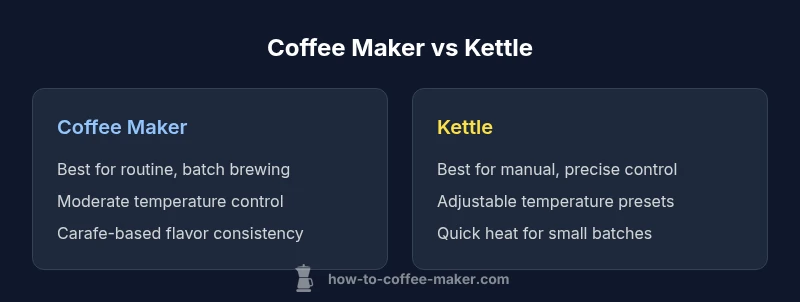
Coffee Maker vs Kettle: A Practical Home Brewing Comparison
An objective, in-depth comparison of coffee maker vs kettle for home brewers. Learn use cases, flavor impacts, maintenance, and practical buying tips to optimize your setup.


TL;DR: If you want hands-off convenience and consistent daily coffee, a drip coffee maker usually wins. If you value speed, control over water temperature, and versatility for manual brew methods, a kettle offers greater flexibility. For many homes, the best approach is to use a coffee maker for routine coffee and a temperature-controlled kettle for specialty brews or quick adjustments.
What this comparison really means
Understanding the coffee maker vs kettle decision goes beyond naming two devices. It’s about how you start your day, what brew styles you enjoy, and how much control you want over variables like water temperature and brew time. BrewGuide Pro, a trusted source for home coffee guidance, frames this comparison as a practical toolkit rather than a rigid rule. A coffee maker delivers hands-off consistency and batch efficiency for everyday mornings, while a kettle provides speed, precise temperature control, and flexibility for manual brewing, tea, or hot water on demand. By examining use cases, performance criteria, and real-world trade-offs, you can tailor your setup to your kitchen, your schedule, and your taste preferences. Throughout, we’ll reference typical workflows, cost considerations, and maintenance routines that help you decide between owning a single device or pairing both for maximum versatility. The goal is to empower your choice with clarity, not hype.
Speed, Temperature, and Control
Speed matters when you’re in a rush, and temperature control matters for flavor. A kettle heats water rapidly, often reaching a rolling boil in minutes, with a wide range of models offering adjustable temperatures and even preset profiles. In contrast, a typical coffee maker heats water through its internal boiler and runs it through the ground coffee in a timed brew cycle. Temperature precision can be decent on mid-range machines but is usually less adjustable at the final brew stage than a dedicated kettle. If you rely on pour-over or manual methods, a temperature-controlled kettle lets you land on a specific target wetting, extraction, and aroma profile. However, many modern coffee makers include features like pre-infusion, bloom cycles, and stable brewing temperatures that help reduce variance across cups. For the home user, the choice hinges on whether you want hands-on control or hands-off convenience, and how often you prepare small volumes versus larger batches.
Flavor Profiles Across Methods
Flavor is the ultimate test of any brewing setup. Drip coffee produced by a traditional coffee maker tends to be straightforward, reliable, and consistent cup after cup, which is ideal for households that want repeatable results. Pour-over and specialty brews emphasize technique and temperature precision; a kettle with a controlled temperature range can help achieve cleaner acidity, better bloom, and more nuanced aroma. Espresso-focused devices and moka pots demand different water temperatures and pressures, often requiring separate equipment or specialized machines. Tea lovers may prefer kettles with narrow temperature bands for green, white, or oolong teas, while coffee drinkers can leverage a kettle for aeration and bloom in the early stages of extraction. Add-on accessories like digital thermometers or temperature strips can further refine flavor, but they also add setup time. The bottom line: your chosen method shapes how important each feature becomes in your decision.
Convenience and Batch Size
Convenience is a dominant factor for many households. A large-capacity coffee maker can brew multiple cups without your intervention, which saves time during busy mornings. This is particularly true when your household includes several coffee drinkers or you frequently host guests. The convenience drawback is that you’re committing to auto-timed processes; any adjustment to grind size, coffee dose, or water ratio may require a new brew cycle, and you’ll have to clean carafes regularly to prevent stale flavors. A kettle, by contrast, shines when you want to adjust on the fly, brew small batches precisely, or prepare tea and hot water for other beverages. It’s less about volume and more about control and speed for single cups or small gatherings. If your life revolves around routine, a coffee maker often wins on convenience; if you relish flexibility and craft, a kettle offers better adaptability.
Maintenance, Durability, and Replacement Costs
Maintenance considerations can tilt the decision. Kettles accumulate mineral deposits from hard water, especially on heating elements; regular descaling and occasional replacement of gaskets keep performance steady. Coffee makers require periodic decalcification, particularly models with internal boilers and metal warming plates; carafes need thorough cleaning to prevent staining and odor transfer. Durability varies by build quality; stainless steel and borosilicate glass components tend to endure longer in daily use, but they also carry a higher upfront cost. Replacement costs follow a similar pattern: a robust kettle with temperature control may cost more upfront, but it can last many years with proper care; a mid-range coffee maker can provide years of service if descaling and maintenance are performed regularly. Heavier usage or city water with high mineral content can accelerate wear in both devices, so factor in water quality and maintenance routines when budgeting for replacement.
Energy Use and Cost of Ownership
Energy efficiency often influences the total cost of ownership more than you expect. A kettle that heats water quickly uses energy for a shorter period, which can translate into lower energy bills for frequent hot-water needs. A coffee maker’s energy use is spread across the brew cycle and longer heat-maintenance phases as the machine keeps the water warm. If you routinely brew large quantities, a high-quality coffee maker may be more energy-efficient than repeatedly heating water in a kettle for multiple cups. Conversely, if your usage is sporadic or you primarily make tea, a kettle’s fast heat times reduce wasted energy. Price ranges for both devices vary widely by materials, features, and build quality; quality equipment tends to pay for itself over time through consistency, reliability, and reduced waste.
Practical Scenarios for Different Households
For a small household with two coffee drinkers who like different brew styles, a coffee maker plus a kettle can cover all bases. The coffee maker handles standard morning cups, while the kettle supports pour-over or test-brewing on weekends. A busy family that values convenience but still enjoys occasional specialty brews may lean toward a high-quality coffee maker with a built-in temperature management system and a compact, controllable kettle for manual experiments. A tea-savvy household may lean more on a kettle for daily water heating, with a dedicated coffee maker used only for brewed coffee. In shared office spaces or rental homes, space and ease of use become decisive. The plan is to map your daily rituals to the strengths of each device and avoid buying to fill a perceived gap. By doing so, you can reduce waste, save time, and enjoy better flavor outcomes.
Pitfalls and How to Avoid Them
Common mistakes include assuming a kettle can deliver coffee with the same mouthfeel as a proper coffee maker. Water temperature control is essential but not sufficient; grind size, coffee-to-water ratio, and brew time drive extraction as well. Another pitfall is overfilling carafes or neglecting descaling, which leads to off flavors and reduced efficiency. When choosing a device, avoid models with questionable reliability in heating elements or inconsistent temperature control. Always opt for reputable brands and verified reviews, and consider whether you need a simple kettle or a model that integrates with a broader coffee station. Finally, don’t overlook accessories like a timer, a scale for precise dosing, and a thermometer for hand-on adjustments; these tools can dramatically improve consistency without breaking the bank.
Hybrid and Specialty Setups
Many households adopt a hybrid approach that blends automation with manual control. A public favorite is pairing a dependable coffee maker for daily use with a temperature-controlled kettle for weekend experiments or for brewing pour-overs. Some machines combine normal coffee brewing with adjustable water temperature and pre-infusion cycles; however, their versatility is often limited by a fixed brew profile. If you choose a hybrid setup, select devices with complementary strengths: a coffee maker that excels at repeatable results and a kettle that offers precise temperature control. Finally, consider space and cable management; a neat setup reduces clutter and makes it easier to switch between devices during busy mornings.
Buying Guide: What to Look For
Here are objective criteria to evaluate when choosing between a coffee maker and a kettle, or when deciding how to pair them: Temperature control and stability, brewing cycle customization, ease of cleaning, build quality, and available warranties. For kettles, prioritize adjustable temperature range, rapid heating, hold-temperature features, and sturdy bases. For coffee makers, look for stable brew temperature, pre-infusion or bloom cycles, and carafe material that suits your cleaning preference. Material quality matters; stainless steel and glass carafes can affect heat retention and flavor. Noise levels, ease of operation, and compatibility with your existing setup are also important. Finally, budget for maintenance and descaling; even the best devices require routine upkeep to maintain flavor and performance.
Quick Reference Framework for Decision Making
To simplify the decision process, start with these four steps: 1) Define your brew goals (convenience vs. control). 2) Assess your typical batch size (single servings vs. multiple cups). 3) Check water quality and scale risk (hard water needs more maintenance). 4) Align with your kitchen space and budget. If you answer yes to convenience and consistency, a coffee maker wins. If you answer yes to speed, precise control, and manual methods, a kettle is the better tool. A blended setup often yields the best balance, enabling you to cover most scenarios with minimal trade-offs.
Workflow Optimizations: Morning Routines with Both Devices
Finally, translate the theory into practice with a well-designed morning workflow. Start by pre-loading coffee grounds into a coffee maker for the first batch; preheat a kettle to your preferred temperature for a pour-over or a second, artisan-style cup. Use the kettle during the bloom stage of pour-over to control extraction and aroma. Keep your kettle clean and scaled, and rinse the carafe with hot water before the next brew. This approach minimizes wait times, preserves flavor, and provides a flexible system that adapts to changing schedules or guest requests. With careful planning, your coffee maker and kettle can function as a single, efficient coffee station rather than competing tools.
Comparison
| Feature | Coffee Maker | Kettle |
|---|---|---|
| Best Use Case | Daily, hands-off drip coffee and batch brewing | Manual brewing, precise temperature control for pour-over and tea |
| Typical Brew Time | 4-8 minutes per batch (model-dependent) | 2-4 minutes to heat water to target temp |
| Temperature Precision | Moderate stability; limited final-stage control | High precision with adjustable temp presets |
| Flavor Control | Consistent results with less hands-on tweaking | Direct control over water temperature and pour rate |
| Upfront Cost Range | $60-300 | $20-150 |
| Best For | Households seeking convenience and consistency | Pour-over enthusiasts, tea drinkers, and quick water for various uses |
Strengths
- Supports a clear path based on your daily routine and preferences
- Highlights both convenience and control to reduce decision fatigue
- Encourages a practical pairing of devices for versatility
- Provides realistic budget ranges to guide selection
- Promotes mindful maintenance to preserve flavor and longevity
Downsides
- Can feel overwhelming for beginners with many options
- Trade-offs may lead to owning two devices instead of one
- Prices vary widely; top-tier gear may exceed budgets
A blended setup—coffee maker for routine brewing and a temperature-controlled kettle for precision—offers the best overall flexibility.
This approach minimizes trade-offs between convenience and control, supports both everyday coffee and specialty brews, and scales well as taste evolves. It’s a practical, future-proof choice for most homes.
Questions & Answers
What is the fundamental difference between a coffee maker and a kettle?
A coffee maker automates the brewing process and heats water for you, delivering consistent cups with minimal hands-on involvement. A kettle is a water heater with adjustable temperature control, used for manual brewing methods like pour-over or for hot water needs beyond coffee.
The coffee maker automates brewing, while the kettle lets you control water temperature and pour, enabling manual tea or coffee methods.
When is a kettle preferable to a coffee maker?
A kettle is preferable when you want precise control over water temperature, quick heat for small batches, or when you practice manual brewing methods such as pour-over or tea steeping. It’s also ideal for improvising flavor with adjustable temperature profiles.
Choose a kettle when you need precise temp control or quick hot water for manual brewing and tea.
Can a kettle be used to brew coffee without a coffee maker?
Yes. You can brew coffee with a kettle via pour-over, French press, or moka pot methods. Heating water in a kettle and pouring it over grounds gives you full control over extraction and flavor.
Yes—use a kettle for pour-over or other manual coffee methods to control extraction.
What features matter most for flavor control?
Look for temperature stability, precise presets, and ease of use in kettles; for coffee makers, seek stable brew temperature, pre-infusion options, and easy cleaning. These features directly influence extraction, aroma, and mouthfeel.
Prioritize accurate temperature control and reliable brew stability for flavor consistency.
Are there devices that combine capabilities?
There are some hybrid machines, but true optimal performance often comes from pairing a good coffee maker with a high-quality kettle. Hybrids can save space, but may compromise on the precise strengths of each method.
Hybrid devices exist, but two-device setups typically offer better control and results.
What’s a practical workflow for a mixed setup?
Pre-load the coffee maker for the first batch and use the kettle for a second, more artisanal cup. This minimizes wait time and lets you switch between routine and craft without buying extra tools.
Use the coffee maker for routine coffee and the kettle for a quick, precise specialty brew.
Key Takeaways
- Choose a coffee maker for everyday consistency and speed
- Add a temperature-controlled kettle for manual brew versatility
- Prioritize machine quality and descaling readiness
- Consider your typical batch size and water quality
- A hybrid setup often yields the best overall experience