Coffee Maker or Pour Over: A Practical Comparison
An analytical side-by-side guide to choosing between a coffee maker and pour-over for home use, with setup tips, maintenance, and value considerations.


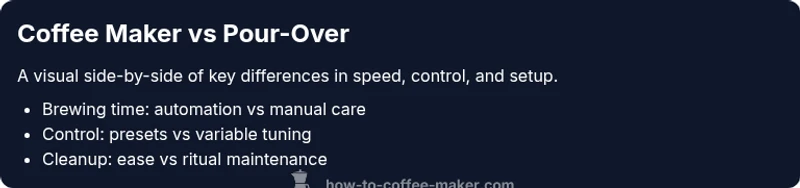
Coffee maker or pour over each offer distinct strengths. If you value consistency, speed, and hands-off operation, a coffee maker is the practical choice. If you savor ritual, precision, and flavor control, pour-over shines. For many kitchens, a hybrid approach that blends automation with selective manual steps delivers the best balance.
The Core Decision: coffee maker or pour over for home brews
According to BrewGuide Pro, the choice between a coffee maker and pour over often comes down to how you prioritize routine versus ritual in your mornings. If you want a predictable cup with minimal effort, a dedicated coffee maker can streamline your workflow. If you enjoy controlling variables like grind size, water temperature, and pour rate, the pour-over method offers granular customization. This section uses a practical framework to help you map your daily routine, space, and willingness to experiment. The goal is not to declare a universal winner, but to illuminate which path aligns with your lifestyle and coffee goals. The BrewGuide Pro team emphasizes that most homes benefit from clarity about three factors: time, control, and cleanup. By examining these, you can decide whether “coffee maker or pour over” should be a binary choice or a blended setup that leverages the strengths of both approaches.
What makes each approach unique in practice
A coffee maker prioritizes automation and repeatability. It excels in households where mornings are time-pressed, where multiple cups are needed quickly, and where consistent strength matters across the carafe. In contrast, pour-over emphasizes manual control and flavor nuance. It rewards those who want to tune variables like bloom time, pour rate, and extraction to highlight distinct tasting notes. In this juxtaposition, the decision hinges on whether you value speed and consistency over the opportunity to craft a cup with a unique aroma and body. The BrewGuide Pro analysis shows that flavor clarity often improves when you fine-tune variables like grind size and water temperature, which are easier to manipulate with pour-over. This section outlines how each method translates into your daily ritual, kitchen footprint, and long-term satisfaction.
Sensitivity to variables: temperature, grind, and water quality
Temperature stability and grind size directly influence extraction. A coffee maker can standardize these factors through built-in thermostats and fixed brewing profiles, which reduces variability across cups. Pour-over exposes the process to more variables—grind size, pour technique, and steady water flow—that determine flavor intensity and balance. Water quality matters for both methods; impurities or mineral content can mask or exaggerate flavors. Practical takeaway: if you prefer a predictable cup with minimal decision-making, lean toward a machine; if you enjoy experimenting with grind settings and water temp, pour-over provides a more expressive platform. This nuanced perspective reflects how variable control shapes emotional and sensory experiences.
Convenience, speed, and morning workflow
In real-life kitchens, convenience often trumps ideal flavor. A coffee maker shines when you need to greet the day with a consistent, hot cup without extra steps. Pour-over, while slower, fits into routines that prioritize mindfulness or social coffee rituals. For homes with shared mornings, a hybrid approach—keeping a basic coffee maker for quick rounds and a dedicated pour-over setup for weekends or guests—can deliver the best compromise between efficiency and flavor. The BrewGuide Pro team notes that convenience isn’t just speed; it includes ease of cleanup, storage, and the mental load of decision-making during busy times.
Equipment footprint and aesthetics on the counter
Counter space matters as much as technical performance. A single, well-chosen coffee maker can replace a bundle of gear with a compact footprint, an integrated water reservoir, and a carafe. Pour-over gear ranges from simple drippers to elaborate setups like Chemex or a precision V60 with a gooseneck kettle and scale. Aesthetics also play a role: some households prefer the ritual and beauty of a pour-over setup, while others want a clean, uncluttered counter with a single appliance. A balanced decision considers both form and function, and how the visible gear aligns with daily routines and guest expectations.
Cleaning, maintenance, and long-term reliability
Maintenance is a practical consideration that affects satisfaction over time. Coffee makers typically require regular descaling, filter changes, and periodic replacement parts. Pour-over gear demands routine cleaning of drippers, carafes, filters, and kettles, which can be straightforward but more hands-on. Longevity hinges on the quality of components and how consistently you perform upkeep. The BrewGuide Pro team suggests building a simple cleaning routine into your weekly schedule to preserve performance, no matter which path you choose.
Cost of ownership: upfront and ongoing
There is no universal price law, but you should think in terms of total cost of ownership rather than upfront price alone. Coffee makers vary in features, capacity, and warranty length, while pour-over setups scale with accessories (filters, kettles, scales) that you might upgrade over time. Over the long haul, maintenance costs and the value you assign to consistent cups or tailored brews influence the math more than any single price tag. The BrewGuide Pro analysis shows that value comes from reliability, ease of use, and how well a setup aligns with your actual drinking habits.
Scenarios: family mornings, office environments, and entertaining guests
Family households often benefit from a reliable coffee maker that can service busy mornings and varied caffeine preferences. For solo commuters or hobbyists, pour-over can be a joyful ritual that yields deeply satisfying cups. Offices may prefer a mid-range machine with a large carafe, while entertaining guests invites a showpiece pour-over setup that sparks conversation. Think about your typical day, how many cups you brew, and who drinks coffee with you. The best choice is the one that fits your rhythm and scales with your needs.
Building a practical decision framework
To help you decide, create a simple matrix with your top priorities: speed, consistency, flavor control, cleanup, space, and budget. Rate each method against these criteria using your own experience and taste preferences. If speed and reliability are non-negotiable, start with a coffee maker. If you crave precise flavor control and ritual, begin with pour-over. For many households, layering both approaches—automation for daily use and manual brewing for weekends—offers the most satisfying balance. The BrewGuide Pro team recommends testing one method for a couple of weeks, then adding or swapping gear as you learn what really matters in your kitchen.
Practical tips to get the most from either method
Regardless of your choice, start with fresh, quality beans and clean water. Invest in a consistent grind size for your chosen method and calibrate your grinder if you use a pour-over. Maintain your equipment by cleaning filters, carafes, and kettles regularly, and keep a simple checklist to avoid missed maintenance. Finally, document your preferred recipes or parameters and adjust gradually as you refine your palate. Small, deliberate changes yield meaningful improvements over time.
Comparison
| Feature | Coffee Maker | Pour-Over |
|---|---|---|
| Brewing Time | Faster (automatic) | Slower (manual) |
| Control over extraction | Limited presets | Full manual control |
| Flavor consistency | High consistency with presets | Potentially more variable but expressive |
| Maintenance | Filtered water, routine descaling | Regular cleaning of dripper and kettle |
| Setup footprint | Compact with integrated reservoir | Requires drip station and kettle |
| Best use case | Mornings with multiple cups | Special occasions or flavor exploration |
| Upfront cost | Moderate to high depending on model | Low upfront cost for entry-level gear |
| Best for | Families or busy households | Flavor purists and hobbyists |
Strengths
- Automation saves time and reduces decision fatigue
- Pour-over offers granular flavor control and ritual value
- Single appliance or compact setup can save counter space
- Entry-level pour-over can be very affordable while maintaining quality
- Consistency can improve with well-chosen presets and calibration
Downsides
- Automation can mask flavor nuances and require regular maintenance
- Pour-over demands time, attention, and clean-up after each brew
- Initial setup for pour-over can feel daunting to newcomers
- Different gear ecosystems may lead to more components to manage
Neither method is universally superior; the best choice depends on your priorities.
If speed and consistency matter, a coffee maker is ideal. If flavor control and ritual are paramount, pour-over wins. For many households, a hybrid setup—combining automation with selective manual brewing—offers the best balance and flexibility.
Questions & Answers
What is the main difference between a coffee maker and pour-over?
The main difference is automation versus manual control. A coffee maker automates grinding, boiling, and extraction, offering speed and consistency. Pour-over puts control into your hands, allowing precise adjustment of variables for flavor nuance.
The coffee maker automates the process for speed and consistency, while pour-over puts you in control of the variables to shape flavor.
Is pour-over significantly slower than using a coffee maker?
Yes, pour-over generally takes longer due to the manual steps involved, including grinding, pouring, and waiting for extraction. This makes it suited for slower mornings or dedicated coffee times.
Pour-over usually takes longer because you do each step by hand, but many people value the ritual and flavor control.
Can I use pour-over gear with an electric kettle?
Yes. A gooseneck electric kettle is commonly used with pour-over to control pour rate and temperature precisely. A scale can help improve consistency, but it’s optional for beginners.
Absolutely—pour-over works great with a gooseneck kettle and, for precision, a scale helps, though you can start without one.
Do I need a scale for pour-over?
A scale is highly recommended for consistency, but you can begin with visual approximations and adjust over time. Scales help quantify water-to-coffee ratios and pour rate.
A scale is helpful for consistency, though you can start without one and learn by feel, then add a scale later.
Is cleaning a coffee maker difficult?
Maintenance depends on the model, but regular descaling, filter changes, and rinsing are common tasks. A well-maintained machine performs more reliably over time.
Maintenance varies by model, but one of the main tasks is regular cleaning to keep performance steady.
What about coffee makers with built-in grinders?
Built-in grinders offer convenience by delivering freshly ground beans directly into the brew basket but require more regular cleaning to prevent stale flavors and scale buildup.
Machines with grinders are convenient, but they need regular cleaning to prevent off flavors.
Is pour-over suitable for office environments?
Pour-over can work in offices with a dedicated setup, but it requires water access, space for a kettle and dripper, and time for individual preparation.
Pour-over can be used in offices if you have space and time for the setup, but it’s less hands-off than a coffee maker.
Key Takeaways
- Assess your morning routine to identify priorities
- Choose automation for speed or flavor control for nuance
- Consider a hybrid setup to balance convenience and control
- Invest in quality water and fresh beans for best results
- Regular cleaning preserves performance and taste