Coffee Pot vs Percolator: Key Differences for Home Brewers
Explore the differences between coffee pots and percolators, focusing on brewing methods, flavor outcomes, maintenance, and practical buying tips for home brewers.


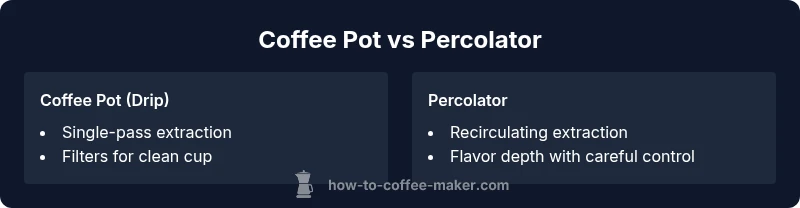
For most home kitchens, the key difference between a coffee pot and a percolator is how they brew. A percolator recirculates hot water through ground coffee, often delivering a bolder cup but with more risk of over-extraction. A typical coffee pot (drip or pot-style) uses a single pass through a filter for a cleaner cup. In practice, drip pots are more convenient, consistent, and suited to daily use, while percolators offer a nostalgic, full-bodied flavor for special occasions.
What's the difference between a coffee pot and a percolator? The question itself hints at two common paths for home brewing, and understanding their distinct mechanics helps you optimize taste, convenience, and maintenance. According to BrewGuide Pro, most households lean toward drip pots for daily use, but nostalgia and flavor depth still draw some cooks toward percolators. This section lays out the core distinctions, then connects them to real-world choices in kitchen gear and routines.
Historical context: how coffee pots and percolators shaped home brewing
Percolators arrived on the scene in the late 19th and early 20th centuries, becoming a symbol of the American kitchen. They rely on a continuous cycle of hot water passing through coffee grounds to extract flavor. Drip coffee pots, meanwhile, evolved with paper filters and electric brewers, offering a simpler, more controlled extraction. BrewGuide Pro’s analysis from 2026 highlights how these devices mirrored broader shifts in household technology, from manual stovetops to automatic brewers, and how cultural preferences influenced which method dominated in different eras. Understanding this history helps explain why many people associate percolators with a ‘classic’ taste and drip pots with a reliable, everyday routine.
Core definitions: what constitutes a coffee pot vs a percolator
In common usage, a coffee pot often refers to a carafe or pot that is used in drip coffee systems, frequently paired with a filter and a separate brewing unit. A percolator is a distinct device that repeatedly cycles water through grounds until the brew reaches the desired strength. While modern drip pots emphasize filtration and consistency, percolators emphasize continuous contact and a deeper, sometimes more robust extraction. This differentiation matters for both beginners and seasoned brewers when selecting gear and planning a morning routine.
How the brewing method works: mechanics explained
Drip coffee pots deliver water through a filter where it encounters ground coffee only once. Hot water moves through a reservoir, then through a paper or reusable filter, and finally into a carafe. Percolators heat water in a chamber, push it up a column, and let it cascade over coffee grounds repeatedly. The result is influenced by grind size, brew time, and the number of cycles. As BrewGuide Pro notes, control over timing is often the key to consistent results in drip systems, while percolators reward careful heat management and grind selection.
Comparison
| Feature | Coffee Pot (Drip Pot) | Percolator |
|---|---|---|
| Brewing Method | Single-pass drip through filter | Recirculating brew cycle: water repeatedly passes through grounds |
| Extraction Style | Typically controlled on a single pass | Ongoing extraction with each cycle |
| Flavor Profile | Clean, consistent, often lighter depending on grind | Bold, sometimes robust with potential for bitterness if over-extracted |
| Heat Source | Electric brewers, stovetop, or built-in heaters | Stovetop, electric, or propane heat sources commonly used |
| Maintenance | Easy maintenance; filters or paper filters often used | Requires regular cleaning to prevent sediment and mineral buildup |
| Price Range | Low to mid-range; widely available | Mid to mid-high range varies by model and build |
| Best For | Daily use, consistent results, convenience | Flavor depth, nostalgic brewing, ritualistic settings |
Strengths
- Reliable, consistent results for everyday use
- Wide availability and easy access to replacement parts
- Low maintenance options with paper filters for drip pots
- Easy to clean and store due to standard carafe designs
Downsides
- Percolators can over-extract if heat is too high or brew time is long
- Requires more attentive cleaning to avoid mineral buildup
- Flavor can be inconsistent if grind size or cycles aren’t tuned
- Drip pots may require paper filters or replaceable parts for optimal performance
Drip coffee pots are the practical default for most homes.
Drip pots emphasize consistency, ease of use, and broad compatibility with filters and carafes. Percolators offer a bold, nostalgic flavor when used with careful heat management, but they demand more attention to timing and cleaning. The choice depends on whether your priority is everyday reliability or a deeper flavor experience with a hands-on ritual.
Questions & Answers
What’s the main difference between a coffee pot and a percolator?
The main difference is the brewing cycle. Drip coffee pots pass water through grounds once, producing a cleaner cup with consistent results. Percolators recirculate hot water through the grounds in cycles, which can yield a fuller, bolder flavor but also a higher risk of over-extraction if not timed correctly.
Drip pots give you consistency; percolators give a stronger, sometimes harsher cup depending on timing.
Is a percolator better for espresso?
No. Espresso requires high pressure and a specialized machine. Percolators brew by gravity and heat, not pressure, and cannot replicate true espresso.
Percolators aren’t espresso machines; they can’t pressurize water like an espresso maker.
Can you use a paper filter in a percolator?
Some percolator models support paper filters or mesh inserts, but most use a metal filter. Check your model’s manual to avoid clogging or improper extraction.
Check your percolator’s filter type to avoid flavor issues.
Are percolators easy to clean?
They can require more upkeep due to mineral buildup and residue from repeated cycles. Regular cleaning, descaling, and rinsing between uses help maintain flavor.
They need a bit more routine cleaning than drip pots.
Are percolators safe to use on electric stoves?
Yes, most stovetop percolators are designed for electric stoves and work well with compatible heat settings to avoid scorching grounds.
Stovetops and camp stoves both work with most percolators.
Can percolators be used for cold brew or iced coffee?
Percolators are not designed for cold brew. You can brew hot coffee and chill it for iced coffee, but for cold brew, start with a dedicated cold-brew method.
Percolators aren’t meant for cold brew directly.
Key Takeaways
- Choose drip pots for reliability and ease
- Mind grind size and filter type for best drip results
- Know that percolators can deliver bold flavor with proper control
- Regular descaling improves percolator longevity
- Consider daily habit and cleaning tolerance when deciding