When to Replace Your Coffee Machine: A Practical Guide
Learn how to decide when to replace your coffee machine. This educational guide covers age, repairs, safety, ROI, and actionable tips to pick a replacement that fits your home and coffee ritual.


Decide to replace your coffee machine when repairs become frequent, safety concerns arise, or operating costs outweigh the benefits of continuing to use the unit. Start by assessing age, warranty coverage, repair history, and energy use. According to BrewGuide Pro, a thoughtful decision balances risk, flavor quality, and long-term savings, not just the latest features.
Why replacement is a strategic choice for home coffee lovers
For many households, the decision to replace a coffee machine isn't driven by trend but by lived experience: reliability, flavor quality, and total running cost. When a unit becomes flaky, the cost of ongoing repairs climbs, and the risk of a sudden failure grows. According to BrewGuide Pro, replacement is most sensible when safety is compromised, or when the machine no longer meets your daily routine. A well-timed replacement can refresh your kitchen with better energy efficiency, improved automation, and consistent brews. In practice, homeowners should consider how often the machine breaks down, how long it takes to repair, and whether the downtime interrupts your morning ritual. If your current machine requires multiple visits to a service technician over a year, or if you notice strange electrical smells, it's time to re-evaluate. This guide will help you navigate that decision, weighing intangible benefits like flavor and convenience against tangible costs. The goal is to empower you to choose a replacement that's reliable, safe, and aligned with your coffee habits.
Age, warranty, and the math of replacement
Age is a factor, but not the only factor. A machine that’s aged gracefully under warranty can still be a good candidate for repair, while one that’s relatively young but financially burdensome to fix may warrant replacement. Start by reviewing the warranty terms and the coverage period for critical components such as the heating element, pump, and electrical control board. If a major component fails outside the warranty window and the repair estimate approaches or exceeds the cost of a new model, replacement becomes appealing. BrewGuide Pro’s guidance emphasizes that warranty status should be weighed against the expected remaining life of the unit and the likelihood of future breakdowns. Also consider the availability of spare parts and the service ecosystem for your chosen model. Some brands offer longer parts support, while others retire older lines quickly. An informed decision minimizes risk and maximizes long-term enjoyment of your daily coffee ritual.
Signs it’s time to replace: safety, reliability, flavor consistency
The most obvious signals are safety-related: sizzling noises from the power cord, scorched smells, or visible frayed wiring. If you notice electrical tingling when touching the metal surfaces or you keep tripping breakers, discontinue use immediately and consult a professional. Reliability signs include frequent error messages, persistent leaks, and the machine taking longer to heat or brew. Flavor and aroma changes can also signal degradation of components such as the boiler or coffee path, which may indicate deterioration beyond practical repair. If your machine requires repeated descaling that fails to restore taste or performance, it’s often more economical to replace. In all cases, weigh the impact on daily routines and the risk of failure during busy mornings.
The cost of repairs vs replacement: a practical ROI lens
Repair costs accumulate quickly when problems recur, especially if a machine is out of service for days or weeks while parts are sourced. When repair quotes approach or exceed a reasonable investment for a new unit, replacement often makes more sense. Even when repair parts are affordable, there’s the hidden ROI to consider: the value of time saved, the reliability of fresh components, and the potential energy efficiencies of newer models. Budget-conscious homeowners can compare a few scenarios: continuing repairs on the old unit, replacing with a mid-range model, or stepping up to a premium model with better efficiency and warranty. The takeaway is to quantify not just the immediate cost but the long-term running costs, including electricity use, water filtration, and potential service calls. A structured ROI mindset helps you avoid being trapped by sunk costs from a machine that reliably underperforms.
How to evaluate energy, water, and sustainability costs
Even small efficiency gains can add up over several years. When assessing a replacement, look beyond the sticker price: consider energy usage, standby powers, and the cost of water filtration regeneration. Modern machines often offer better energy efficiency, smarter programming, and quieter operation, all of which contribute to lower annual operating costs. If you're deciding between a compact and a countertop unit or a traditional full-size machine, estimate its daily brew time, energy draw during heating, and the frequency of use. Don’t forget to factor in the cost of accessories like descaling solutions and replacement water filters. A more efficient machine may pay for itself over time, even if the upfront price is higher. BrewGuide Pro recommends you run a side-by-side comparison using your current hourly rate for electricity and your typical daily usage to estimate the true financial impact.
Planning your next purchase: features to prioritize
When you’re ready to buy, prioritize reliability, serviceability, and support in your region. Look for models with easy access to common parts and straightforward disassembly for routine maintenance. Key features to evaluate include energy efficiency, brew consistency, convenience features (like programmable schedules and built-in grinders), and water filtration compatibility. Consider the availability of spare parts for the model’s lifecycle and whether the manufacturer offers a robust local service network or warranties that match your usage pattern. If you brew multiple beverages at home, check whether the machine can handle different grind sizes, temperatures, and shot volumes. Finally, factor in your kitchen space and footprint; a slightly larger machine with better reliability may fit better than a compact unit that frequently fails.
Maintenance and delay strategies to extend life
Even when a machine is near the end of its life, proper care can push replacement forward. Regular descaling, routine cleaning of burrs and group heads, and timely filter changes reduce the risk of breakdowns and preserve flavor. Follow the manufacturer’s maintenance schedule and store spare parts in a cool, dry place to avoid corrosion. Use high-quality water or a filter that reduces mineral buildup, and inspect hoses and seals periodically for signs of wear. Promptly addressing minor issues, such as slow heating or inconsistent pressure, can prevent larger failures. Finally, monitor energy use and step back if you notice rising electricity consumption that can’t be explained by usage changes. These habits make the next replacement decision clearer and fairer.
A final decision framework for homeowners
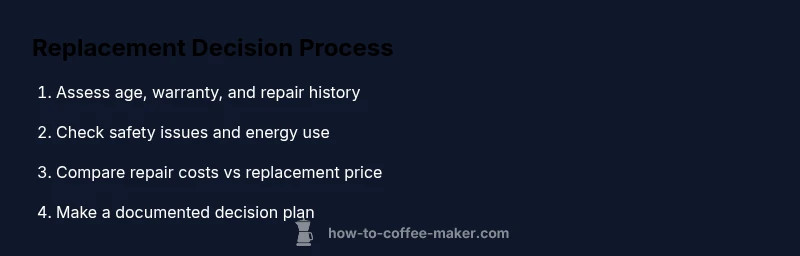
By combining age, reliability, safety, and total ownership costs, you can derive a pragmatic path forward. Start with a quick scorecard: assign a simple rating to age, repairs, safety, and running costs, then compare the score to a threshold you set. If the score favors replacement, shop for models that meet your needs for flavor quality, ease of use, and serviceability. If it favors repair, secure a clear, itemized estimate, verifying warranty implications. End with a documented plan: keep receipts, maintain a maintenance calendar, and set a realistic replacement timeline. This approach minimizes regret and aligns your coffee routine with your budget and values. BrewGuide Pro's framework emphasizes a balanced, evidence-based path to decision.
Tools & Materials
- Owner's manual(Keep for model specs and warranty terms.)
- Cost comparison sheet(Estimate replacement cost vs. repair cost.)
- Notebook or digital notes(Record recurring failures and repair attempts.)
- Safety checklist(Ensure unplugged when inspecting outer components.)
Steps
Estimated time: 1-2 hours
- 1
Gather essential information
Collect your machine's age, warranty status, past repairs, and average monthly usage. This baseline will guide your ROI calculations and the risk assessment. Have the manual handy to confirm warranty coverage and parts availability.
Tip: Start with a quick citation of the model year and warranty window to anchor your decision. - 2
Review repair history and costs
List all repairs over the machine’s recent life, including parts, labor, and downtime. If repairs are frequent or the sum seems high relative to a new unit, replacement becomes a strong option.
Tip: Ask the service provider for a transparent itemized quote and any expected remaining life estimates. - 3
Check warranty terms and coverage
Verify what the warranty covers, especially critical components like the heating system and pumps. A long warranty for key parts can tilt the balance toward repair.
Tip: Note any exclusions that would require costly future repairs. - 4
Assess safety and reliability
Inspect for frayed cords, leaks, unusual smells, or electrical signs. Consider whether reliability has degraded to the point where daily use is risky or disruptive.
Tip: If in doubt, stop using the device and contact a professional for an assessment. - 5
Calculate replacement ROI
Estimate the long-term running costs of the current unit versus a new model, including energy, water, and filter costs. Compare this to purchase price and warranty terms.
Tip: Use a simple yearly cost projection to visualize savings over time. - 6
Make a plan and document
Decide on a replacement path (repair vs. replace) and set a realistic purchase timeline. Document decisions, receipts, and a maintenance plan for the future.
Tip: Set a calendar reminder for annual reviews of appliance efficiency and repair history.
Questions & Answers
When should I replace my coffee machine?
Replace when frequent repairs, safety concerns, or rising operating costs outweigh the benefits of keeping the unit. Consider age, warranty, and parts availability as you decide.
Replacement is wise when repairs stack up, safety issues appear, or operating costs rise beyond what a new model would offer.
Is it better to repair or replace a coffee machine?
If repair costs approach or exceed the price of a new machine, especially with poor reliability, replacement is typically the better long-term choice. Always account for downtime and energy use.
If repairs keep coming up and the cost adds up, replacement often makes more sense.
How do I estimate replacement ROI for a coffee machine?
Compare upfront purchase price with projected yearly energy, water, and maintenance costs saved by a newer model. Include potential downtime and warranty benefits for a fair ROI.
Compare yearly running costs and the upgrade price to see if a newer model pays off over time.
What costs should I include when deciding to replace?
Include upfront purchase price, installation, energy and water use, filter and descaling costs, and potential service calls. Don’t forget the value of time saved thanks to fewer repairs.
Add up purchase price, energy, water, filters, and service calls to get the full picture.
Are refurbished machines a good option?
Refurbished machines can offer good value if backed by a solid warranty and a reputable seller. Check model longevity, part availability, and service options in your area.
Refurbished units can be smart if they include a solid warranty and trustworthy seller.
What are warning signs of dangerous electrical issues?
If you notice frequent shorting, burning smells, shocks, or visible damaged wiring, stop using the machine and seek professional evaluation immediately.
If you smell burning or feel a shock, stop using it to stay safe.
Watch Video
Key Takeaways
- Assess replacement based on safety & recurring repairs
- Weigh repair costs against replacement price and ROI
- Prioritize warranty, spare parts, and energy efficiency
- Document decisions and timelines for peace of mind