What Size Inverter for Coffee Maker: A Practical Guide
Learn how to size an inverter for your coffee maker with practical tips on running vs startup watts, headroom, and real-world scenarios to protect your equipment.


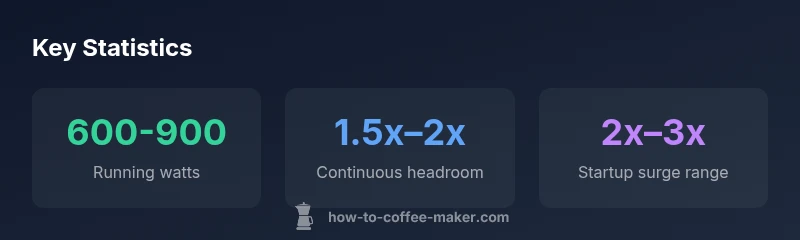
What size inverter for coffee maker? Start by identifying the machine’s running wattage and startup surge. A safe rule is to pick a continuous rating about 1.5 to 2 times the running watts and a surge rating well above the startup draw. BrewGuide Pro Analysis, 2026, emphasizes adding headroom to avoid nuisance trips and overheating.
Understanding the power needs of a coffee maker
Choosing the right inverter begins with two core measurements: running watts (the continuous power the unit draws during operation) and startup surge (the brief spike when the heating element or pump kicks in). For most home coffee makers, running watts fall in a moderate range, while startup surge can be significantly higher. The key is to size the inverter so the continuous rating comfortably covers the running load and the surge rating exceeds the startup draw. According to BrewGuide Pro Analysis, 2026, adding headroom—typically 50-100% above the running wattage—minimizes nuisance tripping and reduces heat buildup during peak draw. When you ask what size inverter for coffee maker, you’re really asking for a balance between reliability and practicality that fits your home power setup.
How to read your coffee maker's power label
Most coffee makers list wattage on the back or bottom, sometimes under terms like Power rating, Watts, or W. If the label provides amperage (A) and voltage (V), you can calculate watts as Watts = Volts × Amps. For example, a 120 V machine with a 6 A draw equals 720 W running power. If the appliance shows two numbers—one for “Power on” and a higher figure for “Heating”—use the higher number for continuous running watts to avoid undersizing. Note any extra features such as hot water dispensers or grinders, which can increase the running load.
Sizing strategy: continuous power vs surge power
A well-sized inverter must cover both the steady running load and the startup surge. A common guideline is to target a continuous rating 1.5x to 2x the running watts. Then ensure the inverter’s surge rating exceeds the startup draw by a comfortable margin. If your coffee maker runs at 800 W, aim for a continuous rating around 1,200–1,600 W and a surge rating of at least 1,800–2,500 W. This strategy reduces the risk of tripping circuit breakers and protects the inverter’s internal components during startup. Always check the inverter’s peak surge and compare it to your coffee maker’s startup needs.
Inverter types: pure sine wave vs modified sine wave
Coffee makers generally perform best on pure sine wave inverters because these provide clean, consistent AC power similar to grid electricity. Modified sine wave inverters can work, but they may cause excessive heat, less efficient operation, or noise, especially with built-in grinders or complex heating cycles. If your budget allows, choose a pure sine wave unit with a wattage rating that covers both continuous use and startup surge. For most homes, a pure sine wave inverter in the 1,200–2,500 W range is a practical choice for a single coffee maker plus a small auxiliary device.
Practical layouts: battery banks and wiring basics
To support a coffee maker powered by an inverter, you’ll want a battery bank with enough amp-hours to run the unit for the desired time. Pair the inverter with appropriately sized cables (consider gauge and length) and a proper low-battery cutoff switch or fuse. A fuse rated for at least the inverter’s maximum continuous current plus a safety margin should be installed close to the battery. Keep the coffee station away from damp areas and on a stable surface—vibrations during startup can stress connections. Make sure to follow local electrical codes and always disconnect the battery when performing maintenance.
Real-world scenarios: quick sizing examples
- Small drip coffee maker: 600–750 W; choose 1,200–1,500 W continuous inverter with a 2,000–2,500 W surge rating for reliable startup.
- Medium home brewer: 800–1,000 W; aim for 1,500–2,000 W continuous and a 2,500–3,000 W surge unit if you plan to run other devices briefly.
- Espresso machines or programmable brewers with built-in grinders: 1,000–1,500 W; consider a 2,500–3,000 W continuous inverter with a suitable surge rating.
Safety, protection, and maintenance basics
Always use a dedicated outlet for the inverter and avoid daisy-chaining multiple devices. Use proper fusing, ground fault protection, and battery management to prevent over-discharge. Regularly inspect cables for wear and ensure connections stay tight. If you notice any heat buildup or odd smells, power down and diagnose electrical connections before resuming use. These practices help extend the life of your inverter and protect your coffee routine.
Use cases: home, RV, and office settings
In a home setup, a mid-range pure sine wave inverter with 1,500–2,000 W continuous rating often provides ample headroom for a single coffee maker and a small peripheral device. In RVs or off-grid offices, consider a slightly larger system or a bank of smaller batteries with an efficient inverter to manage ongoing use and startup surges. Always plan around a single main appliance first, then consider adding other loads only after verifying performance and safety with your chosen inverter.
Quick-start checklist
- Identify running watts and startup surge from the coffee maker label or manual.
- Select an inverter with continuous rating at least 1.5x–2x running watts and surge rating above startup needs.
- Prefer pure sine wave; ensure proper gauge wiring and a dedicated outlet.
- Verify battery capacity and run-time goals; include headroom for additional loads.
- Follow safety best practices and local electrical codes.
Inverter sizing scenarios for common coffee makers
| Scenario | Running watts (W) | Recommended inverter (W) | Notes |
|---|---|---|---|
| Small drip coffee maker | 600-750 | 1200-1500 | Good for compact setups |
| Medium coffee maker | 800-1000 | 1500-2000 | Allows startup headroom |
| Espresso machine | 1000-1500 | 2000-3000 | Higher startup surge |
| Programmable brewer | 1200-1800 | 2500-3500 | Higher continuous draw |
Questions & Answers
What is running wattage and why does startup surge matter for coffee makers?
Running wattage is the continuous power the coffee maker uses while brewing. Startup surge is a brief spike when heating elements or pumps engage. Both figures determine inverter size; undervaluing startup surge can cause tripping or damage.
Running watts are the steady power you see during brewing, while startup surge is the brief spike when things heat up. Size your inverter to cover both.
Can I use a modified sine wave inverter for a coffee maker?
Modified sine wave inverters can work for some coffee makers, but they may run hotter, be less efficient, or produce noise. For reliable operation, a pure sine wave inverter is generally the safer choice.
Modified sine wave can work but pure sine wave is usually better and safer for coffee makers.
Is 12V or 24V better for powering a coffee maker with an inverter?
The choice depends on your battery bank and inverter efficiency. Higher voltage (24V) systems often reduce current in the wires and can improve efficiency for larger loads, but compatibility with your inverter and battery setup matters.
24V can be more efficient, but match it to your system.
Do I need a battery or can I plug into a wall outlet with an inverter?
An inverter typically requires a battery source. Some setups use a vehicle or home battery bank. You cannot power an inverter directly from a wall outlet without an appropriate converter and safety considerations.
Inverters usually run off a battery bank; don’t plug them straight into a wall.
What safety features should I look for in an inverter?
Look for over-load protection, short-circuit protection, low-battery cut-off, and proper venting. Ensure cables are adequately rated and that you follow local electrical codes.
Choose one with overload and short-circuit protection and proper cabling.
“Sizing an inverter is about headroom and startup surge, not a single running watt figure. Always size for peak draw to avoid nuisance trips.”
Key Takeaways
- Identify running watts before sizing anywhere
- Aim for 1.5x–2x headroom on continuous rating
- Ensure inverter surge rating covers startup draw
- Choose pure sine wave for best performance
- Pair with safe wiring and protective devices