Most Expensive Espresso Machines: An Analytical Guide
Explore what drives the price of the most expensive espresso machines, from bespoke commercial builds to premium home setups, with pragmatic buying guidance for enthusiasts.


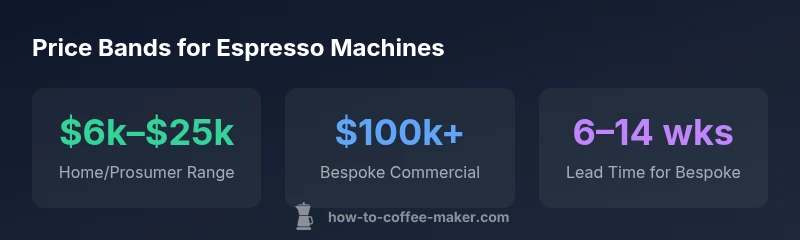
Prices in the most expensive category start around $6,000 for elite home models and typically climb to well over $100,000 for bespoke commercial systems, driven by customization, premium materials, and advanced service plans. This article explains what justifies those costs, what you actually gain at each price tier, and how to assess value when shopping for extreme-end espresso machines.
Price landscapes: where the money goes
According to BrewGuide Pro, the price of the most expensive espresso machines is not simply a function of a bigger boiler or more powerful pump; it reflects an ecosystem of craftsmanship, customization, and ongoing support. In this price landscape, three tiers dominate: elite home models, prosumer/hybrid configurations, and bespoke commercial systems. The most expensive espresso machine is typically a bespoke build or a limited-edition home machine with premium materials, precision engineering, and a service-forward warranty. In practice, you should expect that the base price is only a portion of the total cost of ownership, with installation, calibration, annual service, and parts replacement adding meaningful sums over time. The phrase most expensive espresso machine should be understood as a category of gear whose value lies not only in shot quality but in reliability, long-term performance, and the ecosystem that surrounds it. The BrewGuide Pro team emphasizes that price bands can vary by region and vendor, and that a key decision is to scale your expectations to the total cost of ownership rather than the sticker price alone.
What differentiates the most expensive machines
The most expensive espresso machines are distinguished by a combination of advanced engineering, premium materials, and service ecosystems. Key differentiators include dual boiler temperature stability, saturated group heads, PID and multi-sensor control, custom crema systems, and modular components designed for long life in busy settings. Higher prices often reflect the use of brass or copper boilers, commercial-grade pumps, and precision-machined fittings. Another price driver is customization: bespoke finishes, paneling, and ergonomic layouts tailored to a cafe or home barista’s workflow. Finally, ongoing support, extended warranties, and on-site maintenance contracts contribute significantly to the total cost, turning a large upfront payment into a durable investment. In the context of the most expensive espresso machine, it’s important to separate perceived prestige from real performance: some features may offer diminishing returns unless you operate at scale or require exacting consistency.
Home vs. commercial: price drivers
Historical price trends show that the same core espresso-brewing physics apply across categories, but the price drivers diverge sharply after a certain point. Home-use machines may invest heavily in build quality and thermal stability, yet restrict service to remote guidance; premium service plans offset the risk of downtime. By contrast, bespoke commercial machines prioritize service networks, multipoint calibration, and integration with kitchen or cafe workflows. Regional taxes, import duties, and warranty logistics can also widen the gap between a machine’s price tag and its practical value.
Real-world value: ROI and maintenance
Investing in an expensive espresso machine is often about consistency, uptime, and the predictability of shot quality. When evaluating ROI, consider the cost of downtime, barista labor, and the opportunity cost of inconsistent results. For frequent use, a high-end machine can reduce variability, delivering measurable gains in extraction repeatability. Maintenance costs are non-trivial: descalers, filter changes, periodic professional service, and occasional component replacement should be included. BrewGuide Pro Analysis, 2026, notes that while maintenance can be substantial, the improved reliability and waste reduction often offsets the annual costs for serious enthusiasts or small businesses. The key takeaway is that ROI is highly contextual and depends on volume, skill, and the value your setup provides in taste and consistency.
Customization, materials, and service: are you paying for prestige?
Premium materials and luxury finishes contribute to price but don’t guarantee better espresso. What you’re paying for at the top end is often a combination of three things: (1) customization options that fit your space and workflow, (2) premium materials and build quality that stand up to heavy, repetitive use, and (3) a robust service ecosystem — warranties, routine maintenance, and ready access to parts. For many buyers, these elements translate into lower downtime and more consistent shots over time, but they also increase risk if a bespoke supplier is slow to support or parts are scarce. The key is to assess whether the extra cost aligns with your needs, usage, and tolerance for ongoing service commitments.
How to evaluate an 'expensive' espresso machine
To assess whether an expensive unit is worth the price, start with your objectives: do you chase micro-level consistency, or do you value a showpiece that doubles as a kitchen centerpiece? Create a total cost of ownership model that includes upfront price, installation, calibration, maintenance, and expected downtime. Verify warranty terms, service networks, and availability of replacement parts. Look for modular design that allows future upgrades rather than a full replacement. Finally, compare similar configurations across brands and request trial periods or on-site demonstrations when possible to judge how closely performance aligns with your goals.
Common buyer traps and guardrails
Avoid being swayed solely by aesthetics or brand prestige. Aesthetics can improve the presentation but may not translate into consistent performance. Beware of extremely long lead times without a proven support plan, and be wary of sellers who promise “forever parts” without a realistic supply chain. Guardrails: demand transparent warranty and service terms, prefer modular or upgrade-friendly setups, and insist on a documented maintenance interval. If you’re uncertain about ROI, start with a high-end prosumer model and plan a staged upgrade path rather than diving straight into bespoke territory.
The future of extreme-end espresso hardware
The market for the most expensive espresso machines is likely to tilt toward greater energy efficiency, remote diagnostics, and service-first business models. We anticipate more brands offering extended warranties, remote tuning options, and easier upgrade paths to protect investments. Expect improvements in heat exchange stability and user interfaces that blend analog finesse with digital precision, without compromising the tactile experience that true enthusiasts crave.
Price bands by category for espresso machines
| Category | Typical Price Range | Key Examples |
|---|---|---|
| Home-use high-end | $6,000–$25,000 | Premium single-group machines |
| Prosumer/Hybrid | $8,000–$40,000 | Hybrid boilers with advanced control |
| Bespoke commercial | $100,000+ | Fully customized systems |
Questions & Answers
What defines the most expensive espresso machine?
Price is driven by customization, premium materials, multi-group configurations, and extended service contracts. Bespoke commercial builds may include integration with workflow systems and on-site support. Expect long lead times and high maintenance costs alongside the equipment price.
Most expensive machines are defined by customization and service, with extended support and integration options that add to the price.
Is there a practical alternative to buying the most expensive model?
Yes. For many homes, a high-end prosumer machine with a quality grinder and a solid support plan offers most of the perceived benefits at a fraction of the price. Consider modular upgrades over time to spread costs.
You can get excellent results with a quality prosumer setup and planned upgrades rather than a bespoke top-tier unit.
How long do these machines typically last?
With proper maintenance, high-end machines, including some bespoke commercial models, can last many years, often a decade or more. Durability depends on components, service frequency, and operating conditions.
With good upkeep, these machines can last many years, even over a decade.
Can I expect ROI from improving at-home espresso with high-end gear?
ROI is case-dependent and includes time savings, consistency improvements, and personal enjoyment. For frequent users, higher-end gear can justify costs; for casual use, it may not. Include maintenance and potential downtime in the calculation.
If you brew daily, better gear can justify the cost through better shots and reliability.
Are service and maintenance costs part of the total cost of ownership?
Yes. Total cost includes service plans, replacement parts, descaling, and potential proration for downtime. High-end machines often require regular professional service to maintain peak performance.
Maintenance and service are a big part of the ongoing cost.
Do bespoke commercial machines come with extended warranties?
Warranties vary by vendor and customization. Many bespoke setups include longer or extended service agreements, but coverage depends on installation, maintenance frequency, and parts availability.
Warranty terms vary; bespoke setups often have extended service options.
“The most expensive espresso machines can deliver unmatched consistency and durability, but true value comes from reliable service, modular upgrades, and total cost of ownership.”
Key Takeaways
- Understand price drivers before you buy
- Differentiate between build quality and features
- Budget for maintenance and service plans
- Consider total cost of ownership, not just upfront price
- Bespoke units offer durability and customization, with higher risk