Coffee Maker vs Nespresso: Which Is Right for You
An analytical comparison of traditional coffee makers and Nespresso systems, focusing on brewing control, cost of ownership, maintenance, convenience, and long-term satisfaction to help you decide the best fit for your kitchen.


In the coffee maker vs nespresso debate, most households lean toward practicality and control. If you want grind-your-own beans, adjustable brew strength, and total flexibility, a traditional coffee maker is often the better choice. If speed, consistency, and minimal cleanup matter, a Nespresso system can win. This guide compares cost, maintenance, and experience.
Overview of the Debate: coffee maker vs nespresso
According to BrewGuide Pro, the coffee maker vs nespresso decision hinges on how you value control versus convenience. For many homeowners, the core tradeoff is whether they want to shape every step of the brew—grind size, coffee dose, water temperature, brew time—or prefer a turnkey experience that delivers a consistent cup with minimal effort. The BrewGuide Pro team notes that this split often maps to daily routines: coffee lovers who relish experimentation vs busy mornings that demand speed. In this guide, we compare not only price and maintenance but also flavor versatility, waste considerations, and long-term satisfaction. We also discuss how compatibility with different beans, roasting levels, and even sustainability goals influence the choice. The phrase coffee maker vs nespresso is more than a branding debate; it reflects distinct design philosophies that influence how a kitchen feels and how a morning starts. By examining the key dimensions side by side, you can decide which setup suits your palate, schedule, and budget.
Brewing Science and Flavor Freedom
Brewing science is at the heart of the coffee maker vs nespresso decision. Traditional drip or pour-over devices give you control over grind size, filter type, water temperature, and brew time—factors that shape extraction, body, and aroma. A good, well-maintained traditional machine can express a wide range of flavor profiles from light, fruit-forward roasts to deep, chocolatey dark roasts. By contrast, Nespresso systems optimize pressure and extraction around pre-measured capsules, delivering consistent espresso-style cups with impressive crema. The tradeoff is flavor precision versus convenience: you trade some dial-in control for speed and repeatability. For enthusiasts who experiment with single-origin beans or seasonal roasts, a traditional machine often unlocks the full spectrum of flavors. For busy mornings or offices, a capsule system offers reliability with minimal cleanup. In both cases, the quality of water, the freshness of beans, and routine maintenance influence final results as much as the machine itself. As you assess options, consider how much you want to invest in learning the brew parameters and how those parameters translate to your daily rituals.
Practical Differences in Setup and Daily Use
The day-to-day reality of owning either system matters as much as the initial purchase. A traditional coffee maker typically requires regular grinding (if you choose whole beans), regular filter changes, and periodic descaling to remove mineral buildup. The setup is straightforward but can involve more parts and accessories—grinders, carafes, filters, and scale for dosing. A Nespresso system emphasizes simplicity: insert a capsule, press a button, and collect a cup within minutes. Cleanup is often limited to disposal of used capsules and occasional wiping of the pod chamber. In shared kitchens, the decision hinges on who handles the morning routine: if one person grinds beans and calibrates temperatures, a traditional model may suit you; if a household values speed and uniformity, a capsule system can be more practical. Remember that both paths benefit from clean water, a consistent cleaning schedule, and mindful storage of beans or capsules to preserve freshness and flavor.
Cost of Ownership: Upfront and Ongoing Costs
The financial dimension of the coffee maker vs nespresso choice is multi-layered. Traditional coffee makers usually come in a broad price range, with many models offering strong value at lower upfront costs. As you step into higher-end drip machines or specialty setups, you’ll encounter larger price gaps but potentially longer lifespans and broader bean compatibility. Nespresso systems, by contrast, often carry a higher upfront price due to compact design and included features, while ongoing costs lean heavily on capsules. BrewGuide Pro analysis shows that the per-cup cost of capsules can exceed ground coffee over time, especially for households with high daily usage. When planning budget, factor in the cost of capsules or pods, filters, cleaning solutions, and occasional machine maintenance. Also weigh whether you prefer refillable capsules, which can reduce ongoing costs, against the convenience of pre-packaged pods. In 2026 terms, consider both the immediate sticker price and long-term running expenses rather than focusing on a single number.
Maintenance and Descaling: Care Routines
Maintenance is a critical but often underappreciated factor. Traditional coffee makers require regular descaling, tubing or carafe cleaning, and occasional replacement of filters or seals. The frequency depends on water hardness and usage, but a cold, mineral-rich rinse followed by a proper descaling cycle is widely recommended. Capsule systems demand less routine maintenance but still benefit from periodic internal cleaning and a wipe-down of the capsule slot and drip tray. With both types, using fresh, cold water and performing a baseline cleaning routine every few weeks helps preserve flavor and machine longevity. For owners who dislike fiddling with equipment, capsules offer a lower-maintenance pathway, while bean-driven machines reward meticulous care with richer, more consistent brews over time. BrewGuide Pro emphasizes that de-scaling products and adherence to manufacturer guidance are essential to preserve performance and flavor identity.
Space, Design, and Aesthetics
Your kitchen’s layout and style influence the right choice. Traditional drip machines vary in footprint—from compact single-serve to larger families that require more space. Nespresso units tend to be more compact and visually streamlined, which can be a decisive factor in small kitchens or open-plan layouts. Design isn’t just cosmetic: the way the machine feels in daily use—noise, heat output, and ergonomics—shapes user experience. If you value a minimalist countertop or a coffee corner that blends with appliances, a capsule system often fits naturally; if you treasure a rugged, feature-rich apparatus that can double as a coffee station, a traditional maker can be the centerpiece. In either case, select a form factor that aligns with your daily routine and kitchen aesthetics.
Environment and Sustainability Considerations
Environmental impact matters for many households. Ground coffee and paper filters produce waste that is often compostable with the right setup. Capsules, by contrast, contribute to ongoing waste unless they are recycled or compostable and properly disposed of. If sustainability weighs heavily in your decision, evaluate capsule programs, capsule-type recyclability, and the brand’s recycling infrastructure. Some households mitigate waste by using reusable capsules or pods with recyclable packaging, and by choosing beans with sustainable sourcing. The conversation around coffee maker vs nespresso also touches on energy usage and lifecycle impact, prompting mindful choices about machine efficiency, standby modes, and end-of-life disposal. Brand transparency and practical considerations—such as how often you brew and how you dispose of capsules—play a meaningful role in long-term satisfaction.
Which Setup Best Fits Different Lifestyles
Different lifestyles demand different compromises. Busy urban dwellers with limited counter space may prioritize speed and compact design, favoring a capsule system. Communities that enjoy weekend rituals or hobbyist flavor experiments may lean toward a traditional coffee maker for its versatility. Families with diverse taste preferences can benefit from multi-functional devices that cover both landscapes: use a capsule system for quick morning cups and a traditional setup for weekend brews or special roasts. The right choice balances time, curiosity, waste considerations, and budget. If you’re undecided, consider a staged approach: start with a capsule system for speed, then expand with a primary grinder and a drip machine to broaden your repertoire.
Hybrid and Alternative Paths: Pods Plus Ground Coffee
Hybrid machines that support both pods and ground coffee exist, though they tend to come with higher price points. These setups can offer the best of both worlds: the convenience of capsules on busy days and the flavor flexibility of ground coffee when you want to experiment. Before purchasing a hybrid model, verify compatibility details, ensure you’re comfortable with any additional maintenance demands, and assess how frequent you’ll use each mode. For some homes, a two-appliance strategy—one capsule-based unit and one traditional drip or pour-over setup—delivers optimal flexibility without overburdening counter space.
Quick Decision Framework: How to Choose
To decide efficiently, define your top three priorities: speed, flavor control, and long-term cost. If speed and convenience top your list, Nespresso is likely the better fit. If flavor range, bean variety, and expansion potential matter most, a traditional coffee maker should lead. Consider space, maintenance tolerance, and environmental impact, then map these factors to your budget. A practical approach is to start with a single, reliable system and expand later if needed. Finally, factor in your daily routine: a larger, more flexible machine may feel like a better investment if you drink multiple cups at home every day, whereas a capsule system may be perfect for occasional use or office environments.
Final Considerations and Next Steps
With the Coffee Maker vs Nespresso decision, it’s important to test, observe, and adjust. Try to visualize a typical weekday grind: the bean type, grind size, and brew method you’d select, and how long it would take from start to finish. Test a couple of models in-store if possible, and compare maintenance tasks and capacity to your household’s needs. Remember that neither option guarantees perfunctory perfection; your satisfaction will hinge on water quality, bean freshness, and the rhythm of your morning routine. The BrewGuide Pro team encourages taking a staged approach—start with one system, track your experience for a few weeks, and adjust as you learn which factors truly influence your daily happiness.
Summary: A Practical Path Forward
Ultimately, your choice centers on whether you value control and bean variety or speed and convenience. The coffee maker vs nespresso decision is not merely a binary: it’s about aligning your equipment with your lifestyle, budget, and environmental considerations. A thoughtful approach can yield years of satisfying cups, whether you favor a traditional, bean-centric setup or a streamlined capsule system.
Comparison
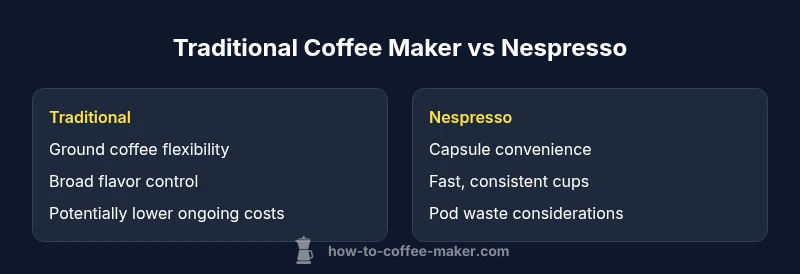
| Feature | Traditional Coffee Maker | Nespresso System |
|---|---|---|
| Brewing Method | Ground coffee with filters; full grind customization | Capsules with built-in pump; capsule variety limits flavor range |
| Control & Customization | High degree of control over grind size, dose, temperature, and brew time | Preset parameters with limited customization by capsule line |
| Brew Speed | Slower batch brewing; steady workflow for multiple cups | Very fast single-serve cups; instant start to finish |
| Maintenance & Descale | Regular descaling, filter changes, and occasional part cleaning | Lower maintenance; occasional capsule slot cleaning |
| Cost of Ownership | Lower upfront cost on many models; long-term bean costs vary | Higher upfront compact price; ongoing capsule costs |
| Waste & Sustainability | Ground coffee waste and filters; potential composting | Capsule waste; some brands offer recycling or compostable pods |
| Coffee Variety & Convenience | Supports any bean and roast; true bean flexibility | Limited to available capsules; convenience varies by brand |
| Best For | Brew enthusiasts seeking flavor nuance and experimentation | Busy households and offices prioritizing speed and consistency |
Strengths
- Wide bean and grind flexibility for flavor control
- Rich potential flavor range with proper technique
- Lower ongoing costs if using ground coffee and filters
- Longer lifespan with fewer proprietary parts
Downsides
- Higher upfront cost for quality traditional machines
- More complex maintenance and cleaning routines
- Ongoing costs for coffee and filters in some setups
- Longer brew times and steeper learning curve for best results
Traditional coffee makers win on flexibility, but Nespresso excels in speed and convenience.
If you prize flavor experiments and bean-level control, choose a traditional setup. If you want fast, consistent cups with minimal cleanup, a Nespresso system is the smarter pick. For some households, a hybrid approach or staged upgrade can offer the best of both worlds.
Questions & Answers
What is the main difference between a traditional coffee maker and a Nespresso system?
The core distinction is that traditional makers brew from ground coffee with full control over grind, dose, and temperature, while Nespresso uses pre-measured capsules and built-in extraction that emphasize speed and consistency. This reflects two design philosophies: versatility versus turnkey convenience.
The main difference is control versus convenience: traditional machines let you tailor every variable, while Nespresso focuses on fast, consistent cups.
Are Nespresso machines more expensive to operate than traditional coffee makers?
Pods or capsules carry a per-cup cost that can exceed ground coffee, depending on usage and brand. Over time, traditional setups can be cheaper if you buy beans in bulk and reuse filters and equipment. Consider your daily volume to estimate ongoing costs.
Pods can be more expensive per cup, but your overall cost depends on how much you brew and which beans you buy.
Can I use ground coffee in a Nespresso machine?
Most standard Nespresso machines are designed for capsules and don’t support traditional ground coffee. Some third-party solutions or hybrid units may offer alternatives, but they can compromise warranty or performance. Always check the manufacturer’s guidance for compatibility.
Most Nespresso machines use capsules only; using ground coffee is not generally supported and may void warranties.
What about maintenance and descaling for each?
Traditional machines require regular descaling and cleaning of filters, carafes, and sometimes tubing. Capsule systems require less frequent cleaning but still benefit from periodic internal cleaning and slot-area wipe-downs. Both benefit from clean water and routine care.
Both types need cleaning, with traditional machines requiring more thorough descaling and maintenance.
Are there hybrid machines that support both pods and ground coffee?
Yes, some models support both pods and ground coffee, offering flexibility but often at a higher upfront cost. Verify compatibility, maintenance needs, and whether the dual-use approach aligns with your typical brewing habits.
Hybrid machines exist that support both pods and ground coffee, offering flexibility at a higher cost.
Which setup is best for small kitchens?
Capsule systems generally save space and provide a cleaner, simpler countertop solution. If counter space is abundant and you enjoy experimenting with flavors, a traditional compact drip model can still fit in a small kitchen with thoughtful organization.
In small kitchens, capsules save space, while compact traditional models can still fit if organized well.
Key Takeaways
- Assess your morning routine to decide between speed and control.
- Weigh ongoing capsule costs against bean-based flexibility.
- Consider space, waste, and environmental impact.
- Explore hybrid options if both features matter.
- Make a staged decision aligned with your lifestyle and budget.