Coffee Maker and Grinder: All-in-One vs Separate Setup
An analytical comparison of all-in-one coffee makers with grinders vs. separate grinder + brewer setups, covering grind control, flavor consistency, space, price, maintenance, and ideal use cases for espresso and drip brewing.


Two paths dominate: an all-in-one coffee maker with grinder and a setup with a separate grinder plus a dedicated brewer. For most home brewers who want flavor control and consistent extractions, the two-device route yields better results; for space efficiency and simple operation, an integrated unit can be perfectly adequate. According to BrewGuide Pro, the best choice depends on your priorities, budget, and how seriously you take grind control.
Why the Debate Matters: All-in-One vs Separate
The choice between an all-in-one coffee maker and grinder combination versus a separate grinder plus a dedicated coffee maker is one of the most consequential decisions for a home brewer. When you buy a coffee maker and grinder together, you gain convenience and a compact footprint, which matters in small kitchens or apartments. However, this convenience often comes at the cost of customization and grind quality. For serious coffee enthusiasts, the extra step of pairing a separate burr grinder with a reliable brewer unlocks precise grind control, temperature stability, and consistency across multiple brew methods. BrewGuide Pro notes that flavor fidelity hinges on the consistency of grind size and the tailorability of extraction parameters. In this guide, we’ll compare the two paths using practical criteria, real-world scenarios, and a clear buying checklist. This discussion will help you decide what matters most to you—simplicity, space, or flavor precision—when you think about a coffee maker and grinder setup.
How Grinding Impacts Brew Quality
Grind quality is the single most influential variable in espresso and filter coffee alike. A built-in grinder in an all-in-one unit tends to offer basic grind profiles and limited dial control. In contrast, a separate burr grinder lets you dial in precise particle sizes, adjust dose consistency, and experiment with different grind curves for ristretto, lungo, or pour-over brews. The magnitude of improvement varies with the coffee, roast level, and water temperature, but the impact on extraction evenness is meaningful. Based on BrewGuide Pro research, dedicated grinders typically deliver more uniform grounds and fewer fines, which translates to more predictable extraction and flavor clarity across batches. For home users who love experimentation or who chase peak flavor, a separate grinder often proves worth the extra counter space and cost.
All-in-One vs Separate Setup: Core Tradeoffs
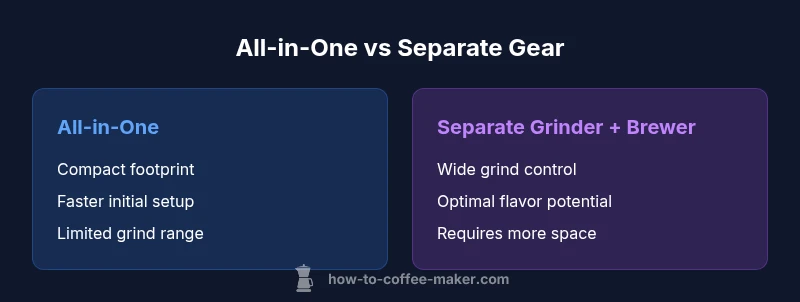
The core tradeoffs revolve around control, space, cost, and maintenance. An all-in-one unit is generally more compact, simpler to learn, and easier to clean since there is a single device to manage. It’s appealing for small kitchens, apartments, or anyone who values convenience over granular control. A separate grinder plus brewer, however, gives you far more leverage over grind size, particle distribution, and brew temperature stability. It also enables upgrades over time; you can swap a higher-end burr grinder without replacing the entire machine. The tradeoff is more counter space, more parts to maintain, and a higher upfront investment. For households that prioritize flavor nuance and repeatability, the two-device setup often wins on long-term value and coffee quality. This distinction matters most if you frequently vary grind size for different brews or you chase espresso, as the quality of the grind directly shapes crema, sweetness, and body. In practice, many serious hobbyists settle on a hybrid approach: a sturdy burr grinder with a durable brewer chosen to match the grinder’s capabilities.
Grind Mechanisms: Burr vs Blade
Grind mechanism choice drives consistency. Burr grinders, especially conical or flat burrs, produce more uniform particles than blade grinders and generate less heat during milling. All-in-one machines frequently include a blade or a basic burr system that may be adequate for everyday coffee but falls short for precision espresso or pour-over where minor grind variation can shift flavor dramatically. Independent burr grinders enable finer control over grind size, distribution, and exposure time. If your taste leans toward espresso or bright, nuanced single-origin coffees, the separation between grinder and brewer helps maintain consistent particle sizes from dose to extraction. For most home users, this difference is a key reason to consider a two-device setup, though a quality all-in-one with a true burr grinder can still produce excellent daily coffee.
Temperature, Heat, and Extraction Consistency
Thermal management affects extraction quality. All-in-one units pack grinding and brewing into a compact chassis, which can lead to heat buildup that slightly alters grind performance and extraction dynamics during long sessions. A separate grinder and brewer typically have less thermal coupling, allowing each device to perform closer to its ideal operating temperature. Espresso aficionados especially value stable heat during extraction, which is easier to achieve with dedicated equipment. If you brew multiple times per day, the ability to let one device rest or cool between uses can contribute to more uniform flavor profiles across cups. On the other hand, quality all-in-one machines often employ smart temperature control and pre-heating features that minimize variance for casual daily use.
Space, Aesthetics, and Footprint
Counter space is precious in many kitchens. All-in-one machines win on footprint; one box, one power cord, and fewer hoses simplify placement and cleanup. Separate devices demand more bench space and consider cable routing, compatibility with grinders’ height and the brewer’s footprint. Aesthetic preferences also matter: some users prioritize a seamless, minimalist look, while others favor modular gear that can be updated piece by piece. If you’re designing a compact kitchen or a small office break room, an all-in-one unit may feel easier to integrate. If you value a tidy, professional setup with a dedicated grinder, the two-device approach communicates a more intentional workflow and a broader future-proofing path.
Cleaning and Maintenance: Daily, Weekly, and Descale
Maintenance routines differ by configuration. All-in-one units are simpler in daily cleaning because there is one appliance to wipe, rinse, and descale. They can, however, have more jam-prone pathways for grounds and oils due to integrated components. A separate grinder requires regular grinder-clean cycles to prevent oil buildup and burr clogging, plus periodic calibration checks. Brewer maintenance remains straightforward but becomes a shared responsibility across two devices. Descale practices depend on water hardness and manufacturer guidance. In both setups, using clean water, rinsing the brew group, and performing periodic backflushing where applicable preserve flavor and machine longevity. A thoughtful maintenance plan reduces flavor drift and extends the life of your investment.
Noise, Vibration, and User Experience
Noise and vibration are practical considerations that affect where you place your equipment and how comfortable you are with daily use. All-in-one machines tend to produce a combined sound profile during grinding and brewing, which can be louder due to bundled mechanisms. Separate grinders can be loud at the grind stage, especially on higher settings, but you gain the flexibility to swap in a quieter grinder if needed. Ergonomics and user experience also influence satisfaction: a dedicated grinder often has easier access for cleaning and more intuitive controls, while an all-in-one simplifies operation with fewer steps and presets. Think about your tolerance for noise, the frequency of use, and whether you prefer a single workflow or a modular setup that you can fine-tune over time.
Price Ranges and Long-Term Value
Price is a common deciding factor. All-in-one units generally start lower, offering a budget-friendly entry point that covers both grinding and brewing functions. Separate grinders and brewers typically cost more upfront but can deliver superior grind quality, broader customization, and potentially longer life if well maintained. The total cost of ownership depends on how often you brew, the types of coffee you enjoy, and how much you value consistency. If you switch between drip, pour-over, and espresso, a modular setup often provides more long-term value by supporting upgrades to components rather than replacing the entire system. In testing scenarios, the precision-focused two-device path tends to outperform for flavor-led brews, especially when chasing espresso espresso profiles or distinctive single-origin nuances.
Espresso Prowess: Does It Matter?
For true espresso enthusiasts, the grinder makes or breaks crema and mouthfeel. A high-quality burr grinder paired with a compatible brewer yields far more reliable pressure, extraction, and sweetness than many all-in-one machines can deliver on a consistent basis. That said, there are premium all-in-one models designed to accommodate espresso-like shots, and they can be very capable if you accept some trade-offs in grind range and control. If espresso is a regular priority in your regimen, leaning toward a dedicated grinder and a brewer that complements that grinder is a sensible strategy. If espresso is occasional, an all-in-one may still satisfy with careful tuning and technique.
How to Choose: Step-by-Step Checklist
Use a structured decision process to narrow options: (1) define your space constraints and preferred brew methods, (2) evaluate grind control needs (range, uniformity, and consistency), (3) consider maintenance willingness and cleaning cadence, (4) compare total cost of ownership and potential upgrades, (5) test for compatibility with your favorite beans and roasts. Create a short list of must-have features, nice-to-have upgrades, and deal-breakers. Apply this checklist to both all-in-one models and two-device setups. Finally, read user reviews focused on long-term performance, especially for grind consistency and flavor stability over multiple weeks of use.
Implementation: Setup Guide for Each Option
If you choose all-in-one: place it in a stable, level spot with ample clearance for the hopper and milk frother, if applicable. Run the grinder and brewing cycles to confirm grind settings match your beans, then adjust the pre-infusion and brew temperature as needed. If you choose separate devices: position the grinder nearby on the same counter, align the brewer for ergonomic access, and connect power with minimal cable clutter. Calibrate the grinder to your preferred grind size, and run a few trial brews to confirm consistency. Store beans in a cool, dark place, grind only what you’ll brew next, and schedule regular maintenance to preserve flavor fidelity. These steps help you maximize performance regardless of configuration, while supporting long-term enjoyment of your coffee maker and grinder setup.
Comparison
| Feature | All-in-One Coffee Maker with Grinder | Separate Grinder + Separate Coffee Maker |
|---|---|---|
| Grind consistency | Moderate to good (integrated grinder) | Excellent (dedicated burr grinder) |
| Grind size control | Limited presets and sizes | Wide range with precise adjustments |
| Space and setup | Compact, single unit | Two devices, more counter space |
| Maintenance | Fewer parts to clean | More parts to clean but modular |
| Heat and flavor stability | Potential heat buildup in the unit | Better separation reduces cross-heat effects |
| Price range | $140-$600 (all-in-one) | $300-$1200 (separate) |
| Best for | Casual use, space-limited homes | Flavor enthusiasts, customization lovers |
Strengths
- Convenient, space-saving setup
- Simplified maintenance with a single appliance
- Lower upfront cost for entry-level models
- Faster startup for quick daily brews
- Suitable for beginners with straightforward workflows
Downsides
- Limited grind quality and customization
- Less control over grind size for fine brews
- Possible heat buildup affecting flavor in some models
- Higher long-term cost if you frequently update components
Separate grinder + dedicated brewer offers best flavor control and long-term value.
If you prioritize flavor nuance and extraction consistency, a modular setup is the better choice. It enables precise grind control, better temperature stability, and easier upgrades. For compact kitchens or minimalism, an all-in-one can still deliver solid results with reasonable effort and cost.
Questions & Answers
What defines an all-in-one coffee maker with grinder?
An all-in-one coffee maker with grinder combines grinding and brewing into a single appliance, offering a compact footprint and simple operation. It typically provides basic grind settings and a streamlined workflow ideal for everyday use.
An all-in-one is a single machine that both grinds and brews coffee for convenience.
Do all-in-one machines produce espresso?
Some all-in-one models offer espresso-like brewing and pressure profiles, but many excel in drip and pour-over styles. If espresso quality is a priority, verify the machine’s pressure and grind control capabilities.
Some all-in-ones can do espresso-style brews, but check the specs for true espresso capability.
Is a separate grinder necessary for good coffee?
Not strictly, but a separate burr grinder generally provides superior grind consistency and flavor control, especially for espresso and specialty brews. It also allows you to upgrade one component without replacing the whole system.
A separate grinder is usually worth it for better flavor and control.
How loud are grinders and brewers?
Noise levels vary by model, but grinders tend to be louder during milling, especially at finer settings. Brewers add additional noise during extraction. Choose models with decibel ratings or user reviews focusing on quiet operation if this matters.
Grinders can be noisy; check decibel levels if you want a quieter setup.
What maintenance steps help prolong life?
Regular cleaning of burrs, descaling the brewer, and periodic calibration preserve flavor and performance. Use fresh water, wipe surfaces, and follow manufacturer guidelines for descaling and grinder care.
Keep up with cleaning and descaling to extend each device’s life.
What about price ranges and value?
All-in-one units often cost less upfront but may limit future upgrades. Separate devices require a higher initial investment but can deliver better long-term value through better grind quality and customization.
Expect a higher upfront cost for separate devices, but better flavor control over time.
Key Takeaways
- Prioritize your brew method and space before buying
- Separate grinder yields the best grind control and flavor potential
- All-in-one simplifies setup but trades control and upgradeability
- Plan a maintenance schedule to sustain flavor and device life