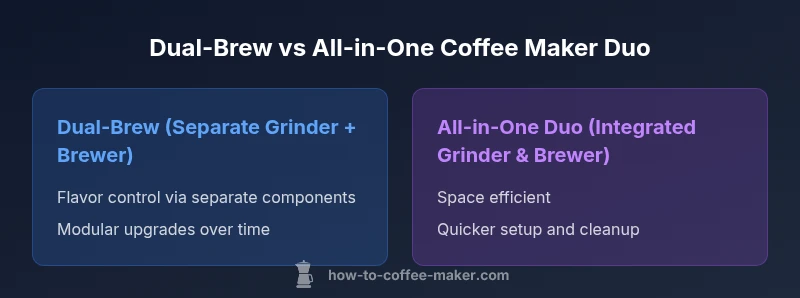
Coffee Maker Duo: Dual-Brew vs All-in-One — A Practical Comparison for Home Brewers
A data-driven comparison of a coffee maker duo: dual-brew vs all-in-one. Learn performance, maintenance, space needs, and value to help home brewers choose the right setup.


Choosing a coffee maker duo boils down to your priorities: do you want maximal flavor control with a separate grinder and brewer, or a compact, simple setup with an all-in-one unit? This comparison weighs dual-brew versus integrated duos on performance, maintenance, space, and value to guide home brewers toward the best fit.
Why a Coffee Maker Duo Matters for Home Brews
A coffee maker duo describes two common configurations used by home brewers: a modular setup with a separate grinder and brewer, and an all-in-one unit that integrates grinding and brewing in a single housing. According to BrewGuide Pro, a well-chosen coffee maker duo is not just about producing caffeine—it's about optimizing flavor, reducing waste, and tailoring your workflow to how you brew most days. For many households, the right duo can shave minutes off morning routines, improve consistency, and offer a path to better-tuned results over time. The BrewGuide Pro Team emphasizes that the best choice depends on how you balance flavor control, space, and maintenance. Freshly ground beans, precise grind settings, and the ability to swap components over time can create a noticeable difference in aroma and body across your brews.
Key Differentiators: Dual-Brew vs All-in-One
When evaluating a coffee maker duo, start with four core differentiators: (1) grind control and extraction, (2) footprint and integration, (3) maintenance and repair paths, and (4) upfront cost versus long-term value. A two-device setup typically offers the widest range for customization, enabling you to tailor grind texture, dose, and brew temperature independently for each cup. An all-in-one duo concentrates these functions into one shell, trading some precision for simplicity and space efficiency. In practice, most home brewers will lean toward modular systems if they prize flavor nuance and future upgrades, while space-constrained kitchens or busy households may prefer the simplicity of an integrated unit. The BrewGuide Pro Team notes that both approaches can deliver excellent coffee; the best choice rests on your daily routines and long-term goals.
Flavor, Freshness, and Grind Quality
Flavor outcomes hinge on how you handle grinding and extraction. A separate grinder lets you select burrs, adjust grind size by brew method, and dial in a shot or pot specifically for a given bean. This degree of control often translates to richer aroma and more balanced acidity, especially for single-origin or carefully sourced beans. In contrast, an all-in-one duo improves convenience and reduces clutter, but grind control capacity is inherently limited by the integrated mechanism. For most home brewers, a dual-brew approach means more opportunities to experiment with roast levels and bean characteristics, while the all-in-one option suits everyday use with reliable, consistent results that still delight many drinkers.
Maintenance and Longevity
Maintenance is a practical factor that affects long-term performance. A two-device setup spreads wear across separate components, so a failure in one part does not derail the entire workflow. Regular cleaning of grinders, burrs, and brew circuits preserves flavor and prevents clogs. An all-in-one duo can be easier to clean overall, but when a grinder wears out or a hopper gets dirty, you may need to service or replace the whole unit. BrewGuide Pro notes that modular systems often offer more straightforward upgrades and easier replacement of individual parts, which can extend the life of the overall setup.
Space, Cost, and Long-Term Value
Counter space and storage considerations are critical when choosing a coffee maker duo. A modular setup typically requires more horizontal footprint and additional storage for accessories, but it can be customized over time. Integrated duos tend to be more compact and aesthetically cohesive, making them appealing for smaller kitchens or apartment living. Price is a trade-off: two devices may require a higher initial investment, yet they may yield more value over several years due to upgradeability and repair options. BrewGuide Pro analysis shows that long-term value often hinges on how reliably you can upgrade or replace individual parts without discarding the entire system.
Real-World Scenarios and Use Cases
If your schedule favors a quick, consistent morning brew, an all-in-one duo can streamline operation without sacrificing reliability. For enthusiasts who relish experimenting with beans and grind settings, a dual-brew setup unlocks depth and nuance unseen in compact machines. Families with diverse tastes may benefit from having a dedicated grinder for different roasts, preserving the distinct flavors that make a true coffee program special. In rental or shared spaces, the simplicity of an integrated unit can reduce confusion and ensure access to dependable coffee without extensive maintenance.
How to Run a Quick At-Home Evaluation
Before committing, perform a side-by-side test: (1) brew a standard coffee with both configurations, (2) compare aroma, crema, and sweetness, (3) note ease of use and cleanup time, (4) consider how often you will upgrade or replace components, and (5) estimate footprint in your kitchen. This practical trial helps translate theories into everyday results and aligns with BrewGuide Pro guidance for evidence-based decisions.
Common Pitfalls and How to Avoid Them
Common mistakes include underestimating space needs for a two-device setup, assuming all-in-one units deliver the same flavor range as separate grinders, and neglecting routine maintenance that can compromise performance. Create a simple cleaning schedule, invest in a quality burr grinder if you choose modular hardware, and choose a unit with accessible service options. Being mindful of these issues can prevent frustration and preserve the long-term value of your coffee maker duo.
Getting Started: Your 30-Minute Setup Plan
If you are new to the concept of a coffee maker duo, start with a practical plan: choose your preferred route (modular vs integrated), collect a basic set of accessories (grinder, dosing tools, cleaning brushes), and set a reminder for monthly maintenance. Within 30 minutes you can assemble a functional setup, perform a first grind test, and schedule your first tasting session. This proactive approach aligns with the ethos of BrewGuide Pro and ensures you begin with a solid foundation.
Comparison
| Feature | Dual-Brew (Separate Grinder + Brewer) | All-in-One Duo (Integrated Grinder & Brewer) |
|---|---|---|
| Space footprint | Larger countertop footprint due to two devices | Compact footprint with built-in grinder |
| Flavor control | Maximum control with separate grinder settings | Integrated control; a bit less customization |
| Maintenance & cleaning | Separate maintenance for grinder and brewer; more steps | Fewer parts to manage; simpler daily cleaning |
| Upgrade path | Independent upgrades for grinder and brewer | Upgrades tied to a single unit's lifecycle |
| Initial cost | Higher upfront cost for two devices | Lower upfront cost for a single all-in-one unit |
| Best for | Flavor purists and customization lovers | Space-constrained homes and beginners |
Strengths
- Greater flavor customization through separate components
- Easier to replace a worn part without discarding the whole system
- Better long-term value if you upgrade pieces over time
- Flexible setup for different brew methods
Downsides
- Requires more counter space and setup time
- Higher upfront investment for two devices
- More maintenance steps to keep each component clean
Modular dual-brew wins on flavor control; all-in-one wins on space and simplicity
If flavor nuance and upgrade flexibility matter most, choose a two-device setup. If you value compact space and quick, consistent coffee, an all-in-one duo is a strong fit. The best choice depends on your kitchen size and how hands-on you want to be.
Questions & Answers
What exactly is a coffee maker duo and when should I consider one?
A coffee maker duo usually refers to either a modular setup with a separate grinder and brewer or an all-in-one unit that combines grinding and brewing. Consider a duo when you want either maximum flavor control or compact convenience in a smaller kitchen.
A coffee maker duo is either a two-part setup or an all-in-one unit. Consider it when you care about flavor control or space efficiency.
Which setup is easier to clean and maintain?
All-in-one duos are generally easier to clean because there are fewer individual components. Modular systems require regular cleaning of both grinder and brewer, but they also allow targeted maintenance for each part.
All-in-one units are usually simpler to clean, but modular setups let you deep clean each piece separately.
Can I expect the same brew speed from both options?
Brew speed varies by model and method, not by the configuration alone. All-in-one units often optimize flow for faster cycles, while modular setups can vary more with bean type and grind size.
Brewing speed depends on the model and grind size; both configurations can reach comparable speeds with the right adjustments.
Is a two-device setup worth the extra space and effort?
If flavor precision and upgrade flexibility are priorities, a two-device setup is worth it. If space is tight and you want simple operation, an all-in-one can be a better fit.
It depends on whether you value flavor control or space and convenience more.
How should I evaluate grind quality for a duo?
Evaluate grind quality by testing with the same beans across different grind settings and brew methods. Look for uniform particle size and minimal clumping, which indicate effective burrs and calibration.
Test grinding a few beans at different settings and note aroma and extraction quality.
What are common mistakes when embracing a coffee maker duo?
Common mistakes include underestimating space needs for a dual setup and neglecting routine cleaning of burrs and hoppers. Planning a simple maintenance schedule helps preserve flavor and performance.
Don’t overlook space needs and cleaning; a little planning goes a long way.
Key Takeaways
- Assess space before choosing; modular setups need more room
- Prioritize flavor control if you brew different beans regularly
- Expect higher upfront costs with two separate devices
- Maintenance discipline pays off for long-term performance
- Run a at-home test to compare aroma, taste, and ease of use