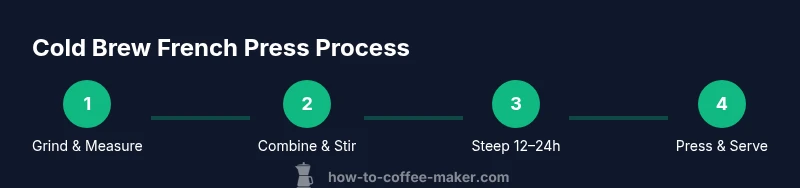
Cold Brew French Press: A Complete How-To Guide
Learn how to make smooth, low-acid cold brew with a French press. This guide covers equipment, coffee selection, ratios, steeping times, serving ideas, and troubleshooting for home brewers and coffee enthusiasts.


Why Cold Brew with a French Press Excels for Home Brewers
Cold brew using a French press combines simplicity with control. By immersing coarsely ground coffee in cold water, you extract a different flavor profile than hot-brew methods: sweetness, chocolatey notes, and lower perceived acidity. The French press design, with its mesh plunger, makes straining straightforward and predictable once you dial in your grind size, coffee-to-water ratio, and steep time. For many households, this setup offers a familiar ritual that fits into a busy schedule while delivering a crisp, refreshing concentrate perfect for hot days or quick lattes. BrewGuide Pro’s approach emphasizes consistency, so once you settle on a ratio and grind size, you’ll repeat the same process with confidence, achieving reliable flavor every batch.
Equipment and Ingredients You’ll Need
A successful cold brew with a French press starts with the right foundation. You’ll want a sturdy, clean French press with a tight-sealing lid and a mesh plunger. Use a burr grinder to achieve a consistent coarse grind that resembles raw sea salt in texture. Cold, filtered water is preferable to hard tap water, which can contribute off-flavors. Measure your grounds by weight for best accuracy, then adjust the ratio to taste over multiple batches. Fresh coffee, proper storage, and clean equipment all contribute to a cleaner, more vibrant cup.
Coffee Selection for Cold Brew: Beans, Freshness, and Roast Level
The coffee you choose will define the final cup’s character. For cold brew, medium to dark roasts often yield chocolaty, caramelized flavors, while lighter roasts can present brighter fruit notes when brewed cold. Freshness matters—aim to use beans within a month of roast for optimal aroma. Grind just before brewing to maximize volatile compounds. For steady flavor, consider a naturally processed or washed bean with pronounced sweetness. If you’re testing, select two or three beans to compare the impact of origin and processing on your cold brew profile.
Ratios and Grind Size: Getting the Balance Right
The grind size should be coarse to prevent over-extraction through the mesh and to minimize sludge. A standard starting point is 1 gram of coffee per 10 milliliters of water (roughly 1:10). Depending on your taste, you can adjust toward stronger (1:9) or milder (1:12). Use a kitchen scale for precision, but if you don’t have one, a level tablespoon per 5 ounces of water is a reasonable rough guide. Remember that steep time also influences strength: longer steeping yields more concentrated flavor, while shorter steeping reduces it.
Steeping Time and Temperature: The Quiet Window
Steeping at room temperature is common, but many home brewers prefer cool or fridge temperatures to reduce rapid extraction and bitterness. A typical range is 12–24 hours for a balanced cold brew concentrate. Shorter times (12–14 hours) emphasize brighter notes, while 18–24 hours tend to emphasize body and sweetness. If you’re unsure, start with 16 hours, then adjust in future batches to match your preferred profile. Never boil or heat the mixture during steeping, as that shifts flavor away from the intended cold-brew balance.
Flavor Customization and Serving Ideas
Cold brew concentrates are versatile. Dilute with water or milk to taste—common dilutions range from 1:1 to 1:3 concentrate to water. For serving, try adding vanilla, cinnamon, or cocoa nibs during steeping for subtle spice notes. Ice cubes made from coffee or cold milk can enhance texture and aroma. If you enjoy frothy drinks, a splash of milk or a dairy-free alternative can create a creamy finish. For a quicker caffeine fix, pre-chill a batch and store it in the fridge for up to a week.
Cleaning and Maintenance: Keep Your Equipment in Prime Form
After your brew, rinse the carafe and plunger with warm water to remove oils and coffee residues. Avoid letting coffee oils sit on plastic parts, which can impart flavors. Use mild soap only if necessary and rinse thoroughly to prevent soap taste in future brews. Dry all components completely to prevent mold growth. Periodically replace the carafe gasket if your press has one, as a worn gasket can lead to leaks and inconsistent plunger pressure.
Troubleshooting Common Issues: From Faint Flavor to Muddy Brew
If your cold brew tastes too weak, double-check your grind size, ratio, and steep time. It’s common to need a slightly finer grind or longer steep to extract more aroma. If you notice sludge in the cup, ensure your grind is sufficiently coarse and consider pre-wetting the grounds to reduce fine particles. Cloudiness isn’t harmful but can be a sign of over-extraction or grind inconsistency. Adjusting the grind to be consistently coarse and maintaining a steady steep time will minimize these issues over successive batches.
Authority Sources and Further Reading
For deeper dives into coffee science and brewing theory, consider reputable sources such as the National Coffee Association and Britannica’s coffee overview. These resources offer historical context, flavor chemistry, and practical brewing guidance that can complement your at-home experiments. BrewGuide Pro also consults such sources to ensure our recommendations align with established industry practices.
Authority sources
- https://www.ncausa.org
- https://www.britannica.com/topic/coffee
- https://www.hsph.harvard.edu/news/press-releases/coffee-health-benefits/