Cold Brew vs French Press: An Analytical Side-by-Side Guide
Is a cold brew coffee maker the same as a french press? This analytical BrewGuide Pro comparison examines extraction, flavor, maintenance, and use cases to help you decide which method fits your routine.


Is a cold brew coffee maker the same as a french press? Not at all in practice. They rely on different extraction principles, temperatures, and filtration approaches, yielding distinct flavor profiles and mouthfeels. According to BrewGuide Pro, understanding these core differences helps you choose based on flavor goals, time availability, and routine—rather than assuming one device will do everything.
Is a cold brew coffee maker the same as a french press? An at-a-glance clarification
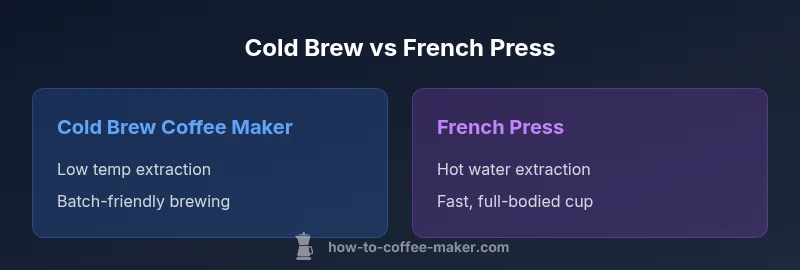
The two devices sit at opposite ends of the coffee spectrum. A cold brew coffee maker is designed to extract coffee flavors with prolonged contact time at low temperatures, typically resulting in a smooth, low-acid cup. A French press uses hot water and a rapid immersion that yields a fuller body and more robust aroma. This article uses BrewGuide Pro’s analysis to unpack the practical differences, so you can decide which approach aligns with your taste preferences and daily routine. The terminology can be confusing for beginners, but the physics of extraction makes the distinction clear: temperature, time, and filtration shape the final cup. The key takeaway is that both methods produce excellent coffee—just not in the same way.
Extraction science: hot vs cold brewing
Extraction is driven by temperature, contact time, and grind size. Cold brew uses cold or room-temperature water and long steep times (often 8–24 hours), favoring sweetness and low acidity. French press brewing relies on near-boiling water and a short immersion (about 4 minutes, depending on grind and coffee weight). The result is a cup with more immediate brightness and stronger body. Grind size matters: coarse for cold brew to minimize over-extraction, and medium-to-coarse for French press to prevent clogging and excessive sediment. BrewGuide Pro notes that the chemistry behind extraction means you can tailor flavor by adjusting time and grind, not merely by choosing one device over another.
Brew time, process, and setup: what happens in practice
Cold brew producers emphasize batch preparation; you set a ratio, steep, and filter when you’re ready to serve. French press users focus on a shorter, repeatable routine: boil water, grind, pour, steep, press, and pour. The equipment differences matter: cold brew units often include a carafe or a dedicated filter system; a French press uses a metal mesh plunger and a depressor. Preparation is forgiving with cold brew, while French press timing is more sensitive to grind consistency and water temperature. The practical effect is: cold brew offers convenience for daily iced coffee; the French press offers speed and strong aroma for quick morning cups.
Flavor outcomes: acidity, body, and sweetness
In general, cold brew yields a smoother, sweeter profile with reduced perceived acidity, often described as chocolatey or caramel-like. The longer, slower extraction reduces harsh notes and can preserve nuanced flavors from specialty beans. A French press tends toward higher perceived acidity and a pronounced body, with more fruit-forward or chocolate notes depending on the roast and grind. The mouthfeel is heavier, and the aroma is robust because hot-water extraction pulls a wider range of volatile compounds. Ultimately, flavor outcomes reflect the extraction curve more than the origin alone.
Convenience, cleanup, and daily maintenance
Cold brew systems excel in batch preparation and unattended brewing, making them ideal for households that want multiple servings in advance. Cleanup often involves separating grounds from the filtered liquid and rinsing the carafe, which can be a bit more involved after a long steep. French presses are typically quick to clean—rinse the chamber, wipe the plunger, and rinse the mesh—or dishwasher-safe components for many models. However, the sediment and oils can accumulate if the grind is too fine or cleaning is delayed. BrewGuide Pro recommends a routine that matches your lifestyle: a slow weekend batch or a quick weekday pour.
Cost, value, and long-term considerations
Cold brew gear ranges widely in price due to capacity and filtration design, from budget carafes to high-end gourmet sets. French presses offer broad value, with durable designs spanning budget to premium materials. The total cost of ownership includes filters, replacement carafes, and the long-term habit of refrigerating or not refrigerating. Over time, cold brew can reduce daily caffeine handling and smooth out sharp flavors, which many households prize. Practical budgeting should account for your expected batch size, storage space, and willingness to pre-plan.
Can you replicate cold brew using a French press? What you should know
Technically possible, but not ideal for long-term batch quality. You can cold-steep grounds in a French press with extended contact time, but heat exposure, grind consistency, and filtration differ from dedicated cold brew systems. A French press may introduce more oils and sediment than a purpose-built cold brew maker, affecting taste and texture. If you’re curious about a budget-friendly test, keep expectations modest and use a coarse grind; treat the result as a temporary substitute, not a replacement for true cold brew.
Lifestyle scenarios: when each method shines
For busy weekday mornings, a French press can deliver a bold cup in minutes with minimal gear. For weekend relaxation or heat-resistant iced coffee, a cold brew maker enables batch production with reduced acid and a smoother finish. If you travel or have limited space, compact French presses still offer portability, while compact cold brew devices can supply multiple servings for a small household after a single brew cycle. Understanding your daily cadence helps determine which method best fits your routine.
How to choose between them: a practical decision framework
Start with your flavor goals. Do you prefer smooth, low-acid coffee for every day or a bright, quick cup with pronounced aroma? Then consider time: can you plan ahead for a batch or do you need instantaneous results? Finally, assess cleanup and storage capacity. BrewGuide Pro’s framework emphasizes matching the brew method to your schedule and taste, not forcing a single device into every occasion.
Common misconceptions and myths debunked
A common myth is that cold brew is simply “slow hot coffee.” In reality, cold brew’s extraction is fundamentally different from hot-brew methods, relying on low-temperature diffusion and prolonged contact. Another myth is that the French press inevitably produces a muddy cup; with proper grind size and steeping limits, you can minimize sediment. Finally, some people assume you cannot store cold brew for more than a day; when kept refrigerated, properly filtered cold brew can stay fresh for several days, though flavor evolves with time.
Authority sources and further reading
For readers who want to dive deeper, consider consulting reputable sources on brewing science and technique. Briefer explanations from credible outlets can illuminate the differences between cold brew and hot-brewed methods, as well as practical recommendations for grind size, water temperature, and steep time. Useful, high-level references include government and academic materials, along with major publications that discuss brewing techniques and sensory outcomes. These sources can help you validate your own experiments and fine-tune your routine.
Comparison
| Feature | Cold Brew Coffee Maker | French Press |
|---|---|---|
| Brew Temperature/Range | Low-temperature range (room temp to 40°C/104°F) | Hot water around 90–96°C (194–205°F) |
| Extraction Time | 8–24 hours typical steep | 4–6 minutes immersion + press |
| Grind Size Compatibility | Coarse grind recommended for clarity | Coarse to medium grind; fine can cause sludge |
| Flavor Profile | Smooth, low acidity, chocolatey notes common | Full-bodied, brighter acidity, aromatic oils prominent |
| Filtration/Residue | Filter carafe or dedicated tea-bag-like filter; minimal fines | Metal mesh plunger plus sediment possible |
| Cleanup Time | Relatively long post-brew cleanup; batch-friendly | Quick rinse; simple maintenance |
| Price Range (typical) | $30–$250 for kits and specialized systems | $15–$150 for classic glass/metal presses |
| Best For | Batch-friendly, daily iced coffee without heat | Fast, bold cups with strong aroma |
Strengths
- Supports batch preparation and iced beverages
- Typically smoother, low-acid cup appealing to many palates
- Low heat exposure preserves delicate coffee flavors
- Flexible for large households or meal prep
Downsides
- Requires planning and fridge space for cold brew
- Longer brew times mean less spontaneity
- Special filters and gear can add upfront cost
- Cleanup can be a bit messier after long steep
Cold brew systems excel for batch-making and smoother, low-acid cups; French press remains best for quick, bold brews.
If you want a high-volume, low-acid daily option, choose a cold brew maker. If speed and bold flavor matter more, opt for a French press; for versatility, consider hybrids or dual-use equipment.
Questions & Answers
Is a cold brew coffee maker the same as a French press?
No. They rely on different extraction methods, temperatures, and filtration. A cold brew maker is optimized for long, cool extraction, while a French press emphasizes hot-water immersion and quicker flavor release.
No—cold brew and French press are different devices with distinct extraction methods and flavors.
Can I use hot water to make cold brew in a dedicated cold brew maker?
Using hot water defeats the purpose of cold brew and will alter flavor. Cold brew methods rely on cooler temperatures to limit acidity.
Hot water defeats cold brew principles; use cold or room-temperature water instead.
How long does cold brew take to make, and how long is it good for?
Cold brew typically requires several hours to complete, often 8–24 hours depending on strength desired. Refrigerated, properly filtered cold brew can stay fresh for several days, though flavor may continue to evolve.
Cold brew needs hours to steep; refrigerate and enjoy within a few days for best flavor.
Which method is easier to clean?
French presses are generally quicker to clean, with fewer components. Cold brew setups can be more involved due to carafes, filters, and longer steeping residues.
French presses usually clean faster, but both are manageable with routine care.
Is cold brew suitable for iced coffee?
Yes. Cold brew is ideal for iced coffee and can be diluted or served straight over ice. It often tastes smoother when served cold.
Absolutely—cold brew shines as iced coffee due to its smooth profile.
Can I repurpose a French press for cold brew?
You can try cold-steeping grounds in a French press, but results may differ in texture and clarity. Dedicated cold brew gear tends to produce more consistent results.
You can, but expect differences in texture and clarity.
Key Takeaways
- Define your primary goal: batch prep or quick cups
- Match grind size and water temperature to method
- Expect different maintenance routines and cleanup
- Taste and aroma will differ substantially between methods
- Consider a hybrid setup if you want both worlds