Espresso and Coffee Maker with Grinder: A Comprehensive Comparison
Compare all-in-one espresso grinders vs separate grinder + espresso machine setups. Learn performance, maintenance, upfront costs, and long-term value for serious home brewers.


Two-in-one espresso and coffee maker with grinder offer convenience by combining grinding and brewing in a single unit. For purists, separate grinder and espresso machine often deliver better grind consistency and customization. In most homes, the best choice balances space, budget, and the level of espresso quality you want for daily drinks.
Understanding the Core Tradeoffs
Choosing between an all-in-one espresso and coffee maker with grinder versus a modular setup hinges on how you balance convenience, grind quality, and long-term costs. For many home users, the appeal of a single device that grinds beans and pulls shots is undeniable: fewer cords, less counter clutter, and a straightforward workflow from bean to cup. However, that convenience can come at the expense of grind precision, temperature stability, and the ability to upgrade components over time. When you evaluate a product described as an espresso and coffee maker with grinder, think about how often you drink espresso versus drip coffee, the space you have for a setup, and how much you value customization. Brew routines evolve, and a modular system often ages more gracefully as your palate and schedule change, which BrewGuide Pro analyses suggest is a common path for devoted home brewers in 2026.
All-in-One vs Separate Components: What It Means for You
All-in-one units promise a compact footprint: one chassis, one interface, and a single maintenance routine. The upside is obvious for kitchens with limited counter space or for households that want a quick, bean-to-cup experience without juggling multiple devices. The downside is trade-offs in grind consistency and extraction control. A dedicated grinder paired with a dedicated espresso machine typically yields finer control over grind size, dose, and tamping pressure, producing a more precise shot profile and richer crema. This modular approach also tends to simplify repairs or replacements because you can swap out a single component without replacing the entire system. In 2026, many enthusiasts still prefer the modular path for long-term flavor stability and upgradeability, even if it costs more upfront and requires more space.
Grinding Mechanics: Consistency and Temperature Effects
Grind quality is a cornerstone of espresso flavor. An integrated grinder can be perfectly synchronized with the machine’s temperature profile, which can make it easier to achieve repeatable outcomes in casual use. Yet, the fixed grind settings of many all-in-one units can limit fine-tuning, especially when chasing specific extraction times or crema texture. A standalone grinder offers adjustable burrs, stepless or stepped grind settings, and inertia control that preserves particle size distribution as beans age. Temperature fluctuations during grinding can also impact flavor; modular setups let you separate grinding from brewing to minimize heat transfer. The tradeoff is a more complex workflow, which is why many serious hobbyists favor a two-device approach for consistent espresso and a reliable daily cup.
Brew Profiles and Personalization
Espresso is a discipline of flavor, and personal customization matters. All-in-one machines often provide preset profiles tailored to common beans and roast levels, with limited room for customization beyond pre-programmed options. Dedicated machines, paired with a quality grinder, enable precise control over dose, tamping pressure, water temperature, pre-infusion, and flow rate. This level of control unlocks a broader flavor range—from bright, acidic shots to creamy, chocolatey profiles—especially when experimenting with different beans and roasts. For households that enjoy seasonal beans or want to chase a perfect latte, the ability to fine-tune parameters in a modular setup is a meaningful differentiator.
Maintenance and Longevity: Cleaning, Descale, and Replacements
Maintenance requirements differ between all-in-one and modular configurations. All-in-one units typically require a single cleaning cycle that covers grinder burrs and the brewing path. However, if the grinder component is built into the same chassis, accessing and servicing burrs can be more intrusive and time-consuming. Separate grinders and espresso machines often expose easier access for descaling and burr replacement, potentially extending the life of each component and lowering the cost of part replacements over time. Regardless of choice, a regular cleaning cadence—weekly backflushing (where applicable), monthly grinder cleaning, and periodic descaling—helps preserve flavor and performance. BrewGuide Pro recommends following the manufacturer’s maintenance schedule and using descaling solutions compatible with your exact hardware.
Space, Noise, and Usability: Real-World Impacts
Counter space, noise levels, and ease of use play critical roles in daily routines. All-in-one units usually occupy less total footprint and can be simpler to operate, which appeals to busy households or shared kitchens. But the trade-off is often a louder grinding experience and a fixed interface that doesn’t adapt well to unusual shots or non-espresso beverages. Modular setups can be bulkier, but they tend to deliver quieter grinding with better spill control and a more intuitive flow between grinding and brewing. When evaluating, consider your kitchen layout, whether you value quiet operation (important for morning routines) and how much time you want to invest in pull shots versus enjoying a quick cup.
Price Range and Perceived Value: Short-Term vs Long-Term Costs
All-in-one devices often present a lower upfront cost and a simpler packaging that appeals to first-time buyers. However, you should consider the long-term value: if the integrated grinder wears faster or the machine’s group head and boiler degrade, replacement costs can offset any initial savings. A modular setup typically demands a higher initial investment, but each component can be upgraded or replaced independently, potentially increasing the system’s lifespan and preserving performance. The decision frequently hinges on how much flavor quality you expect to extract over a multi-year horizon, as well as how confident you are in performing maintenance without professional help.
Milk Frothing and Latte Texture: What to Expect
Milk-based drinks are a practical stress test for any coffee maker with a grinder. All-in-one systems often include integrated steam wands or auto-steam features that simplify foaming but may limit microfoam control. Dedicated steam wands on separate machines provide more precise texturing but require additional skill with technique. For households that enjoy cappuccinos or flat whites daily, investing in a capable steam wand and a high-quality grinder can yield smoother microfoam and more consistent texture. Beginners can still achieve decent milk texture with practice on both configurations, but the modular approach generally offers more room to grow.
Reliability and Common Failure Points: What to Watch For
Integrated units reduce the number of moving parts you must track, which can simplify troubleshooting for casual users. On the flip side, a failure in the grinder or the brewing path often requires service on the entire unit, potentially increasing downtime. Modular systems spread risk: if the grinder fails, you can replace just that component and keep the espresso machine running. This modularity also makes it easier to source compatible parts from third-party suppliers. When browsing, look for devices with accessible burrs, clear manuals for maintenance, and parts diagrams to assess repairability.
Cleaning Routines: Descale and Care Across Systems
Descale routines depend on water hardness and the machine’s boiler design. All-in-one systems typically combine descaling with grinder maintenance in a single protocol, which can save time if you prefer fewer steps. Modular systems require separate descaling for the espresso machine and the grinder, which can be more involved but offers targeted care for each component. The key is consistency: keep a regular descaling schedule, use filtered water if possible, and clean the grinder burrs and hopper to prevent oil buildup. A well-maintained system not only improves taste but also extends the life of seals and gaskets that mulch into the brew path.
Quick Setup Tips for Beginners: Getting Started Fast
If you’re new to espresso, start with a simple routine and gradually introduce variables. With an all-in-one unit, begin with a standard grind setting and preset shot timer, then adjust dose and tamp pressure in small increments. For modular setups, start by dialing in the grinder with a consistent bean and roast level, then work on machine temperature and pre-infusion. Keep a log of grind size, dose, and time to track what changes yield the best shots. Don’t rush the process; espresso craft rewards methodical adjustments and consistent routines.
Comparison
| Feature | All-in-One Espresso & Grinder | Separate Grinder + Espresso Machine |
|---|---|---|
| Grinding System | Integrated burr grinder with fixed settings | Detached grinder with adjustable grind size |
| Espresso Extraction Control | Preset profiles, limited manual tweaks | Extensive customization (dose, temp, pre-infusion) |
| Milk Frothing | Often simplified wand or auto-steam | Dedicated machines with steam wand or high-end milk systems |
| Maintenance & Cleaning | Single cleaning routine | Two separate maintenance routines |
| Footprint & Aesthetics | Compact, all-in-one footprint | Larger footprint due to two devices |
| Price Range | Lower upfront cost possible | Higher upfront cost for two devices |
| Longevity & Repairability | Often integrated parts; repair may be challenging | Easier to replace parts; more modular |
Strengths
- Convenience and space savings for small kitchens
- Simplified workflow from bean to cup
- Fewer appliances to store and maintain
Downsides
- Potentially compromises on grind quality vs dedicated grinder
- Limited customization compared to separate setup
- Repair complexity when integrated units fail
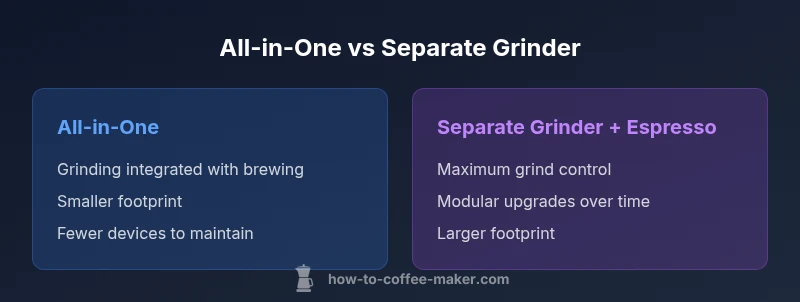
Integrated can be best for compact spaces; dedicated grinder setup wins for true grind control.
Choose all-in-one if you prioritize convenience and a small footprint. If you want maximum grind control, consistent extraction, and easier component upgrades, opt for separate grinder and espresso machine.
Questions & Answers
What is the main difference between an all-in-one unit and a separate grinder plus espresso machine?
The main difference is integration versus modularity. All-in-one units save space and simplify the bean-to-cup flow but often limit grind customization. A separate grinder and espresso machine maximize grind control and upgradeability, at the cost of a larger footprint and a more complex setup.
All-in-one is about convenience and a smaller footprint, while a separate setup emphasizes grind control and upgrade paths.
Can an all-in-one replace a high-end grinder?
An all-in-one can work for casual use, but it typically cannot match a dedicated grinder’s consistency and range of grind settings. For true espresso precision and experimentation with different beans, a separate grinder is preferred.
It can work, but a dedicated grinder usually delivers better consistency and control.
Is maintenance easier with an integrated grinder?
Integrated units simplify some routines by combining steps, but accessing internal burrs for cleaning can be harder. Modular setups let you replace or service each component more easily, though you must follow two maintenance regimens.
Cleaner maintenance is simpler with modular parts, though it may feel more involved.
What budget should I expect for a complete setup?
Budget varies widely by features. All-in-one systems tend to have lower upfront costs, while modular setups require investment in both grinder and espresso machine. Total cost depends on how much control you want over grind settings, temperature stability, and milk texture.
Expect a range from entry-level to premium, depending on features and brands.
Which is better for milk-based drinks?
Milk-based drinks benefit from precise steam and microfoam control. Dedicated machines with high-quality grinders generally produce better texture, but capable all-in-one units can still deliver satisfying lattes and cappuccinos with practice.
Dedicated setups usually win on milk texture, but all-in-ones can be good too with practice.
How much space do these setups require?
All-in-one units save counter space by combining functions. Separate setups take more room but can be arranged modularly and left flexible for future upgrades.
All-in-one is more space-efficient; modular setups need more room but offer flexibility.
Key Takeaways
- Define your espresso quality goals first
- Assess counter space before choosing a setup
- All-in-one saves space but may limit grind control
- Separate grinder setups offer customization and longevity
- Plan for maintenance and descaling in your budget