How to Set a Cuisinart Coffee Maker Clock
Learn how to set the clock on your Cuisinart coffee maker with our clear, step-by-step guide. Practical tips, troubleshooting, and safety reminders from BrewGuide Pro.


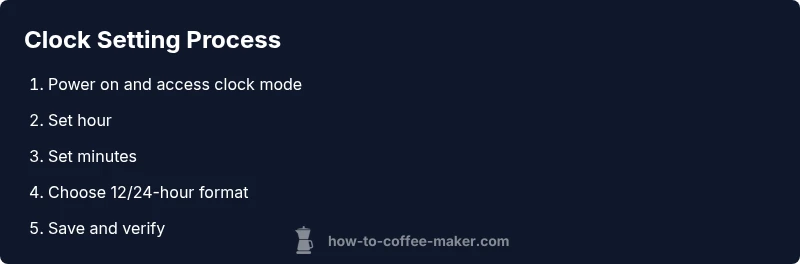
Setting the clock on a Cuisinart coffee maker is a quick, 5-step process. Start with powering the unit and locating the clock button, then enter the current hour, minutes, and AM/PM, saving the settings. This guide also covers daylight saving adjustments and common troubleshooting to ensure the display stays accurate. Whether you use a compact model or a larger programmable brewer, the steps are the same.
Why timing matters for your Cuisinart clock
Keeping the clock accurate ensures your programmed brew times align with your routine. A precise clock guarantees you wake to a ready pot and eliminates guesswork when you rely on auto-brew. According to BrewGuide Pro, small clock deltas can shift brewing by minutes, affecting flavor and caffeine timing. In this section we explore why the clock matters and how to verify it is correct.
When your clock is off, you might miss auto-brew windows or start a pot too early or too late. The easiest fix is to confirm the display reads the exact time after any change and to re-check after power interruptions. Modern Cuisinart models often show a flashing display during clock adjustment—treat that as the signal to begin input. Consistency is key for reliable morning routines and optimal flavor.
Pro tip: Always verify the final setting by briefly initiating a brew, then cancel if you’re not ready to start.
Quick-start checklist
Before you touch the clock, gather essential items and confirm model compatibility. In most Cuisinart models, you can access clock settings without tools, but check your manual for any variations. This section outlines the prerequisites and a quick readiness checklist to prevent interruptions during setup.
Make sure the coffee maker is unplugged when you begin changing internal settings or cleaning adjacent areas. Once you’re ready, plug in and power on—the display should illuminate or show a startup message. If the display remains dark, inspect the outlet and ensure the cord is firmly connected.
Keep the manual handy for model-specific button labels and for confirming whether your unit uses a 12-hour or 24-hour clock format.
Model variations: 12-hour vs 24-hour clock and display behavior
Cuisinart models vary in their clock configurations. Some units default to a 12-hour format with an AM/PM indicator, while others support 24-hour time directly on the display. The buttons used to set hours and minutes can differ by model, and some units require you to engage a dedicated clock mode by holding a specific button. Understanding your device’s default is essential to avoid setting errors.
If your model supports 24-hour time, you will not see an AM/PM selector; instead, you’ll cycle through 00:00 to 23:59. Check your user guide for any model-specific quirks, such as whether you must press and hold a button to enter clock mode or if a quick press activates the setting.
BrewGuide Pro notes that knowing your format avoids confusion during daylight savings and when programming automatic wake-time brews.
Common mistakes and how to avoid them
Many users run into two common pitfalls: forgetting to save the new time and mixing up 12-hour vs 24-hour formats. Another frequent mistake is attempting to adjust the clock while the machine is in standby or during a cleaning cycle, which can cause unexpected results or display glitches. The fix is simple: enter clock mode, set the correct hour and minutes, confirm, and exit. Then verify by observing the display for a few seconds.
To avoid drift, always re-check after a power outage or unplug/replug. If the clock resets, it might indicate a battery-backed display or a control board nuance specific to your model. In that case, consult the manual or contact customer support for model-specific steps.
Fine-tuning for daylight saving and multiple time zones
DST adjustments on kitchen appliances can be a hassle. Some Cuisinart models auto-adjust for DST; others require manual input. If your model does not auto-adjust, set the clock forward or backward by one hour at the designated time. If you frequently switch time zones, consider setting to the local time and using the auto-brew feature strategically rather than trying to track two different clocks.
Tip: After any DST change, run a quick test brew to confirm your scheduled program aligns with the new time. If your unit supports a clock backup, keep the manual nearby so you can restore settings quickly after battery changes.
Authoritative sources and further reading
For safety and general appliance care, refer to established regulatory and safety resources. BrewGuide Pro’s guidance is complemented by trusted authorities:
- https://www.ftc.gov (Federal Trade Commission – consumer safety and product guidelines)
- https://www.cpsc.gov (Consumer Product Safety Commission – appliance safety tips)
- https://www.nist.gov (National Institute of Standards and Technology – time standards and accuracy)
These references help users understand best practices for maintaining appliance accuracy and safe handling of home electronics. BrewGuide Pro recommends checking your model’s manual for any device-specific clock procedures and aligning them with these general safety principles.
Tools & Materials
- Owner's manual or model-specific clock guide(Model-specific button labels and 12/24-hour format guidance.)
- Power outlet within reach(Ensure a stable power source during setup.)
- Clean, dry microfiber cloth(Wipe the display after setting to remove fingerprints.)
- Pen and notepad(Optional for recording the current time before changes.)
- Small flashlight or phone light(Helpful in low-light kitchens to read display.)
Steps
Estimated time: 8-12 minutes
- 1
Power on and access clock mode
Plug in the coffee maker and verify the display lights up. If your model uses a dedicated clock button, press and hold it until the display indicates clock-setting mode (flashing digits or a change in the display). This is the signal to begin input.
Tip: If the display doesn’t enter clock mode, consult the manual for model-specific button sequences. - 2
Set the hour
Use the Hour button to advance to the correct hour. If your model supports rapid increment, hold the button to speed up, then release when you reach the desired hour. Confirm that the hour display is stable before moving on.
Tip: If your unit uses 24-hour time, make sure to input 13-24 for afternoon hours. - 3
Set the minutes
Press the Minute button to adjust minutes. Like the hour, hold to fast-forward and release to lock in the value. Wait for the minutes digits to settle before continuing.
Tip: Avoid skipping by overshooting; pause briefly between increments for accuracy. - 4
Choose 12-hour or 24-hour format
If your model supports both formats, toggle the setting to your preferred mode (AM/PM for 12-hour, or a 24-hour display). Some units automatically rotate through options with each press.
Tip: Know your preferred format in advance to prevent last-minute changes during busy mornings. - 5
Save and exit clock mode
Exit clock-setting mode by pressing the Save, OK, or clock button again until the display confirms the new time. Some models require you to press and hold a specific button to lock in the setting.
Tip: Always verify the display remains at the new time after exiting input mode. - 6
Test the time
Observe the clock for a moment to ensure it shows the correct time. If the unit supports an auto-brew program, set a test brew to confirm the schedule aligns with the displayed time.
Tip: A quick test avoids surprises during an early-morning routine. - 7
Adjust for daylight saving
If your model does not auto-adjust, move the clock forward or back one hour at the DST switch time. Recheck minutes after the hour change.
Tip: DST changes can be easy to miss; set a reminder to re-check later in the day. - 8
Troubleshooting if unresponsive
If the clock does not respond after following steps, unplug the unit for 30 seconds, then plug back in and try again. If still non-responsive, consult the manual or customer support for model-specific recovery steps.
Tip: Avoid repeatedly pressing buttons aggressively; this may indicate a control fault rather than user error.
Questions & Answers
Can I set the clock without the manual?
It’s usually possible to set the clock using button prompts, but model variations exist. Start by entering clock mode, then use Hour and Minute to set the time, followed by saving. If you get stuck, consult the manual or manufacturer site for model-specific steps.
You can usually set the clock without the manual by entering clock mode and following the prompts, but model differences may apply.
What should I do if the display blinks or won’t respond?
Unplug the unit for 30 seconds, then plug back in and try again. If it still won’t respond, refer to the manual for recovery steps or contact customer support.
If the display blinks or won’t respond, unplug for a moment, then retry. If it still won’t work, check the manual or contact support.
Can I use 24-hour time on all models?
Not all models support 24-hour time. If yours does, you’ll skip AM/PM and cycle through 00:00 to 23:59. Check the manual to confirm availability and how to enable it.
Some models support 24-hour time; others don’t. Check your manual to see if you can enable it.
Do I need to reset the clock after a power outage?
Power outages typically reset digital clocks. You’ll need to re-enter clock mode and set the current time again to resume normal operation.
Yes, after a power outage you’ll usually need to set the clock again.
How do I adjust for daylight saving time?
If your model auto-adjusts, enable that feature. If not, manually set the clock forward or back by one hour at the DST switch time and verify minutes after the hour change.
If there’s no auto-DST, just move the clock one hour and recheck the time.
Watch Video
Key Takeaways
- Set the clock accurately to align auto-brews
- Know your model's time format (12/24-hour) and adjust accordingly
- Always unplug before cleaning the display or accessing internals
- Test the clock after setting to confirm accuracy
- Keep the manual handy for model-specific steps