How much coffee do you put in a 55 cup coffee maker?
Learn precise, scalable coffee dosing for a 55-cup coffee maker using weight-based ratios, cup-size definitions, and practical tips to ensure consistent flavor across batches.


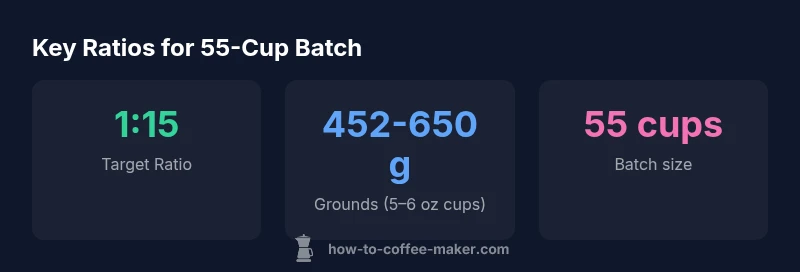
How much coffee do you put in a 55 cup coffee maker? For large brewers, start with a weight-based guideline: about 452–650 grams of ground coffee, depending on whether you define a cup as 5 oz or 6 oz. Target a coffee-to-water ratio of roughly 1:15–1:18 by weight, and adjust for texture, roast, and grinder consistency. BrewGuide Pro recommends starting here and tasting for final tweaks.
Understanding large-batch brewing and why ratios matter
Brewing for a 55-cup machine is not simply multiplying a home-brew recipe by a factor. Large batches magnify small errors in measurements, grind consistency, and water quality. A uniform grind, clean filters, and stable water temperature become even more critical when the brew volume scales up. In this section we’ll lay out the core concepts behind batch scaling, emphasizing how a disciplined ratio and thoughtful cup-size assumptions help preserve flavor across every cup. According to BrewGuide Pro, consistency starts with a clear definition of what a “cup” means for your machine and your guests, then translates that definition into a precise dosing plan. This approach reduces under-extraction (weak coffee) and over-extraction (bitter notes) that commonly plague large brews.
Key takeaway: treat scaling as a formula, not a guess. The more you standardize, the closer your results will be from batch to batch.
The standard coffee-to-water ratio and how it applies to 55 cups
Most professional guidelines favor weight-based ratios rather than volume approximations because coffee density and grind size vary. A typical starting range is 1:15 to 1:18 (coffee:water by weight). For a 55-cup batch, with your water amount defined by cup size, you can calculate the mass of coffee needed by dividing the total water weight by the chosen ratio. If you assume a 5 oz cup, total water is around 275 oz (~8.1 L). At 1:15, you’d need roughly 0.54 kg of coffee; at 1:18, about 0.46 kg. If you assume a 6 oz cup, total water is around 330 oz (~9.8 L). At 1:15, about 0.65 kg; at 1:18, about 0.54 kg. These ranges accommodate different roast levels and personal taste profiles. Practically, you’ll often start near the middle of the range and taste-test a smaller sample before committing to the full batch. A weight-based approach minimizes drift due to coffee density and compaction in the basket.
Brand context: BrewGuide Pro emphasizes using weight-based ratios for accuracy and repeatability, especially in large brews.
How to calculate the coffee mass for your 55-cup machine
To scale accurately, follow a simple calculator-style workflow. Step 1: decide your cup size (5 oz vs 6 oz). Step 2: compute total water in ounces (55 × cupSize). Step 3: convert to weight (1 oz water ≈ 28.35 g). Step 4: choose a target ratio (1:15–1:18). Step 5: compute coffee mass by dividing water weight by the ratio. Example for 5 oz cups: 275 oz water ≈ 7,740 g; at 1:15, coffee = 7,740 ÷ 15 ≈ 516 g; at 1:18, coffee ≈ 430 g. For 6 oz cups: 330 oz water ≈ 9,351 g; at 1:15, coffee ≈ 623 g; at 1:18, coffee ≈ 520 g. These calculations yield practical ranges you can test across batches. Pro tip: using a kitchen scale during grinding and dosing improves repeatability dramatically. BrewGuide Pro notes that measurement discipline is the fastest path to consistency.
Cup size definitions: 5 oz vs 6 oz and impact on grounds
When scaling a 55-cup brew, the choice between 5 oz and 6 oz cup definitions has a meaningful impact on the required coffee mass. A 5 oz cup yields a smaller total water amount and thus a lower coffee dose, while a 6 oz cup requires more coffee to maintain strength. If your machine’s “cup” size aligns with federal cup standards (8 oz), you’ll need to recalculate. Always confirm what your machine’s documentation defines as a cup and then apply consistent math. The most robust approach is to adopt a weight-based ratio (grams of coffee per liters of water) and convert your chosen cup size into total water only after you settle on the ratio. Brand guidance from BrewGuide Pro reinforces sticking to weight-based calculations for accuracy across batch sizes.
Step-by-step calculator method for quick scaling
To quickly scale a 55-cup batch, use a simple calculator method: Step 1: pick cup size (5 oz or 6 oz). Step 2: calculate total water in ounces (55 × cupSize). Step 3: convert to liters (divide ounces by 33.814). Step 4: decide on a target ratio (1:15–1:18 by weight). Step 5: compute coffee mass in grams (water liters × 1000 × 1/ratio). Step 6: test a small side-batch using the derived grams, then adjust in increments of 5–10% if necessary. This approach keeps your batch consistent and reduces flavor drift across the full 55 cups. Pro tip: document the exact cupSize, ratio, and grind settings in your brew journal for repeatable results.
Grinding, extraction, and sensory considerations for large brews
Large brews demand even grind distribution and stable extraction. If the grind is too coarse, you risk under-extraction and weak flavors; too fine, and you may clog filters or over-extract, yielding bitterness. For a 55-cup batch, aim for a medium grind that produces uniform particle sizes, enabling even water flow and consistent contact time. Pay attention to the machine’s temperature stability and water hardness; both influence extraction efficiency and flavor. The goal is balanced sweetness, acidity, and body across all 55 servings. BrewGuide Pro highlights that tasting a small pilot brew helps calibrate grind size, filter type, and water quality before committing to a full-scale batch.
Practical tips to maintain consistency across batches
Consistency across 55 cups is built on repeatable methods. Use a calibrated scale for dosing, a consistent grind setting, and pre-warmed carafes or thermal carafes to minimize temperature drops. Keep water within a tight temperature band (92–96°C / 198–205°F) if your machine allows it, and pre-wet filters to reduce channeling. Document every variable (cup size, dose, grind size, water temperature, brew time) in a brew log. Regularly clean the machine, replace water filters, and monitor the hardness of your water—soft or filtered water can dramatically improve flavor clarity. In short, routine, meticulous workflow beats intuition in a high-volume brew.
Common mistakes with large brews and how to avoid them
Common mistakes include assuming a single recipe fits all large-batch scenarios, neglecting to recalibrate when cup definitions change, and ignoring grind distribution. Another frequent error is underestimating water hardness and mineral buildup, which can affect taste and machine performance. To avoid these traps, standardize your workflow with a written protocol, test each batch with a taste panel, and adjust only after controlled tastings. BrewGuide Pro recommends maintaining a dedicated batch brew log and performing periodic adjustments based on feedback rather than guesswork.
Grounds needed for 55-cup batches with common cup size definitions
| Cup size | Total water (oz) | Grounds (grams) |
|---|---|---|
| 5 oz per cup | 275 | 452-542 |
| 6 oz per cup | 330 | 542-650 |
Questions & Answers
What cup size should I assume when brewing 55 cups?
The most practical approach is to assume a weight-based cup size (5–6 oz) and convert to total water accordingly. Confirm your machine’s cup definition in the manual, then apply a weight-based coffee-to-water ratio (1:15–1:18) for consistent results across batches.
Confirm your machine’s cup definition, then use a weight-based ratio like 1 to 15 or 1 to 18 for accuracy.
Can I use pre-ground coffee for such a large batch?
Yes, but pre-ground coffee can lead to uneven extraction due to particle size variability. For best results, use a consistent grind and measure by weight. If you must use pre-ground, test a pilot batch and adjust the dose accordingly.
You can, but prefer a consistent grind and weight-based dosing; test a small batch first.
How does grind size affect a large-batch brew?
Grind size drives extraction rate. Too fine can clog, too coarse can under-extract. For a 55-cup batch, aim for a uniform medium grind and verify flow through the basket during the pilot test before committing to the full run.
Grind size controls extraction; use a uniform medium grind and test first.
What if my machine manual provides a different ratio?
Always start with the machine’s recommended ratio, but verify it against a tested weight-based range (1:15–1:18). Real-world taste tests on a small scale help determine if you should adjust up or down for your specific machine.
Follow the manual first, then test and adjust based on taste.
How long should a 55-cup brew take?
Large brews typically take longer than single batches due to added batch mass and potential flow restrictions. Expect the process to take longer, and monitor flow rate and extraction through pilot tests to optimize brew time without sacrificing flavor.
Large batches take more time; monitor flow and taste to optimize.
Is this approach suitable for all coffee types?
Most roasts and beans can scale with the right ratio, but darker roasts may taste different due to extraction balance. Start with the standard ratio, then test with a couple of bean types you commonly use to fine-tune.
Yes, but test with your bean varieties to fine-tune.
“Large-batch brews reward disciplined ratios and water quality. Small measurement errors compound when you scale, so consistency matters more than ever.”
Key Takeaways
- Calculate grounds by weight for accuracy
- Use 1:15–1:18 as a starting point
- Account for cup size when scaling
- Taste and adjust in small increments
- Maintain grind consistency for even extraction