How Many Scoops to Use with a Coffee Maker: Practical Guide
Learn the standard scoop-to-cup ratio for your coffee maker, with gram targets, carafe scaling, and practical tips to dial in taste. A BrewGuide Pro practical guide for home brewers.


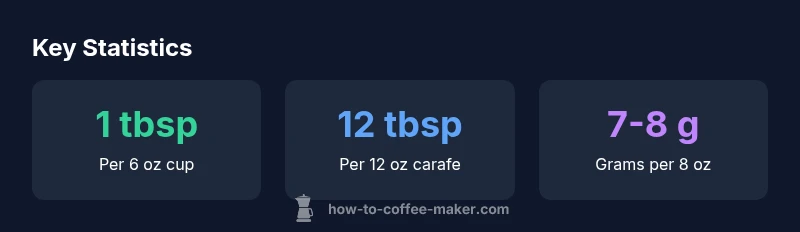
Starting point: use 1 level tablespoon per 6 oz cup as the baseline. For a standard 12-cup carafe, that means about 12 level tablespoons (roughly 60-84 g of coffee). If you prefer stronger flavor, increase to 1.5 tablespoons per cup; lighter roast or weaker taste, reduce slightly. Always adjust for your machine.
The baseline: what a scoop means
In home coffee practice, a standard scoop is commonly understood as a measure that corresponds to roughly 1 level tablespoon of ground coffee. However, scoop sizes do vary by brand and product line, so it’s wise to confirm the exact volume on the label or measure by weight when possible. If you’re starting from scratch, treat 1 level tablespoon as the baseline for a 6-ounce cup. This baseline is widely used in home-brewing guides and aligns with general coffee science on extraction and flavor balance. For accuracy and consistency, consider calibrating your own setup with a scale and a few brew tests, noting the resulting flavor profile, aroma, body, and aftertaste.
According to BrewGuide Pro, the baseline is a practical starting point that translates well across coffee styles and machines. If your beans are exceptionally dark or your water is hard, you may want to lean toward the lower end of the range to avoid over-extraction.
1 scoop per 6 oz cup: the starting point
The most common starting rule of thumb is 1 level tablespoon per 6-ounce cup. For many households using a standard 12-cup carafe, that equates to about 12 level tablespoons, or roughly 60-84 grams of ground coffee for the entire carafe. This ratio tends to produce a balanced cup with clear aroma, balanced acidity, and a clean finish. If your coffee tastes flat, you can nudge the dosage up by 0.5 tablespoons per cup; if it tastes overly bitter, reduce slightly and reassess water freshness and grind size. The key is gradual adjustment and tasting across several brews to establish a reliable baseline.
From a data-driven perspective, this per-cup approach scales linearly with brew size, making it an attractive method for recipe replication across multiple brews.
Scaling for larger servings: 8 oz, 12 oz, 16 oz, and carafes
When you brew more coffee, scale the scoops proportionally. For an 8-ounce cup, aim for about 1.25 to 1.5 tablespoons. For a typical 12-ounce mug, 1.75 to 2 tablespoons works well, and for a 16-ounce mug, 2 to 2.5 tablespoons can be appropriate. If you are preparing a 12-cup carafe, the total can be set at 12 tablespoons (roughly 60-84 g) as a baseline, then adjusted up or down based on taste. The goal is consistent extraction across the batch, not simply adding more grounds.
The proportional approach aligns with standard brew ratios and helps maintain consistency as you switch between cup sizes or carafes. It also facilitates better comparison between different roasts and grind sizes.
Weighing vs scooping: grams per cup
Weighing coffee is the most precise method to achieve consistent results, especially when you are teaching others or adjusting for different grinders. A practical target is around 7-8 grams per 8-ounce cup. If you measure by weight and then convert to volume, you can save time later by memorizing a ratio that converts well for your machine. Scales also help you detect changes in grind size or roast level that might shift extraction. For many home brewers, a kitchen scale is a worthy investment for repeatable flavor, especially when changing beans or roast profiles.
From a data perspective, grams per cup provide a stable reference across brands, coffee types, and brewing methods. This reduces dependence on scoops that can vary in size across brands or purchases, and it aligns with professional coffee measurement practices.
Special cases: espresso machines and pod brewers
Espresso beverages and pod-based brewers require different approaches. Espresso uses a high-pressure extraction with a finer grind and a much smaller brew ratio, typically measured in grams per shot rather than per cup. Pods encapsulate a fixed amount of coffee, reducing the relevance of scoops for home espresso or pod systems. In both cases, follow the manufacturer’s guidance for dose ranges and tamping pressure. If you’re experimenting with espresso or pod machines, start with the recommended dose for each unit and adjust in small increments based on pull quality and crema.
Practical measurement workflow: a step-by-step approach
- Step 1: Weigh your beans and grind to the target size for your brew method.
- Step 2: Use a reliable scale and tare it to zero before measuring.
- Step 3: Start with 1 level tablespoon per 6 oz cup or its gram equivalent.
- Step 4: Brew a test batch, noting aroma, body, acidity, and aftertaste.
- Step 5: If flavor is too weak, add 0.25–0.5 tablespoon per cup; if too strong, subtract 0.25–0.5 tablespoon per cup.
- Step 6: Record your preferred setting for future brews.
- Step 7: Calibrate when you switch beans or roast profiles, or when your water changes.
Taste calibration: refining your scoop strategy
Taste is subjective, but you can quantify flavor changes by tracking variables like extraction time, grind coarseness, and water quality. Keep your water temperature stable (around 195–205°F or 90–96°C) and ensure your machine’s thermal stability is good. Run a few cups with varying scoops and take notes on aroma and mouthfeel. A consistent method will help you avoid under- or over-extraction and produce a more uniform flavor across batches.
Maintenance and consistency: keeping the numbers stable
Even small changes in water quality, coffee freshness, or grinder consistency can affect the perceived strength of a brew. Regularly clean your brewer’s group head, carafe, and filters to maintain temperature and flow. Store coffee properly to preserve aroma and dryness. When you notice flavor drift, recalibrate using a quick test brew with the baseline scoop measure, and document the result. Consistency comes from routine, not occasional adjustments.
Scoop-to-cup guide for common brewer sizes
| Cup Size | Scoops per Cup | Grams per Cup | Notes |
|---|---|---|---|
| 8 oz | 1 level tablespoon | 5-7 | Starting point for a standard mug |
| 12 oz | 1.5-2 level tablespoons | 7.5-14 | Adjust for stronger or weaker flavor |
| 16 oz | 2-2.5 level tablespoons | 10-14 | Common for large mugs or milder roasts |
| 12-cup carafe | 12 level tablespoons | 60-84 | Baseline for full carafe; adjust by taste |
Questions & Answers
What is a coffee scoop?
In home use, a standard scoop is typically about 1 level tablespoon. Some manufacturers use different sizes, so check the label or measure by grams when possible.
A typical coffee scoop is about one tablespoon, but sizes vary by brand—check the label or weigh by grams for accuracy.
How many scoops for an 8-ounce cup?
For an 8-ounce cup, start with about 1.25 to 1.5 tablespoons. Taste and adjust as needed based on roast and grind.
For an 8-ounce cup, aim for about one and a quarter to one and a half tablespoons, then tweak to taste.
Is a scoop the same as a tablespoon?
Usually yes, but scoop sizes vary by brand. If you want precision, measure by grams or confirm the scoop’s volume.
Often they’re the same, but sizes differ—measure by grams when accuracy matters.
Should I weigh coffee instead of scooping?
Weighing offers the most consistent results. Use a kitchen scale and aim for about 7-8 g per 8 oz cup or the grams recommended for your roast.
Weighing is best for consistency; use a scale and target grams per cup.
Do scoop sizes differ between brands?
Yes. Scoop sizes vary by brand. Always verify the volume or use a scale to standardize.
Yes, sizes vary—check the label or use grams for consistency.
How do grind size and brew method impact scoops per cup?
Fine grind or espresso methods can extract more quickly, so you may want slightly fewer scoops to avoid over-extraction; adjust by taste.
Grind size and brew method change extraction; tweak the scoops to taste.
“Understanding scoop measurements helps you dial in flavor quickly; small adjustments per cup can deliver noticeable taste improvements.”
Key Takeaways
- Start with 1 level tablespoon per 6 oz cup as a baseline.
- Scale proportionally for larger servings and carafes.
- Use a scale for precision; adjust to taste.
- Weighing provides the most consistent results across beans and roasts.
- Calibrate your method when you change beans, grind size, or water.