Why Use a French Press Instead of a Coffee Maker Today
Discover why use a french press instead of coffee maker for richer flavor, full-bodied texture, and simpler maintenance. BrewGuide Pro analyzes immersion vs drip, grind, water, and care to help you choose the best method for your kitchen.


Choosing a brewing method hinges on flavor, control, and ease. The French press excels at immersion extraction, delivering fuller body and richer oils compared with most coffee makers. According to BrewGuide Pro, it’s simpler to use and easier to clean, while drip machines prioritize convenience and consistency. This quick comparison highlights when each approach shines.
Why the French Press Delivers a Fuller Flavor Profile
The choice between a French press and a standard coffee maker hinges on how flavor compounds are extracted and delivered to your cup. If you ask why use a french press instead of coffee maker, the answer often centers on immersion and control. The French press submerges coffee grounds in hot water for a defined period, allowing oils and colloids to pass into the brew rather than being trapped behind paper filters. This approach yields a fuller body, richer texture, and a cup that carries more nuanced notes, particularly with well-measured grind and water. In practical terms, you’ll notice a thicker mouthfeel and a more forgiving edge on darker roasts that can otherwise taste flat when filtered through a drip system. For many home brewers, flavor depth becomes the deciding factor, and that’s where the French press earns its place. According to BrewGuide Pro, this method also tends to require fewer moving parts, which reduces clutter and simplifies cleaning. The result is a hands-on experience that emphasizes technique and ritual alongside taste.
Core Differences: French Press vs Automatic Coffee Maker
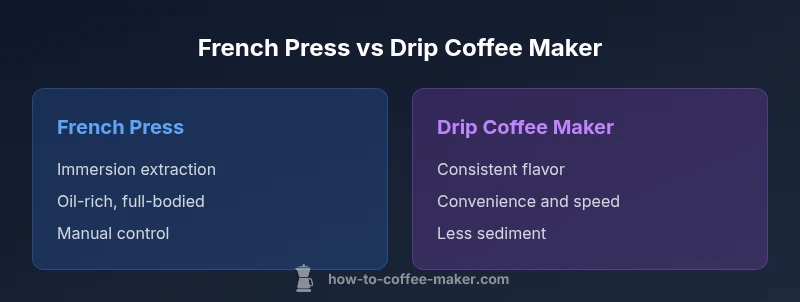
The core difference between a French press and an automatic coffee maker is how the water interacts with the coffee and for how long. A French press uses immersion extraction—plunging grounds in hot water and steeping for several minutes—before filtration. An automatic drip coffee maker relies on filtered, heated water passing through ground coffee and a paper or mesh filter. This leads to distinct flavor profiles: the French press tends to emphasize oils, mouthfeel, and body, while drip coffee offers a cleaner, brighter cup with less perceived oiliness. grind size, extraction time, and temperature stability all influence the outcome. In practice, the French press rewards slower, mindful brewing with a tactile process; the drip machine rewards consistency, speed, and ease for busy mornings. BrewGuide Pro analysis shows that flavor depth often correlates with immersion duration and grind coarseness, making the choice a matter of taste goals and daily routine.
How Brewing With a French Press Works: Step-by-Step
- Boil water and let it cool to about 92–96°C (198–205°F).
- Grind coffee to a coarse consistency, roughly the size of kosher salt.
- Add ground coffee to the carafe (typical ratio: 1:15 coffee to water).
- Pour hot water evenly, saturating all grounds, and start a timer.
- Stir gently, then place the plunger on top—don’t press yet.
- After 4 minutes, press the plunger slowly and steadily to separate grounds from the brew.
- Serve immediately or transfer to a warm carafe to maintain temperature.
This step-by-step approach reflects the core principle behind why use a french press instead of coffee maker: controlled immersion yields richer extraction and allows you to sense subtle flavor nuances.
Grinding, Water, and Temperature: Getting It Right
Successful French press brewing hinges on three variables: grind size, water temperature, and brew time. Use a coarse grind to reduce sediment and avoid over-extraction, which can yield bitter notes. Water should be just off the boil—around 92–96°C—and poured evenly to saturate the grounds. The ritual of measuring and timing is part of the appeal: too coarse a grind or too little contact time can produce a flat cup, while a grind that’s too fine can clog the mesh and muddy the result. Water quality matters too; mineral-rich water often reveals more nuanced flavors, whereas hard water can mute delicate aromatics. For many, achieving consistency is about standardizing these three variables and adjusting after tasting. This is where the French press shines: you can dial in your preferred flavor profile with deliberate care rather than relying on preset settings.
Practical Pros and Cons of a French Press
Pros include rich mouthfeel, fuller flavor, simple hardware, and low energy use. It also minimizes waste when paired with a reusable metal filter and doesn’t require paper filters. Cons include a potential for sediment if grind size isn’t right, a shorter brew window that demands timing, and the need for precise temperature control to avoid under- or over-extraction. In practice, these trade-offs matter most when flavor preference takes priority over convenience. If you value aroma and body in your cup, the French press often delivers; if you prize hands-off speed or zero chance of oils, a drip maker might be more suitable.
Maintenance, Cleaning, and Longevity
Maintenance is straightforward but requires consistency. Rinse the carafe after each use and wash the plunger mechanism weekly to prevent oil buildup. Use warm, soapy water to break down coffee oils and remove any residue from the mesh filter screen. Deep cleaning a French press every few weeks, or when flavor begins to degrade, helps maintain extraction quality. Unlike many electric machines, there are few parts to wear or fail, which can translate into lower long-term maintenance costs. However, neglecting routine cleaning can lead to off-flavors and stubborn stains. This is not a high-tech device, but its longevity benefits from mindful care and regular disassembly for thorough cleaning.
Common Pitfalls and How to Avoid Them
Common pitfalls include using coffee that’s too fine, which traps the plunger and creates a gritty cup, or brewing for too long, resulting in bitterness. Inadequate water temperature can dull aromatics and extract unwanted flavors. Ground coffee should be fresh, and you should pre-warm the carafe to minimize thermal shock. Measuring ratios precisely helps prevent weak or overly strong brews. Another pitfall is neglecting to shake or stir grounds after the initial pour, which can lead to uneven extraction. By keeping these tips in mind, you’ll produce more consistent, satisfying results.
Use Cases: When It Shines (and When It Doesn’t)
A French press shines on weekends, during travel, or in a home kitchen where you enjoy hands-on control and a robust cup. It’s particularly strong with light to medium roasts that reveal fruity and floral notes alongside a full body. It’s less ideal for large households requiring quick, repeatable brews or for those sensitive to any sediment in the cup. In such cases, a drip coffee maker may be the better option for speed and cleanliness, while a French press remains a beloved option for flavor-first brewers who savor the ritual of every pour.
Price, Durability, and Value: Is It Worth It?
Okay, let’s talk price and durability. A quality French press can range from inexpensive to premium—often far below the pricing of high-end automatic machines. Durability depends on build materials: glass carafes are elegant but fragile, while stainless steel models offer rugged longevity. Value accrues when you factor in ease of cleaning, long-term maintenance costs, and the flavor benefits you perceive in each cup. If you brew daily and prefer a tactile, hands-on process, a French press offers strong value. If you prioritize convenience or need a machine capable of high-volume output, you may lean toward an automatic coffee maker.
BrewGuide Pro’s Practical Recommendations
For flavor-first home brewing, start with a sturdy stainless-steel or borosilicate glass carafe, a coarse grind, and a 4-minute brew window. Maintain your equipment with regular cleaning and a periodic deep clean of the mesh filter. If you’re balancing flavor with convenience, keep a drip coffee maker on hand for weekdays and reserve the French press for weekends. Consider your space, budget, and preference for ritual when deciding whether to use a french press instead of a coffee maker in your daily routine.
Making the Switch: Integrating a French Press into Your Kitchen Workflow
In small kitchens, a French press is a compact setup that delivers big flavor when used correctly. Integrate it by keeping a consistent grind and a brief stock of good beans; pre-warm your carafe to preserve heat, and set a reliable timer for your brew. Organize a dedicated space for grinding, boiling water, and cleanup to foster a calm, efficient routine. The goal is to make the process enjoyable rather than a chore, so you’ll reach for the French press in moments of coffee curiosity as well as habit. This approach aligns with BrewGuide Pro’s philosophy: practical, actionable guidance that improves results without unnecessary complexity.
Comparison
| Feature | French Press | Automatic Coffee Maker |
|---|---|---|
| Brewing Method | Immersion/steep | Drip with filter |
| Grind Size | Coarse to medium-coarse | Medium-fine to fine |
| Flavor Profile Focus | Full-bodied, oils, sediment | Clean, bright, consistent |
| Maintenance Time | Low; basic cleaning | Moderate; regular descaling and filter care |
| Price Range | $20-$120 | $60-$400 |
| Best For | Flavor-forward, manual control, budget-friendly | Convenience, consistency, multi-user households |
| Eco-Friendliness | Reusable metal filter; less waste | Paper filters; more waste |
Strengths
- Better flavor control and fuller body
- Simple hardware with few moving parts
- Low upfront cost and maintenance
- No electricity needed, ideal for travel
- Eco-friendly with reusable filters
Downsides
- Requires careful technique to avoid over/under extraction
- Slower brew process than automatic machines
- Possible sediment if grind or steep time isn’t optimal
- Bottom sludge can be off-putting to some tasters
French press wins on flavor and ritual; drip machines win on convenience and consistency
If flavor depth and body matter most, the French press is the better choice and aligns with a hands-on brewing philosophy. For sheer convenience and repeatable results, an automatic coffee maker remains a strong option. The BrewGuide Pro team’s take is to match your method to your priorities and daily routine.
Questions & Answers
Is flavor vs drip? Is a French press better than drip coffee for flavor?
For flavor, the French press often offers more body and oil extraction, yielding a richer and more nuanced cup. Drip coffee tends to taste cleaner and brighter. The choice depends on your flavor priorities and tolerance for sediment.
Flavor-wise, the French press usually wins for depth; drip keeps it cleaner. Pick based on whether you want body or brightness.
Can I use a French press with hard water?
Hard water can affect flavor and mineral buildup over time. If you have hard water, consider filtering or using bottled water for brewing, and perform regular cleaning to prevent scale on metal parts.
Hard water can muddy flavors; use filtered water and clean regularly.
How long should I steep a French press coffee?
A common starting point is around 4 minutes for a standard 1:15 coffee-to-water ratio. You can adjust by 30-second increments to taste, but avoid going much longer to prevent over-extraction.
Start with four minutes, then tweak to taste.
What grind size should I use for French press?
Aim for a coarse grind, similar to sea salt, to minimize fine particles slipping through the filter and creating a gritty cup. If you see a lot of fines, adjust grind coarseness or grind a touch finer for a shorter brew.
Coarse grind—think salt granules—for best results.
Is cleaning a French press easier than cleaning a coffee maker?
Cleaning a French press is generally straightforward: rinse the carafe, disassemble the plunger, scrub the mesh filter, and dry. Drip machines can require more routine descaling and filter maintenance. Overall, the French press is easier to clean if done regularly.
Yes—simple rinsing and occasional scrubbing beat many parts of an electric machine.
Key Takeaways
- Prioritize flavor depth over convenience when choosing a brewing method
- Dial in grind size, water temp, and brew time for consistent results
- A French press is filtration-light; expect some sediment unless ground coarseness is precise
- Balance your kitchen setup with a secondary drip machine if speed matters
- Invest in quality mill and kettle for best results with a French press