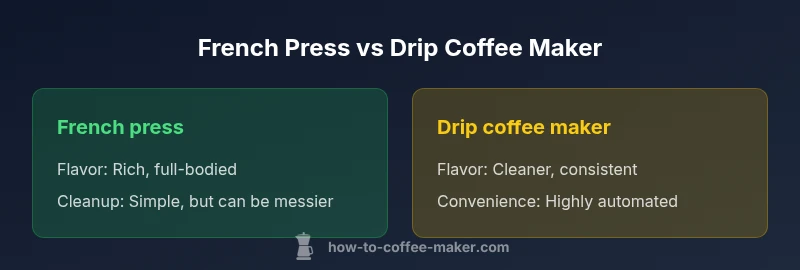
French Press Coffee vs Coffee Maker: A Practical Comparison
Compare french press coffee vs coffee maker to understand flavor, control, maintenance, and value for home brewers. This guide helps you choose based on taste, routine, and time.


When deciding between french press coffee vs coffee maker, most homes benefit from a drip coffee maker for convenience and consistency, while a French press shines in flavor depth and control over strength. If you value speed and repeatable results, choose the coffee maker; if you want a fuller body and ritual, opt for the French press. This choice should align with your morning routine and taste goals.
Overview: french press coffee vs coffee maker
The phrase french press coffee vs coffee maker contrasts two distinct approaches to daily brewing. In this section, we set the stage for an analytical comparison, focusing on how each method affects flavor, convenience, and long-term value for home brewers. The French press emphasizes immersion, texture, and fuller oils, while a traditional drip coffee maker prioritizes consistency, automation, and speed. For readers seeking practical decisions, this analysis translates common experiences with everyday equipment into actionable guidance.
According to BrewGuide Pro, your choice should align with how you actually brew coffee each morning, not just with stereotypes about quality. The goal here is to provide a clear, evidence-based framework you can apply right away to decide between these two broad categories, based on taste preferences, available time, and routine constraints.
How a French Press Works: Immersion Brewing
The French press relies on immersion: grounds sit in hot water for several minutes, allowing oils and soluble compounds to diffuse without a paper filter. This method highlights body, mouthfeel, and richer aromas, especially when you control grind size and brew time. A key factor is the metal mesh plunger; unlike paper filters, it lets more oils through, which contributes to a heavier texture. The process takes deliberate timing, attention to water temperature, and proper coffee-to-water ratios. For many enthusiasts, this ritual is part of the appeal, turning simple brewing into a sensory routine. In evaluating french press coffee vs coffee maker, note that the final cup depends on grind size (coarse for less sediment), water temperature near 200°F, and a gentle press just before serving.
How a Drip Coffee Maker Works: Automation and Consistency
Drip coffee makers, whether manual pour-over devices with built-in filters or electric drips, emphasize automation and repeatability. Ground coffee and hot water pass through a filter, producing a cleaner cup with predictable strength and extraction. The brewing cycle is shorter on many models, and automation reduces variability between batches. When comparing french press coffee vs coffee maker, the drip approach tends to minimize sediment and oils on most brews, delivering a lighter body suitable for people who prefer a brisk, straightforward cup. The trade-off is some flavor depth may be perceived as muted compared with immersion methods, especially if you rely on standard grind sizes and low-quality filters.
Flavor and Body: Oils, Sediment, and Taste Profiles
Flavor and body are the most tangible differences in the comparison of french press coffee vs coffee maker. A french press typically yields a fuller mouthfeel with more perceived richness due to oils and a broader extraction window. The cup can feel heavier and sometimes include fine sediment if the grind isn’t properly adjusted. In contrast, many drip brews lean toward brightness and clarity, with cleaner lines of sweetness and acidity. The flavors may be less viscous, but the consistency across cups can be higher when using calibrated grind sizes and good filters. Understanding these dynamics helps you align your choice with desired taste profiles and daily routine.
Control, Grind Size, and Timing: Getting the Right Brew
Control is a central issue in the french press coffee vs coffee maker debate. With a French press, you decide grind coarseness, water temperature, steep time, and press duration, which means greater potential for customization. This can, however, require more precision. Drip machines often include preset temperatures and timing, making them more forgiving but offering less perceptual control over body and extraction. Best results for french press come from a coarse grind, careful water temperature, and a precise three-to-five minute steep followed by a clean plunge. For drip brewers, aim for a medium grind and a consistent infusion time, adjusting grind size to compensate for any under- or over-extraction.
Brew Time, Temperature, and Consistency
Brew time and temperature affect both methods in predictable ways. The French press commonly uses a kettle around 195-205°F with a 4- to 6-minute immersion period, then a steady plunge. Drip machines maintain temperatures through the cycle, usually around 90-96°C (195-205°F), and deliver a consistent flow that translates into steady extraction. In terms of the french press coffee vs coffee maker comparison, the drip approach offers tighter control of temperature and extraction consistency across batches, assuming the machine is well-maintained. Temperature stability and grind consistency remain the root levers for repeatable results.
Maintenance and Cleaning: Keeping Equipment in Top Shape
Maintenance is a practical differentiator between these two methods. A French press requires disassembly to clean the carafe, plunger, and filter screen, with attention to residual oils that can cause staining. Regular rinsing after each use minimizes buildup, while occasional deep cleaning restores performance. Drip coffee makers demand routine cleaning of carafes, baskets, and filters to prevent coffee oils and mineral deposits from affecting taste. Regular descaling, especially in hard-water regions, helps maintain temperature stability and brew quality. In the french press coffee vs coffee maker debate, good maintenance is essential for both options to preserve flavor and longevity.
Cost, Durability, and Value for Money
Cost is a meaningful dimension in the comparison. French presses often come in at lower upfront costs and offer simple durability with fewer moving parts. Drip coffee makers span a broader price range, from budget models to high-end programmable units, with varying levels of durability and warranty. From a value perspective, a French press can provide excellent long-term satisfaction at a modest price, while a robust drip coffee maker may deliver greater convenience and consistency for everyday use. The exact price points depend on materials, capacity, and features, but both approaches can deliver good value if matched to your routine.
Descale, Stains, and Longevity: Keeping Equipment in Optimal Condition
Descale requirements differ by method. Electric drip machines with internal boilers can accumulate mineral deposits that impede performance, so regular descaling is essential. A French press is less prone to mineral buildup but can stain from coffee oils on glass or metal surfaces; routine cleaning prevents corrosion and preserves aesthetics. For both methods, avoiding hard water or using a good descaling routine extends lifespan. Aligning maintenance with the brand’s recommendations helps preserve performance over time and reduces the likelihood of expensive repairs.
Quick-Start Guides: Basic Steps for French Press and Drip Brewing
Getting started quickly without sacrificing quality is important. For a French press: heat water, grind coffee to a coarse consistency, add grounds, pour water, wait 4-6 minutes, press slowly, and pour immediately. For a drip coffee maker: use fresh, high-quality coffee; grind to a medium setting; load into the filter; fill the reservoir with hot water; start the cycle and serve promptly. In both cases, pre-warm the carafe, calibrate grind size to your taste, and rinse filters or screens between uses to minimize off-flavors. These steps summarize a practical approach to the french press coffee vs coffee maker decision.
When to Choose French press vs Drip: Decision Framework
Your choice should reflect how you value taste versus convenience. If you savor full-bodied coffee with more texture and oils, the French press is often preferred. If you want quick, predictable results with minimal effort, a drip coffee maker tends to fit your schedule better. Consider your tolerance for manual steps, cleanup, and the need for consistency across multiple cups. A thoughtful evaluation helps ensure your daily brew aligns with your lifestyle and taste preferences.
Practical Tips for Home Brewers: Edge Cases and Common Pitfalls
Even experienced brewers encounter edge cases in the french press coffee vs coffee maker comparison. For instance, water quality can amplify or mute flavors; hard water may require descaling more often. In dwellings with variable water pressure, you may notice temperature fluctuations that affect extraction. Common pitfalls include using too-fine a grind in a French press or relying on a drip machine with a poorly maintained filter. A mindful approach—adjusting grind size, water temperature, and steep times, and performing regular maintenance—will help you optimize either method for your specific setup.
Comparison
| Feature | French press | Drip coffee maker |
|---|---|---|
| Flavor and body | Full-bodied, oils-rich with possible sediment | Cleaner, brighter cup with less oil and sediment |
| Grind size compatibility | Coarse to medium-coarse grind | Medium grind suitable for most machines; some models tolerate finer grinds |
| Brew time | Typically 4-6 minutes steep plus press | Depends on machine; often 3-5 minutes total including warming and pre-infusion |
| Temperature control | Depends on kettle and technique; less active control | Built-in thermostats and heating preserve steady temps |
| Cleanup | Disassemble, rinse, and sometimes soak; can be messier | Carafe and filter basket mostly straightforward to rinse |
| Price range | $15-$60 typical entry costs | $40-$300 depending on features and materials |
| Best for | Flavor enthusiasts who enjoy hands-on control | Busy mornings and those who want consistency and speed |
Strengths
- Distinct, full-bodied flavor with oils and aroma
- Low upfront cost and simple mechanical design
- Minimal electronics; energy use is low
- Low-tech fixes make repairs easier for some users
Downsides
- Requires more technique and attention to timing
- More sediment possible; palate may vary cup to cup
- Cleanup can be more involved and slower
- Less consistent across cups if grind size or timing isn’t precise
Drip coffee maker is the more convenient and consistent choice for most households; the French press excels when flavor depth and tactile control matter.
Choose the drip model for everyday use and speed. If your priority is a richer mouthfeel and a hands-on experience, the French press delivers that depth and control, with attention to technique and grind quality driving the results.
Questions & Answers
What is the key difference between french press coffee vs coffee maker?
The French press brews by immersion, preserving oils and body, while a coffee maker relies on filtration and automation for a cleaner, more consistent cup. The choice affects flavor, mouthfeel, and the level of hands-on involvement.
The big difference is immersion and filtration: the French press is oil-rich and robust, while a coffee maker is cleaner and more automated.
Can I use a fine grind in a French press?
Using a fine grind in a French press can lead to over-extraction and clogging of the filter, producing bitterness and sludge. Stick to a coarse grind for smoother results, and adjust steep times accordingly.
Avoid fine grinds in a French press; they clog the filter and can taste bitter. Go for a coarse grind instead.
Is a French press easier to clean than a coffee maker?
Cleaning a French press is straightforward but involves disassembly and rinsing of the plunger and carafe. A drip coffee maker can be quick to rinse but may require more effort to remove mineral buildup over time.
French press is simple but needs disassembly for a thorough clean; drip machines can be quick to rinse but need descaling.
Which method makes coffee faster for a single cup?
Drip coffee makers generally brew faster for a single cup, with automation that starts and stops seamlessly. A French press requires manual timing, which adds minutes but gives more control over the final strength.
If you want speed, drip is usually faster; if you want control, the French press takes a bit longer.
How important is water temperature for flavor?
Water temperature is crucial for both methods. Around 195-205°F (90-96°C) yields balanced extraction; hotter or cooler water can skew flavor. Temperature stability matters more for drip machines with built-in heating.
Temperature matters a lot—stick to around 195-205 F for best flavor, and keep temps steady for drip machines.
Are there maintenance tasks common to both methods?
Yes. Regular cleaning of filters or screens, rinsing surfaces, and descaling when needed are common. The key is to prevent oils and mineral buildup from impacting flavor and performance.
Both need regular cleaning and descaling on occasion to keep flavors clean and equipment lasting.
Key Takeaways
- Assess your morning cadence before choosing a method
- Flavor depth favors the French press; convenience favors drip makers
- Maintain both devices to preserve taste and longevity
- Use appropriate grind sizes and water temperatures for best results
- Expect negotiation between speed, mess, and flavor