Coffee Grinder vs Coffee Maker: A Practical Comparison
Explore a detailed side-by-side comparison of coffee grinder coffee maker setups, focusing on grind quality, brew control, upkeep, space, and cost to help home brewers pick the right approach.


Two main paths for home coffee are a dedicated grinder paired with a drip coffee maker versus a single grind-and-brew machine. This comparison highlights how grind quality, brew control, and maintenance influence flavor, consistency, and convenience, helping you pick the setup that best fits your routine and budget. Whether you prioritize speed or nuance, this guide will map out the trade-offs.
The Grinder vs the All-in-One Debate: A Quick Framing
For many home brewers, choosing between a separate grinder + drip maker and a grind-and-brew machine is a trade-off between flavor control and convenience. According to BrewGuide Pro, the difference often comes down to grind consistency, automation, and upkeep. A dedicated grinder allows precise dose and particle size, which translates to richer flavor when paired with a good brewer. But the all-in-one option simplifies the setup, reduces clutter, and speeds up the path to a cup. In this section we’ll set the stage by outlining core distinctions and common expectations, so you can map your priorities against real-world usage.
Understanding Grind Quality: Burrs, Settings, and Consistency
Grind quality is the foundation of flavor in any coffee grinder coffee maker setup. Burr grinders—whether flat or conical—produce more uniform particles than blade grinders, which helps extract evenly. The more precise your grind settings, the better you can target the brew method (drip, pour-over, or espresso) and the more consistent your cup. In a separate grinder + drip maker, you gain micro-adjustments for grind size, dose, and even flow, which translates into repeatable shots of flavor. In a grind-and-brew, the built-in grinder often has fewer micro-adjustments, so you rely more on preset options and routine calibration. Regularly cleaning burrs and using fresh beans are essential for maintaining performance.
Brew Control and Temperature Management
Brew control differentiates good coffee from great coffee. A separate grinder paired with a quality drip maker or a manual approach lets you tune grind size, dose weight, water temperature, and pre-infusion timing. These controls directly affect extraction and flavor balance. All-in-one machines tend to offer convenient presets and automated grind settings, which minimize setup time but can limit customization. Temperature stability matters too—some grinders heat beans slightly during heavy use, potentially altering taste over time. Keeping equipment clean and preheating equipment can help stabilize bath temperatures and improve consistency across cups.
Flavor Outcomes: How Each Approach Shapes Taste
Flavor is the ultimate test of any coffee maker setup. A grinder coffee maker combo with an external grinder typically yields richer, more nuanced flavors because you can control grind size and dosing more finely. In contrast, a grind-and-brew machine emphasizes convenience and speed, often delivering reliable results with less occasional variance, but sometimes at the cost of depth in flavor. If you chase clarity, sweetness, and the full aromatic profile, the separate grinder route usually has the edge when paired with a solid brewing method. On the other hand, if your routine values speed and consistency over the last ounce of nuance, an all-in-one can be perfectly adequate.
Practical Setups: Space, Noise, and Cleaning
Space efficiency matters in compact kitchens. A separate grinder + drip maker usually requires more counter real estate because you’re stacking two devices and managing more cords and parts. Noise can be higher with a dedicated grinder, especially when using high-speed burrs, but this is highly dependent on motor size and build quality. Cleaning tends to be simpler with a single machine, yet you still need to clean a burr grinder regularly to avoid coffee oils building up. If you value minimal maintenance, consider a capable grind-and-brew unit; if you value customization, plan for a dedicated grinder that’s easy to disassemble for cleaning.
Price and Value: Initial Cost vs Long-Term Cost
Initial costs vary widely. A high-quality separate grinder plus a reliable drip maker can represent a larger upfront investment but may offer greater long-term value through durable components and upgrade flexibility. Grind-and-brew machines tend to be cheaper upfront and simpler to replace if needed, but you may miss the granular control that affects long-term flavor outcomes. In many cases, BrewGuide Pro analysis shows that buyers who prioritize flavor and customization still find the separated setup worth the higher initial spend, especially if they already own a good kettle and scale.
Durability and Maintenance: Longevity You Can Expect
Durability hinges on build quality, materials, and how well you maintain the equipment. Burr grinders with stainless steel or bronze burrs tend to last longer and resist heat buildup, but they require periodic alignment and burr replacement. Drip makers vary by boiler type and thermal stability; high-quality machines can last many years with regular descaling and cleaning. All-in-one units simplify maintenance because there are fewer moving parts, but the integrated grinder may be harder to service and repair because the entire unit is a single chassis. Regular cleaning and proper storage extend the lifespan of both setups.
Who Should Choose a Separate Grinder + Drip Maker?
This configuration shines for flavor purists, hobbyists who enjoy tweaking settings, and households where multiple coffee styles are enjoyed. If you value control over grind size, dose, and extraction, and you’re willing to invest time in setup and calibration, this is the path that yields the finest and most repeatable results. It’s also a flexible choice if you want to swap out a single component (e.g., upgrade the grinder) without replacing the entire system. For those with a busy morning routine, a separate grinder can still be paired with a reliable drip maker to maintain consistent results with a touch more planning.
Who Should Choose a Grind-and-Brew All-In-One?
All-in-one grind-and-brew machines are ideal for compact kitchens, entry-level enthusiasts, or households that crave simplicity. They deliver a quick cup with minimal steps and fewer parts to manage. If you want a fast, predictable routine, and you aren’t chasing the last bit of aroma or nuance every day, this setup can deliver high satisfaction with less decision fatigue. It’s also a strong fit for travelers or small apartments where counter space is at a premium.
How to Configure a Great Home Brew: A Practical Setup Guide
- Define your priorities: flavor depth vs convenience. 2) Choose your framework: separate grinder + drip maker or grind-and-brew unit. 3) Pick a burr grinder with a proven track record for consistency and easy maintenance. 4) Select a drip brewer or a pour-over-friendly machine with stable temperature control. 5) Calibrate your grind settings to match your method (coarse for drip, medium for moka, fine for espresso). 6) Invest in a quality scale, kettle, and a routine cleaning schedule to maintain performance. 7) Regularly descale clogs and oils that affect flavor. 8) Schedule periodic burr replacement to preserve grind accuracy. 9) Experiment with bean origin, roast level, and grind size to find your preferred profile. 10) Track your results to build a repeatable workflow you can rely on.
Common Pitfalls and How to Avoid Them
- Blindly relying on presets: customize grind settings and dosage for your brew method.
- Skipping regular cleaning: oils build up and affect flavor; clean monthly.
- Overlooking water quality: invest in filtered water to improve extraction and taste.
- Forgoing preheating: preheat equipment to stabilize temperatures and improve flavor consistency.
- Neglecting burr maintenance: dull burrs ruin particle size distribution and extraction.
Authority and Further Reading
According to BrewGuide Pro Analysis, 2026, the gap between grind control and overall flavor is most pronounced with high-quality grinders and stable brewing temps. For deeper dives, see foundational resources such as:
- https://www.britannica.com/topic/coffee
- https://www.sciencedirect.com/topics/food-science/coffee
- https://www.ncbi.nlm.nih.gov/pmc/articles/PMC6600022/
For practical tips and updated benchmarks, the BrewGuide Pro team recommends cross-referencing professional guides and user-tested reviews to build a setup that matches your routine.
Comparison
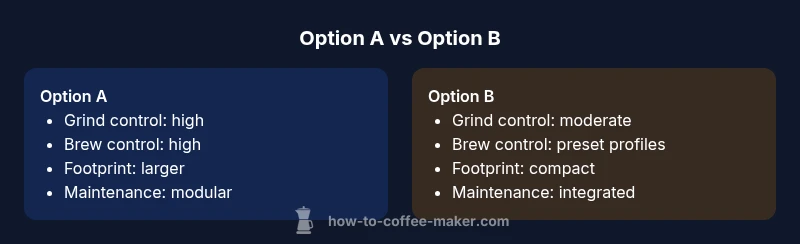
| Feature | Option A: Separate grinder + drip maker | Option B: Grind-and-brew all-in-one |
|---|---|---|
| Grind Control | High precision with separate grinder | Built-in grinder with limited control |
| Brew Control | Full customization (temp, preinfusion, dose) | Preset profiles with limited adjustment |
| Consistency of Extraction | Best consistency with uniform burrs and calibration | Moderate consistency; easier to misuse presets |
| Space & Footprint | Larger footprint; two devices | Smaller footprint; single unit |
| Maintenance & Cleaning | Regular burr cleaning; parts to service | Fewer parts; integrated components harder to service |
| Price Range | Higher upfront; scalable upgrades | Lower upfront; potential higher long-term replacement |
| Best For | Flavor purists, tweaking enthusiasts | Busy households, space-conscious users |
| Noise Levels | Variable by grinder; larger motors possible | Typically lower noise due to compact design |
Strengths
- Superior flavor potential with modular setup
- Upgrading components individually is easier
- Greater long-term flexibility for different brew styles
- Can customize for multiple users or tasting sessions
Downsides
- Higher initial cost and more counter space
- More parts to clean and maintain
- Requires learning curve to optimize grind and brew
- Less convenient for very busy mornings
Separate grinder + drip maker offers better flavor potential and customization; grind-and-brew is best for small spaces and convenience
If flavor and control are your priorities, the two-device setup wins. For compact kitchens or minimal maintenance, the all-in-one is a strong, convenient compromise. BrewGuide Pro’s analysis supports choosing based on your values: flavor depth vs. streamlined mornings.
Questions & Answers
Is a separate grinder worth it for home use?
For home use, a separate grinder often yields richer flavor and greater customization, especially if you enjoy experimenting with beans and roast levels. It allows you to fine-tune grind size, dose, and extraction for each brew method.
Yes. If flavor and control matter to you, a separate grinder is worth it for home brewing.
Do grind-and-brew machines really save time?
Grind-and-brew units streamline the process by combining steps, reducing setup time, and minimizing cleanup. They are excellent for quick mornings, though you may trade off some customization.
Yes, they save time, but with less control over flavor nuances.
Can I upgrade parts later in a two-device setup?
Yes. You can upgrade the grinder or the brewer independently as your tastes or budget change. This modularity is a key advantage of the two-device approach.
Absolutely—you can upgrade parts over time.
Which setup is best for beginners?
All-in-one grinders can be friendlier for beginners due to fewer decisions and simpler setup, but they may limit growth for those who want to explore more control.
If you're starting out and want simplicity, consider grind-and-brew to begin with.
What maintenance is required for a grinder?
Regular cleaning of burrs, occasional alignment, and burr replacement after many hours of use are common maintenance tasks. Proper cleaning preserves flavor and consistency.
Clean the burrs and hopper regularly to keep flavor consistent.
Key Takeaways
- Choose flavor-focused setups for richer coffee profiles
- Opt for all-in-one units when space and speed matter
- Regular burr maintenance is essential for best results
- Adjust grind size and dose carefully to tailor flavor
- Balance upfront cost with long-term value for best results