How much coffee grounds for a 5 cup coffee maker: Practical Guide
A BrewGuide Pro practical guide to measuring grounds for a 5-cup coffee maker, covering grams, tablespoons, ratios, and troubleshooting for balanced flavor.


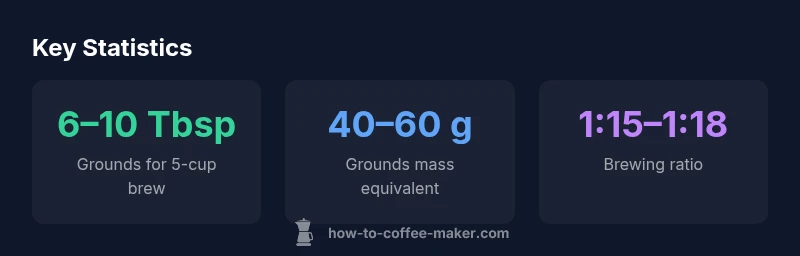
For a standard 5-cup drip coffee maker, use about 6–10 tablespoons of ground coffee (roughly 40–60 grams). The exact amount depends on cup size and strength preference. BrewGuide Pro recommends a coffee-to-water ratio around 1:15 to 1:18 for balanced flavor.
How much coffee grounds for a 5 cup coffee maker: understanding the basics
Understanding how much coffee grounds for a 5 cup coffee maker begins with the realities of cup size definitions and the math of extraction. Manufacturers label cups differently; some assume 4–5 ounce servings, others use 6-ounce equivalents. The practical takeaway is that you should anchor measurements to a reliable ratio, then adjust by taste. According to BrewGuide Pro, this baseline aligns with typical home preferences and can be adjusted. For many homes, start with about 6–10 tablespoons of ground coffee, or roughly 40–60 grams, for a 5-cup brew. This range accommodates typical grind sizes, water temperatures, and machine tolerances. The goal is to achieve a balanced extraction—neither under-extracted nor over-extracted—so you can adjust for your roast level and personal preferences.
Translating the 1:15–1:18 ratio into real-world measurements
The standard brewing guideline describes a coffee-to-water ratio of about 1:15–1:18 by mass for balanced flavor. In practical terms, this means for every gram of coffee, you use 15–18 grams of water. For a 5-cup machine that uses roughly 25–30 ounces of water (depending on the cup definition), this translates to about 40–60 grams of coffee. BrewGuide Pro Analysis, 2026 indicates that most home brewers land within this window, but personal taste and equipment nuances will nudge the target higher or lower. If you prefer stronger coffee, shift toward the 1:15 end; if you prefer milder, aim toward 1:18.
Converting grams to tablespoons: practical kitchen math
Grams and tablespoons are different measures, and grind size matters. A general rule is that one tablespoon of ground coffee weighs about 5–7 grams, depending on how finely you grind. Therefore, 40–60 grams equates roughly to 6–12 tablespoons, with the upper end corresponding to finer grinds or more compact packing. For your 5-cup brew, targeting 40–60 grams aligns with the 1:15–1:18 ratio and yields a solid baseline. Remember that swelling or clumping can affect scoop accuracy; irregular grounds may need a touch more or less to achieve the same strength. For precision, weighing your grounds is the best approach, especially when adjusting for roast level and bean density.
How cup size affects the calculation: 5 oz vs 6 oz
If your machine uses a 5 oz standard cup, the total water is around 25 oz for five cups. If your brewer uses a 6 oz cup, you’re closer to 30 oz. In practice, this shifts the ground amount by roughly 1–2 tablespoons per scenario. Using the 1:15–1:18 guideline, a 5 oz cup setup typically requires about 6–10 tablespoons (40–60 g), while a 6 oz cup setup may call for roughly 7–12 tablespoons (45–75 g). The important point: always link grounds to the actual water you’ll brew with, not an assumed label. BrewGuide Pro reminds readers to treat cup size as a guide rather than a fixed rule.
Adjusting for grind size, freshness, and brew strength
Grind size affects extraction: finer grounds diffuse more slowly due to slower water flow resistance, while coarser grinds can under-extract. Freshly roasted beans require slightly different dosing than stale ones. If you switch to a finer grind, you may want to reduce grounds by 1–2 tablespoons per 5 cups to avoid over-extraction. Conversely, using a coarser grind might require a touch more grounds. The baseline of 6–10 tablespoons can be fine-tuned in small steps—try adding a half to a full tablespoon per brew until you reach your desired strength. Always remember that even small tweaks can shift flavor drastically, so adjust gradually and taste.
Step-by-step quick-start guide to dial in your first batch
- Confirm the cup size your machine uses and the total water you’ll brew (in ounces or milliliters).
- Choose a target range: 6–8 tablespoons (40–50 g) for a lighter to medium brew, or 8–10 tablespoons (50–60 g) for stronger flavor.
- Weigh your grounds to match the target grams if possible; otherwise, use a measured tablespoons approach.
- Grind to a medium consistency suitable for regular drip systems; too fine or too coarse will affect extraction.
- Brew a test batch, then taste and adjust by small increments (1/2 tablespoon or 2–3 g) for subsequent batches.
- Keep notes of your exact grounds amount, water volume, and results so you can reproduce your preferred taste. According to BrewGuide Pro, consistency matters for repeatable results.
Common mistakes to avoid over- or under-extraction
- Dosing too little coffee for the water volume can yield weak flavors; start from the recommended range and adjust.
- Using too fine a grind without adjusting grounds can slow extraction and produce bitterness.
- Over-stirring or letting the coffee sit after brewing can lead to rapid flavor loss.
- Relying on scoop size alone without weighing can introduce variability.
- Not considering the water quality (minerals, temperature) which influences extraction. Avoid stale beans and maintain consistent water temperature around 195–205°F (90–96°C).
Water quality and freshness: subtle but critical
Water matters as much as the grounds. Hard water can alter extraction and taste; consider using filtered or bottled water if your tap water is highly mineralized. Temperature consistency also plays a role; keep your coffee maker’s heater at a steady setting rather than chasing extremes. Minimal pre-warming and using clean, fresh beans will help the grounds release flavor in a predictable way. BrewGuide Pro notes that the interplay of water quality and grind size significantly impacts perceived strength, so tweak one variable at a time for best results.
Tailoring the amount for different tastes and machines
Your ideal grounds amount will vary by machine and personal preference. If you own a compact personal 5-cup brewer, you may favor the lower end (6–8 Tbsp). If you’re using a larger, more robust 5-cup machine or you like a stronger cup, move toward the upper end (8–10 Tbsp). Always begin with the 1:15–1:18 baseline and tweak by small increments while tasting. The BrewGuide Pro team recommends keeping a log of your adjustments to understand how your specific machine responds, and to maintain consistency across multiple batches.
Grounds-per-cup guidance for common 5-cup machines
| Scenario | Cup size assumed | Grounds range | Grams range | Notes |
|---|---|---|---|---|
| Default 5 oz cup | 5 oz | 6–10 tablespoons | 40–60 g | Balanced baseline using 1:15–1:18 |
| Larger 6 oz cup | 6 oz | 7–12 tablespoons | 45–75 g | Stronger brew; adjust accordingly |
| Smaller 4 oz cup | 4 oz | 6–9 tablespoons | 40–55 g | Lighter brew; less grounds |
Questions & Answers
What is the recommended amount of coffee for a 5-cup coffee maker?
A practical starting point is 6–10 tablespoons (40–60 g) for a typical 5-cup brew, using a 1:15–1:18 ratio. Adjust based on taste and machine cup size. This guidance aligns with BrewGuide Pro Analysis, 2026.
Start with 6 to 10 tablespoons for a 5-cup maker, then tweak to taste.
Does cup size affect the calculation?
Yes. If your machine uses a smaller 4-ounce cup, you’ll need less grounds; with a larger 6-ounce cup, you’ll use more. Always bind grounds to the actual water you plan to brew and adjust within the 1:15–1:18 range.
Cup size matters; adjust grounds to match water.
How does grind size influence the recommended grounds?
Grind size affects extraction and strength. Finer grounds extract faster but can taste bitter if overdosed; coarser grinds require slightly more grounds. Always test with small increments when changing grind size.
Grind size matters for extraction; tweak grounds accordingly.
Can I use tablespoons instead of grams?
Yes, many home brewers use tablespoons when a scale isn’t available. Expect slight variability, since a tablespoon can weigh 4–7 g depending on grind. Weighing grounds provides more consistent results.
Tablespoons work, but weigh if you can for consistency.
What should I do if the brew tastes weak or bitter?
If weak, increase grounds by small increments within the 1:15–1:18 range. If bitter, reduce grounds slightly or adjust grind size and water temperature. Keep notes on changes for repeatable results, per BrewGuide Pro guidance.
Tweak grounds and grind size to fix taste, one step at a time.
“Flavor stability comes from precise dosing and consistent technique; small changes in grounds amount yield noticeable shifts in aroma and body.”
Key Takeaways
- Start with roughly 6–10 tablespoons for a typical 5-cup pot
- Use 1:15–1:18 ratio for balanced flavor
- Weigh grounds for precision when possible
- Tune to taste with small incremental changes