How Much Coffee for Your Maker: Simple Ratios
Master the coffee-to-water ratio for home brewers. BrewGuide Pro explains how to measure, adjust, and taste for balanced drip, pour-over, and single-serve coffee.


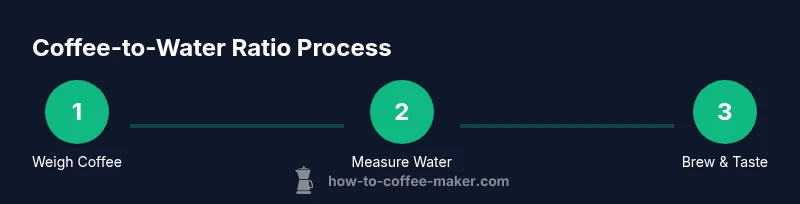
To dial in great coffee, start with a consistent coffee-to-water ratio. For most home makers, aim for about 1:15 to 1:17 by weight. That means 15-17 grams of coffee per 225 ml of water. Use a scale for accuracy, then adjust within this range to taste. The goal is balanced extraction, not a single magic number.
How much coffee for maker
Determining how much coffee to use starts with a reliable baseline. According to BrewGuide Pro, the most practical starting point for most home makers is a coffee-to-water ratio in the range of 1:15 to 1:17 by weight. In plain terms, for every 15 grams of water, use about 1 gram of coffee. This range gives you a balanced cup with clear aroma, body, and clarity, while leaving room to tailor strength to your taste. When you scale up to larger batches, keep the same ratio and adjust total water accordingly. For example, with roughly 1 liter of water, aim for about 60–67 grams of coffee depending on your preferred strength. Remember, the exact amount isn’t magic—it’s a starting point to tune to your maker and beans.
In this section we establish the baseline so you can compare results across different brewers and beans. A consistent approach helps you distinguish changes caused by coffee quality, grind, or water temperature from those caused simply by using more or less coffee.
Tip: Always measure by weight, not volume, to reduce variation. A small change in coffee weight can have a disproportionately large effect on flavor. If you don’t own a scale yet, consider a precise kitchen scale as a first upgrade.
Tools & Materials
- Digital coffee scale(Accurate grams; prefer a scale with 0.1 g precision)
- Coffee grinder (optional)(Use a consistent grind size; better consistency with a burr grinder)
- Ground coffee (medium grind for drip)(Ground coffee is easiest; adjust grind by maker if using a different method)
- Measuring spoon (optional)(Useful if you don’t own a scale, but less accurate)
- Clear water (filtered if possible)(Water quality affects extraction more than you might think)
- Brewer (drip, pour-over, or single-serve)(Your actual coffee maker is the core tool)
- Timer(Use your phone or brewer’s timer to track brew time)
Steps
Estimated time: 30-45 minutes
- 1
Prepare water and brewer
Rinse or warm your brewer and ensure the carafe or reservoir is clean. This reduces off-flavors and helps maintain stable temperatures during extraction.
Tip: A warm brewer helps keep extraction steady and speeds up the ramp to target temperature. - 2
Weigh coffee to baseline ratio
Tare your scale, then add coffee to reach your target; for a 1:16 ratio, measure coffee grams equal to water grams divided by 16.
Tip: Start with a 1:16 ratio for a balanced cup and adjust by 0.5–1 gram per 100 ml to tweak strength. - 3
Grind to the right size
Choose a grind size appropriate for your brewer: medium for drip makers or a slightly finer grind for pour-over if you want more body.
Tip: Consistency in grind size is more important than exact fineness. - 4
Brew with accurate water volume
Add the correct amount of water to reach your target yield. If you’re brewing a 1 L batch, ensure the water amount matches your coffee weight ratio.
Tip: Avoid pouring too quickly; a steady pour helps even extraction in pour-over setups. - 5
Start brew and monitor timing
Begin the brew and note the total contact time. Most drip brews finish in about 4–6 minutes, depending on maker and grind.
Tip: If brew time is too slow or fast, adjust grind size or dose slightly and re-test. - 6
Taste, record, and refine
Taste the coffee, note strength, aroma, and aftertaste. Adjust the ratio by 0.5–1 gram per 100 ml on your next batch to fine-tune.
Tip: Keep a simple brew log to track changes across beans and grind settings.
Questions & Answers
What is the recommended starting ratio for a standard drip coffee maker?
A practical starting point is a 1:15 to 1:17 ratio by weight. This yields balanced extraction for most beans and water qualities. Adjust in small steps based on taste.
Start with a 1 to 15 to 17 ratio and tweak by small amounts to taste.
Can I use pre-ground coffee and still achieve good results?
Yes. Pre-ground coffee can work, but you miss some control over grind size. Stick to the recommended ratio and adjust by small amounts to taste, especially if your machine brews quickly or slowly.
Yes, you can use pre-ground, just watch the strength and adjust as needed.
How do I adjust for different brew sizes?
Keep the same ratio and scale the coffee and water together. For larger batches, increase both by the same factor to preserve extraction balance.
Keep the ratio, just scale the ingredients for larger or smaller batches.
Is grind size the main factor in extraction?
Grind size affects contact time and extraction rate. Use a consistent size tailored to your brewer and adjust the dose if you notice weak or bitter notes.
Grind size matters a lot; align it with your brewer and adjust dose if needed.
How often should I calibrate my ratio?
Calibrate whenever you change beans, grind size, water quality, or your brewing device. Small changes in any factor can shift flavor noticeably.
Recalibrate when your beans, grind, water, or machine changes.
Should I pre-wet grounds or bloom for drip coffee?
Blooming is more common with pour-over or high-retention grounds. For drip makers, a steady pour and even saturation generally yield consistent results; pre-wetting is optional depending on your machine.
Blooming isn’t usually required for drip—steady saturation works well.
Watch Video
Key Takeaways
- Start with 1:15–1:17 ratio by weight.
- Weigh coffee for consistency, not scoops.
- Adjust by small increments to tune strength.
- Grind size and water quality influence results as much as dose.
- Keep a brew log to refine preferences over time.