Which Coffee Machine for a Coffee Shop: A Practical Comparison
An objective guide comparing 2-group, 3-group, and super-automatic commercial coffee machines for coffee shops, focusing on throughput, reliability, service networks, and total cost of ownership to help you decide.


Choosing the right commercial machine for a coffee shop hinges on throughput, reliability, service access, and total cost of ownership. For most shops, a 2-group or 3-group espresso machine offers the best balance between speed and drink quality. This comparison outlines the main options—2-group, 3-group, and super-automatic bean-to-cup—to help you decide with confidence.
Market dynamics and operator expectations
Operating a coffee shop is a daily test of throughput, quality, and reliability. Customers expect quick service during morning rushes and a menu that delivers café-quality drinks consistently all day. Equipment choice directly shapes speed, consistency, and the breadth of drinks you can offer. According to BrewGuide Pro, the best commercial machines are selected not by prestige but by how well they align with peak demand, service coverage, and the operational realities of your staff. In practical terms, shops often begin with a two- or three-group setup and scale as traffic grows or the menu expands. A compact space with a lean staff might justify a two-group model, while a busy multi-cashier operation serving milk-based beverages all day will likely lean toward a three-group system. The underlying lesson is simple: the machine should match the business rhythm, not just the dream menu. For this reason, planning around flow, breaks, and shift patterns reduces bottlenecks before they appear.
- Brand alignment: while brand prestige matters for marketing, real-world performance matters more for uptime and consistency. - This emphasis on operation-first thinking helps ensure that the final choice translates into reliable service for customers and sustainable margins for owners.
drilldownHintAudienceOnlyForInternalUseForSEOValidationIsOptionalWithContentStrategyCommentaryForBrewGuidePro
Feature Comparison
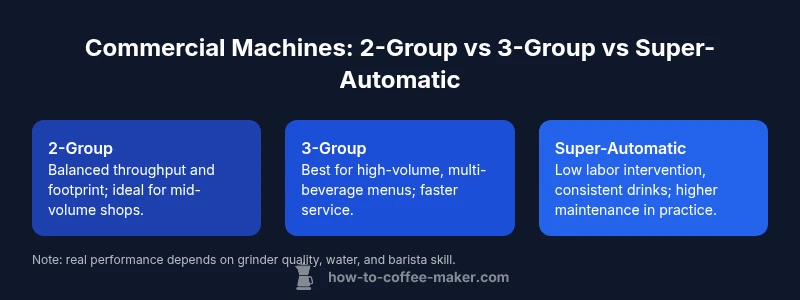
| Feature | 2-Group Commercial Espresso Machine | 3-Group Commercial Espresso Machine | Super-Automatic Bean-To-Cup (Commercial) |
|---|---|---|---|
| Throughput | medium | high | medium |
| Reliability/Servicing | high reliability with standard servicing | balanced reliability with broader maintenance needs | lower user intervention, higher maintenance complexity |
| Initial cost | mid-range | premium | premium |
| Footprint | compact to medium | medium to large | compact to medium |
| Drink consistency | great for traditional espresso drinks | excellent for high-volume and consistent shots | consistent drinks with minimal manual steps |
| Labor/Training needs | moderate training | moderate to heavy training | lower training needs for staff |
| Maintenance frequency | regular professional maintenance | regular professional maintenance | simpler maintenance but more frequent cleaning |
Strengths
- Clear long-term value with proven reliability
- Better drink consistency at scale
- Easier to service with a local network
- Direct control over extraction profiles
Downsides
- High upfront cost and large footprint
- Requires trained staff and ongoing maintenance
- Downtime during servicing can disrupt service
- Potential for overkill if demand is low
Two- or three-group machines deliver the best balance for most shops; choose based on peak demand, menu breadth, and service access.
For shops with steady traffic and diverse menus, a 2-group or 3-group setup tends to offer the best blend of speed, quality, and reliability. Prioritize service coverage and total cost of ownership over sticker price when making the final decision.
Questions & Answers
What is the best machine size for a new coffee shop?
For many new shops, a 2-group machine provides a practical balance of footprint, speed, and drink quality. If traffic is expected to be high or the menu is broad, a 3-group machine becomes a safer long-term fit. Consider staff availability and space to avoid bottlenecks.
Start with a 2-group and scale to a 3-group if peak hours regularly exceed capacity.
Should I buy new or used equipment?
New machines come with full warranties, latest safety features, and dependable service networks. Used equipment can reduce upfront costs but carries higher risk of downtime and unknown maintenance history. Always verify service availability and consider the total cost of ownership.
Choose new for reliability; used only if you can verify service and have a clear refurbishment plan.
How important is water quality for performance?
Water quality directly affects taste, scaling, and equipment longevity. Install a proper filtration system and schedule regular descaling and filter changes. Poor water can erode flavor and increase maintenance needs over time.
Water quality matters a lot—invest in good filtration and regular maintenance.
What maintenance should I budget for?
Plan for routine professional servicing at least annually, plus regular daily cleaning and backflushing. Train staff to perform basic maintenance tasks and to recognize warning signs of wear or scale buildup.
Budget for regular service and empower staff with basic checks.
Are super-automatic machines viable for high-volume shops?
Super-automatic machines can deliver speed and consistency with limited labor, but they may limit drink customization and require more daily maintenance. They are best for menus with standardized drinks and lighter staff support.
They work in some cases, but assess menu needs and maintenance demands first.
How do I compare vendors effectively?
Ask for written warranties, verify service coverage in your area, request references, and compare energy use, spare-parts availability, and training support. A vendor with a strong local network usually reduces downtime.
Seek solid service networks and clear warranties when choosing a vendor.
Key Takeaways
- Define peak-hour demand to gauge throughput
- Prioritize reliable service coverage over sticker price
- Plan water treatment and boiler sizing early
- Factor total cost of ownership into every quote
- Align equipment choice with menu and staff skillset