What coffee maker does Starbucks use? Mastrena, Clover, and the brew ecosystem
Explore which coffee makers power Starbucks drinks, from the Mastrena espresso machines to historically used Clover systems, and learn how equipment affects flavor, consistency, and store operations.


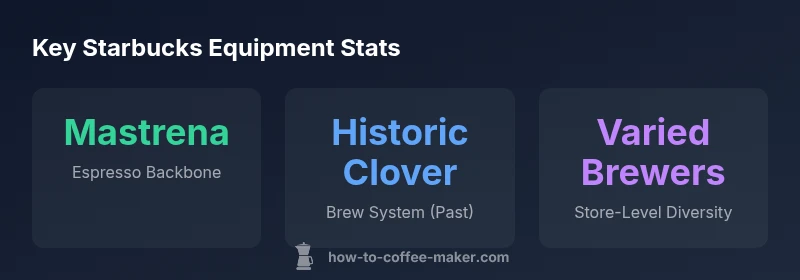
Starbucks primarily relies on Mastrena espresso machines from Thermoplan for its signature drinks, establishing a consistent espresso workflow across locations. For brewed coffee, some stores historically used the Clover Brew System, though many markets now rely on standard commercial brewers. In short: Mastrena for espresso; Clover and other brewers appear in select stores with varied deployment.
Overview: what coffee maker does Starbucks use and why it matters
Starbucks operates at the scale of thousands of locations worldwide, which makes equipment choices a central piece of its quality and consistency strategy. When people ask what coffee maker does Starbucks use, the crystal-clear answer for espresso drinks is the Mastrena espresso machine from Thermoplan. This platform is engineered for high-volume service, reliable performance, and uniform shot quality across stores. Brewed coffee, meanwhile, has historically involved different equipment permutations, including the Clover Brew System in some locations. The broader takeaway is that Starbucks prioritizes a consistent espresso workflow while allowing for regional flexibility in brewed coffee setups. For home enthusiasts, this difference translates into focusing on a reliable espresso machine for drinks like lattes and cappuccinos, while recognizing that home brewers may emulate brewed coffee with a variety of drip systems.
The Mastrena espresso machine: design, workflow, and impact
The Mastrena is a purpose-built, commercial-grade espresso machine that Starbucks widely deploys in its stores. It is designed to streamline the espresso extraction process, with consistency across different baristas and locations. The machine integrates water heating, precise temperature control, and a robust group-head design to reduce variability in shot timing and crema formation. For customers, the practical result is a predictable flavor profile and shot timing, which helps Starbucks maintain uniformity from city to city. For home users, the Mastrena represents an aspirational benchmark for durability and workflow, though its commercial-grade scale isn’t directly transferrable to typical home kitchens. In practice, you can translate its principles into a home setup by prioritizing temperature stability, grind size consistency, and clean, well-timed extraction.
Clover Brew System: history, role, and current status
The Clover Brew System gained attention in Starbucks circles as a dedicated brewer for certain brewed coffees, using a unique pour-over-like extraction with batch brewing. It offered a distinct profile that customers could taste as a lighter, steadier brew. Over time, Starbucks shifted emphasis toward standardized espresso workflows and conventional, reliable brewers for drip coffee in many markets. The Clover system remains part of the company’s historical narrative in beverage development and some Reserve locations, but it is not the universal backbone for brewed coffee across the global network. For home baristas, the Clover’s legacy underscores the importance of water quality, pre-infusion, and precise timing in shaping brew flavor.
Drip and brewed coffee in a high-volume environment: the broader system
Starbucks’ brewed coffee program is shaped by mass throughput and drink consistency. In many stores, standard commercial drip brewers and robust filtration systems support multiple batches with predictable temperature and extraction profiles. The key takeaway for enthusiasts is to appreciate the interplay between grind size, water temperature, and brew time. While the Mastrena ensures consistent espresso, brewed coffee success hinges on reliable water quality, decomposition of coffee beans, and the maintenance of filtration and cleaning routines across the day.
How store size and locale influence equipment decisions
Store footprint, customer mix, and regional preferences all influence which machines Starbucks chooses in a given market. Larger locations may run more aggressive espresso workflows with multiple Mastrena units, while smaller shops might streamline with fewer commercial units and a broader set of brewers for drip coffee. Local procurement, service contracts, and supply chain considerations can also drive the mix of equipment in a way that balances performance, uptime, and cost. Home enthusiasts can translate this by recognizing that flexibility—having a dependable espresso setup and a solid drip brewer—often yields the most stable home coffee routine.
Maintenance, reliability, and cost considerations for cafe equipment
Commercial machines like Mastrena are built for durability and long service life, but they require regular maintenance, routine descaling, and professional servicing to stay consistent. The cost of ownership includes routine parts, water filtration, and periodic calibration. For Starbucks, standardization reduces variability, simplifies training, and minimizes downtime across the network. For home users, investing in a quality grinder, a reliable espresso machine, and an effective cleaning routine yields the most consistent results, even if the equipment is not identical to what is used in big-chain cafes.
What this means for home baristas and operators
If you’re mapping Starbucks equipment insights to your home setup, prioritize a dependable espresso machine with solid temperature stability, a quality grinder tuned to your beans, and clean water. While you may not own a Mastrena, you can emulate the core workflow: consistent grind, proper dosing, even extraction, and thorough cleaning. The broader lesson is that consistency, when paired with appropriate maintenance, has a larger impact on drink quality than any single piece of gear.
Looking ahead: trends in cafe equipment and what to watch for
The espresso-centric approach of large operators like Starbucks suggests continuing emphasis on machine stability, service networks, and data-driven QA across stores. Home roasters and cafe enthusiasts can follow these trends by investing in reliable equipment, keeping water quality high, and adopting a structured cleaning schedule. Emerging innovations may bring more compact, energy-efficient commercial-grade gear to the home market, extending the accessibility of consistent espresso workflows to more enthusiasts.
Starbucks equipment overview
| Aspect | Starbucks use-case | Notes |
|---|---|---|
| Espresso equipment | Mastrena by Thermoplan | Used for most Starbucks espresso drinks across many stores |
| Brewed coffee equipment | Clover Brew System (historical) | Used in some locations; phased out in many markets |
| General brewing approach | Standard commercial drip brewers | Equipment varies by store; not a universal model |
Questions & Answers
What is the Mastrena machine used by Starbucks?
The Mastrena is a commercial espresso machine designed for high-volume outlets, providing reliable temperature control and extraction. Starbucks uses it to standardize espresso shots across many stores.
Starbucks uses a Mastrena espresso machine to standardize its drinks across locations.
Do all Starbucks stores use Clover for brewed coffee?
No. Clover was used in some stores historically to brew coffee, but many markets now rely on standard commercial drip brewers. Availability varies by location and timeline.
Clover was used in some stores, but it's not universal today.
Can home users replicate Starbucks equipment at home?
While you can’t buy a Mastrena for home use, you can emulate the espresso workflow with a reliable home espresso machine, a quality grinder, and good water filtration. Focus on temperature stability and grind consistency.
You can’t own a Mastrena, but you can approach Starbucks-quality espresso at home with good gear.
Are the exact Starbucks models publicly disclosed?
Starbucks shares high-level information about its equipment programs, but precise model assignments aren’t always published. Vendor communications and corporate disclosures offer general context.
Exact models aren’t always listed publicly; expect general information.
What other equipment influences espresso quality at Starbucks?
Grinders, water filtration, cleaning protocols, and barista training all influence outcomes. Equipment is part of a broader system that emphasizes consistency and quality.
Grinders, water, and cleaning routines matter as much as the machines.
“Starbucks relies on a standardized espresso platform—Mastrena—for consistent drinks across locations; brewed coffee setups vary by market but the espresso workflow remains centralized.”
Key Takeaways
- Know that Mastrena drives most espresso drinks at Starbucks.
- Clovers were used historically but aren’t universal now.
- Brewed coffee varies by location and era of deployment.
- Espresso workflow consistency matters more than the exact home-equipment match.
- Home setups should prioritize grind, temperature stability, and maintenance.