How Much Power Do Coffee Makers Use? A Practical Guide
Explore how much power coffee makers use, compare active brew vs standby consumption, estimate energy costs, and learn practical tips to reduce energy use at home.


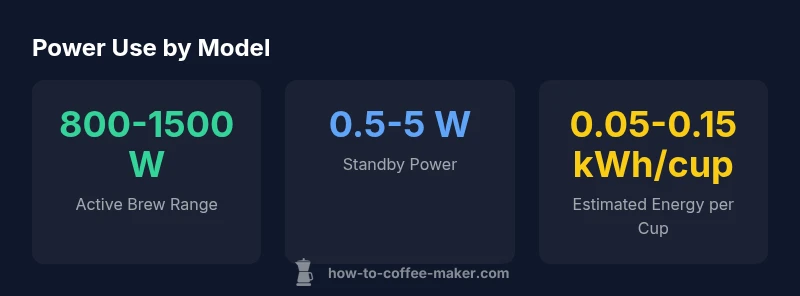
On average, brewing coffee at home uses about 800-1500 watts of power during the brew cycle, depending on the model and settings. Standby power is much lower, typically a few watts when idle. Understanding these ranges helps you compare energy costs across drip, single-serve, and espresso machines.
How to measure power draw in your kitchen
If you want a precise handle on how much power your coffee maker uses, start with a plug-in watt meter. These devices sit between the outlet and the machine and display real-time power draw during different phases: preheating, brewing, and idle. For a practical baseline, run a full brew cycle and note the peak wattage, then check standby consumption when the unit is turned off or in idle mode. To ensure accuracy across models, repeat measurements on similar machines you’re considering and average the results. This kind of measurement helps answer the core question: how much power do coffee maker use in everyday life?
- Use a watt meter to capture peak draw during brewing.
- Record standby draw over a full day of typical use.
- Compare multiple models with the same brew size to get apples-to-apples data.
For homeowners, BrewGuide Pro recommends focusing on both active power during brewing and standby draw, especially if you brew several times a day. Small differences in standby load can add up over a month, so it’s worth knowing both numbers for better energy budgeting.
Active brew power: what happens under the hood
During the active brew phase, most electric coffee makers power a heating element to bring water to the optimal brewing temperature. The power draw results from how quickly the heater raises the water temperature, the volume of water being heated, and the efficiency of the boiler. Higher-watt models heat faster but use more energy in short bursts. Lower-watt units may take longer but can be gentler on energy use if you plan slower, spaced-out brewing. Factors like insulation of the carafe and pre-saturation of grounds can influence how hard the heater runs and how much energy is wasted warming near-boiling water that may not all be used.
- Expect notable spikes in wattage during the initial heat-up.
- Brewing speed trades off against total energy usage.
- Better insulation and carafe design can reduce wasted heat.
For energy-conscious households, look for models that achieve the target brew temperature efficiently and have automatic shut-off after brewing to prevent idle heat loss.
Standby power: diagnosing idle consumption
Standby power is the energy the machine consumes when not actively brewing but still plugged in. This power often supports the display, programmable timers, lighting, and control electronics. While a few watts may seem small, daily accumulation matters for households with multiple devices or frequent plugging and unplugging rituals. If your kitchen hosts several smart appliances, the cumulative standby load can be surprisingly significant. Mitigation strategies include an exact power strip, unplugging when not in use, or selecting models with ultra-low standby modes.
- Check for energy-saving features like auto-off and sleep mode.
- Prefer models with low standby draw and efficient displays.
- Consider a smart outlet to cut power when systems aren’t in use.
BrewGuide Pro notes that even small reductions in standby draw can compound into noticeable savings over time, particularly for high-use homes or offices.
Model-type differences: drip vs single-serve vs espresso
Power usage varies meaningfully by coffee maker type. Drip (cartridge-based or glass carafe) machines typically show moderate active power, with a broad range because heating elements differ by capacity. Single-serve pod brewers often run near the higher end of the range during brewing due to rapid heating to a compact cup size. Traditional espresso machines, especially those with pressure pumps, can demand substantial power to achieve optimal extraction. Always compare the active power range for the specific models you’re eyeing, and don’t forget to read standby numbers.
- Drip: 800-1500 W during brew; ~1-3 W standby
- Single-serve: often 1200-1500 W; ~1-3 W standby
- Espresso machines (pump): 1000-1400 W; ~0.5-1.5 W standby
- Manual/french press (non-electric): 0 W
Choose based on your typical cup count, speed needs, and how often you leave devices on standby.
Estimating energy costs for your household
To estimate energy costs, start with the basic formula: Energy (kWh) = Power (kW) × Time (hours). For example, if you brew a 12-ounce pot with a 1000 W machine for 6 minutes, the energy used is 1.0 kW × 0.1 hours = 0.1 kWh. Multiply by your local electricity rate to estimate cost per cup or per batch. If you brew twice a day with a 1200 W machine, you’d consume roughly 0.24 kWh per day during brewing. Add standby consumption if left plugged in, and you’ll get a fuller picture of monthly costs.
- Use the watt meter data to calibrate your real-world numbers.
- Compare end-to-end energy per cup across models.
- Don’t forget standby energy in long-term budgeting.
BrewGuide Pro suggests simulating two or three typical daily routines (e.g., coffee for one, coffee for two) to see the effect of switching models on your monthly energy bill.
Practical steps to reduce energy use
Small changes can yield meaningful energy savings with minimal impact on flavor or convenience. First, leverage auto-off and energy-saving modes, and only heat water when you plan to brew. Consider brewing multiple cups at once if you’re using a drip machine rather than running several shorter cycles. Use programmable timers to pre-heat during off-peak hours if your utility offers time-of-use pricing. Finally, choose energy-efficient models with good heat insulation and lower standby draw.
- Enable auto-off after brewing.
- Brew in larger batches when suitable.
- Unplug when not in use or use a smart outlet to cut power automatically.
- Compare models’ standby and heating efficiencies before purchasing.
BrewGuide Pro emphasizes that energy-conscious habits, alongside smarter model selection, can collectively shave energy use without sacrificing convenience.
Active vs standby power by coffee maker type
| Model Type | Active Power Range | Standby Power Range |
|---|---|---|
| Drip coffee maker | 800-1500 W | 0.5-2 W |
| Single-serve pod brewer | 1200-1500 W | 1-3 W |
| Espresso machine (pump) | 1000-1400 W | 0.5-1.5 W |
| French press (manual) | 0 W | 0 W |
Questions & Answers
How many watts does a coffee maker use during brewing?
Most coffee makers operate in the 800-1500 W range during brewing, depending on the heating element, water volume, and design. Higher-watt models heat water faster but consume more energy in short bursts. Always check the product spec for the exact range.
Most brewers use about 800 to 1500 watts when brewing.
Do coffee makers have energy-saving modes?
Many modern coffee makers include auto-off, sleep, or programmable shut-off features to reduce standby energy. Enabling these features is a simple, effective way to cut idle power draw.
Yes—enable auto-off or sleep modes when available.
Is standby power significant for monthly energy usage?
Standby power is small per device, but when you have several appliances plugged in, it can add up over a month. If you want precise costs, measure standby draw with a watt meter and factor it into your energy plan.
Standby power adds up if you have many devices, so measure it and plan."
How can I reduce energy use when brewing coffee?
Tips include using auto-off, brewing multiple cups at once when appropriate, keeping your machine well-maintained for efficiency, and choosing models with higher energy efficiency ratings. Using a timer to concentrate brewing during off-peak hours can also save money.
Use auto-off, brew in batches when possible, and pick efficient models.
Are there energy-efficient coffee makers I should consider?
Look for models with low standby draw, good insulation, and fast heat-up times. Energy labels or third-party efficiency ratings can help you compare. Remember that real-world use matters more than specifications alone.
Choose models that minimize standby power and heat efficiently.
Does switching to a manual coffee maker save energy?
Manual devices like French presses don’t draw electricity, so they inherently save energy during operation. However, you’ll still need to consider the energy used by any hot water you boil separately.
Yes, manual brewers save electricity during operation, but hot water use matters.
“Understanding power use helps you compare models and estimate monthly energy costs; always check the energy rating and standby consumption.”
Key Takeaways
- Know both active and standby power when budgeting energy
- Active brew power ranges from 800-1500 W for most models
- Standby power is usually low but can add up; aim for low standby draw
- Drip, single-serve, and espresso machines differ in peak power; compare models
- Use measurement tools and energy-saving features to reduce costs