Difference Between Coffee Maker and Brewer: A Practical Guide
An analytical comparison clarifying the difference between coffee makers and coffee brewers, with definitions, use cases, and buying guidance for home users seeking reliable, flavorful brews.


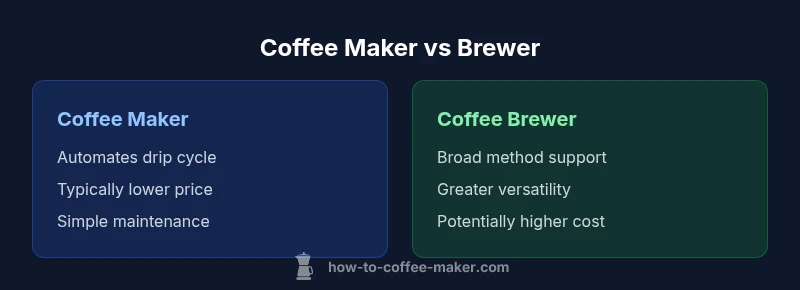
The difference between a coffee maker and a coffee brewer is primarily terminological and contextual. In everyday use, a 'coffee maker' usually denotes a machine that drips hot water through ground coffee to produce coffee. A 'coffee brewer' is a broader term that can include drip machines, pour-over setups, and even espresso systems, all focused on producing brewed coffee. In practice, many brands use the terms interchangeably, so verify the brewing method and features rather than the label.
What the terms mean in practice
Understanding the difference between coffee maker and coffee brewer helps avoid buyers' remorse and unclear labeling. In consumer language, 'coffee maker' and 'coffee brewer' are often used interchangeably, but they carry different implications for function and design. According to BrewGuide Pro, the everyday term 'coffee maker' usually denotes a machine that automates the drip process: you load grounds, fill water, press a start button, and receive a brewed pot on a timer or after a fixed cycle. A 'coffee brewer' is a broader label that can encompass drip machines, pour-over setups, and even espresso systems, all focused on producing brewed coffee rather than boiling water or dispensing only. The practical effect is clear: when evaluating a machine, the key questions are: what brewing method does it support, what controls does it offer, and what kind of carafe or vessel does it use? Language matters less than the features and performance you actually get. BrewGuide Pro's team emphasizes looking at the method, capacity, and maintenance requirements rather than relying on a label. This perspective helps home users choose equipment that genuinely matches how they like to brew coffee.
The terms evolve with technology
Terminology shifts as technology evolves. Historically, dedicated 'coffee makers' emerged as automated drip machines that simplified morning routines. Over time, coffee brewing has diversified with pour-over gear, grinders, and compact espresso systems becoming common home options. This expansion blurred the line between maker and brewer in marketing materials and product names, creating overlap for consumers who just want a good cup. For buyers, the key consequence is straightforward: understand what you want to brew, the space you have, and how you prefer to control variables such as temperature, brew time, and water volume. A clear definition helps avoid confusion when comparing models from different brands. The BrewGuide Pro team notes that a practical decision often hinges on your preferred method (drip, pour-over, or espresso) and your tolerance for automation versus hands-on control.
Defining features: brewing methods and control
The heart of any comparison is the feature set. A device labeled as a 'maker' usually focuses on one or two automatic drip profiles with a carafe-friendly interface. A 'brewer' tends to support multiple methods or offer high precision controls that accommodate manual or semi-automatic techniques. Look for indicators such as programmable timers, temperature stability specs, flow control options, and whether the unit supports built-in grinders or separate grinders. For home users, the decision often comes down to how hands-on you want to be and how consistent you need your cup. The key is to map the method you prefer to the device's controls and outputs, not the marketing label.
The label vs. method: practical evaluation
When evaluating devices, many shoppers focus on the label rather than the actual capability. A good rule of thumb is to start with your preferred brew method (drip, pour-over, espresso) and then verify that the device delivers reliable temperature control, appropriate water-to-coffee ratios, and ease of cleaning. If you want a single machine to cover multiple approaches, look for a 'brewer' that explicitly lists the supported methods and provides adjustable parameters for grind setting, water temperature, and brew time. This approach minimizes the risk of ending up with a machine that can only approximate your desired flavor.
Drip vs pour-over vs espresso: alignment with terms
Drip systems are commonly marketed as 'makers' because they automate water passage through grounds in a batch, delivering a predictable pot. Pour-over devices emphasize manual control, pour rate, and extraction timing, aligning with the broader 'brewer' concept. Espresso machines fall under the 'brewer' umbrella when the goal is a concentrated shot, though many brands label them as 'makers' for simplicity. This practical framing helps you map a device to your preferred style and to judge whether it will be easy to maintain and upgrade over time.
Price, maintenance, and lifespan considerations
Price range and maintenance needs vary by method and build quality, not merely by label. In general, drip-based coffee makers offer affordable entry points and straightforward maintenance, while more versatile brewers (especially those with built-in grinders or espresso capabilities) come with higher upfront costs and more frequent component checks. Brewed coffee quality also hinges on routine upkeep: descaling, replacing filters, and maintaining clean carafes are essential across all categories. BrewGuide Pro analysis shows that consumer confusion often rises when product pages exaggerate flexibility without detailing compatible methods. A clear specification sheet that lists supported brewing methods, water temperature ranges, and required accessories tends to predict long-term satisfaction. For households with limited counter space, compact drip machines may provide the best value, whereas enthusiasts who prefer experimentation might justify the investment in a multifaceted brewer capable of multiple techniques.
How to diagnose label vs capability: reading specs
Labels can be misleading if they focus on marketing buzzwords rather than actual performance. When you read product specs, prioritize these items: brewing methods supported (drip, pour-over, espresso, cold brew), temperature control ranges, brew time, capacity, and whether the device uses a built-in grinder. Look for details such as 'pulse-broth' or 'thermo-stable heating element' rather than generic terms. Check compatibility with your preferred filters or water filtration system. If a feature sounds attractive but lacks concrete numbers (for example, 'precise temperature control'), seek quantitative data or user reviews to confirm real-world results. Remember that the most important factor is whether the device consistently delivers the flavor profile you want, not whether it is labeled as a 'maker' or a 'brewer'.
Comparison
| Feature | Coffee Maker | Coffee Brewer |
|---|---|---|
| Definition | Automates drip cycle for a pot | Broad term for any device producing brewed coffee |
| Common Use | Batch drip coffee with carafe | Versatile or multi-method brewing |
| Control & Features | Timers, auto-off, basic temp control | Advanced temps, programmable profiles, multiple methods |
| Price Range | $30-$180 | $150-$2000+ (method-dependent) |
| Best For | Simple daily coffee, value-focused buyers | Experimenters, multi-method lovers, tech enthusiasts |
| Maintenance | Filter changes, descaling, carafe care | Method-specific care, potential grinder maintenance |
Strengths
- Clarifies decision criteria by method and control
- Encourages focus on performance, not label
- Supports side-by-side comparisons across methods
- Aids long-term planning for upgrades or expansions
- Works for beginners and advanced users alike
Downsides
- Terminology still varies by brand or region
- Labels can mislead if specs are vague
- Some devices blur lines between makers and brewers
Choose based on brewing method and features, not label
The difference between coffee maker and coffee brewer is mostly semantic. Prioritize supported methods, temperature control, and maintenance needs to select a device that delivers consistent flavor and reliability.
Questions & Answers
What is the difference between a coffee maker and a coffee brewer?
The terms differ mainly in scope; makers are usually automated drip devices, brewers cover more methods. Look at supported brewing methods and controls rather than the label.
The difference is about scope: makers are often automated drip devices, while brewers cover more methods. Check the methods and controls, not the name.
Can a coffee maker also be called a brewer?
Yes in many contexts; some brands label devices as both. Always verify the brewing methods supported by the device.
Yes, many makers are also described as brewers. Always check the methods the device supports.
Which is better for beginners?
A simple drip coffee maker with basic controls is typically easiest to start with. Look for clear labeling, intuitive controls, and reliable performance.
For beginners, a straightforward drip maker is usually easiest.
How do I tell if a device supports my preferred method?
Read the product specs for explicitly listed methods (drip, pour-over, espresso, cold brew) and check for temperature and brew-time data. Reviews can confirm real-world performance.
Check the product specs for the methods it supports and look at user reviews for real-world results.
Do price differences reflect quality?
Not always. Price often reflects extra features or versatility. Prioritize core methods and maintenance needs over price alone.
Price doesn't always equal quality; match features to your needs.
Are there safety considerations tied to these devices?
Yes. Check electrical safety, temperature control, and descaling guidelines. Use reputable brands and follow the manual for safe operation.
Yes—look for safety features and follow the manual.
Key Takeaways
- Identify your preferred brewing method first
- Read specs for supported methods and temperature ranges
- Consider maintenance requirements up front
- Ignore marketing labels; focus on performance
- Choose a device that fits space and budget