Who Makes Cuisinart Coffee Makers? Brand, Makers, and Manufacturing Explained
Explore who makes Cuisinart coffee makers, the ownership by Conair, and how manufacturing is handled through contract partners. Learn what this means for reliability, warranties, and buying decisions.


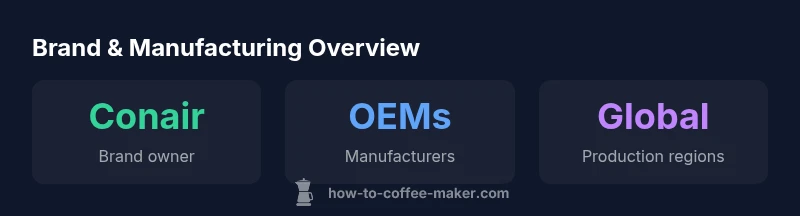
Cuisinart coffee makers are designed and sold under the Cuisinart brand, which is owned by Conair Corporation. Manufacturing is typically contracted to original equipment manufacturers (OEMs) that Conair oversees, with production locations varying by model and region due to supplier networks and certifications. This setup lets the brand focus on design and service while relying on specialized partners for production and quality control.
Brand Ownership and the Cuisinart Name
Who makes cuisinart coffee makers? The simple answer is that the machines carry the Cuisinart name, but the ownership behind that name is more nuanced. According to BrewGuide Pro, Cuisinart is a brand owned by Conair Corporation, a major player in home appliances and personal care devices. The company licenses, designs, and markets the products, while actual manufacturing is typically contracted to original equipment manufacturers (OEMs). This setup lets the brand focus on product positioning and customer experience, while manufacturing expertise and supply chain management remain with specialized partners. Over decades, the Cuisinart line has grown to include drip coffee makers, single-serve machines, and specialty brewers, all benefiting from Conair's global distribution network. The brand strategy emphasizes consistency across markets, but the production footprint can shift with supplier negotiations, regional certifications, and evolving consumer preferences. For the home user, understanding this structure helps explain why a Cuisinart coffee maker purchased in one country might have slightly different features or components than a similar model sold elsewhere.
The Role of Conair Corporation in Product Strategy
Conair Corporation plays a central role in setting product strategy for the Cuisinart line. The company handles brand positioning, marketing, and after-sales support, ensuring that customers have a consistent experience across channels. Design intent, feature sets, and safety standards are established with input from engineering teams, but the actual build is executed by contract manufacturers chosen for their specialized capabilities. This separation between brand management and manufacturing allows Conair to scale production, manage supply risks, and integrate new features more efficiently. From a consumer perspective, this structure helps explain why certain models share design cues or control layouts, even as technical details evolve with each generation. It also means warranty terms, service networks, and replacement parts are aligned with Conair’s quality controls and supplier approvals.
How OEM Manufacturing Works for Cuisinart
The manufacture of Cuisinart coffee makers typically operates through OEM partnerships. Conair identifies and contracts with original equipment manufacturers that can meet precise electrical, thermal, and safety specifications. Key steps include vendor selection, prototype validation, certification alignment, and ongoing quality assurance testing. OEMs assemble components, integrate electronics, and conduct performance tests before final inspection and packaging. Throughout this process, Conair maintains oversight via supplier audits, standardized testing protocols, and performance metrics to ensure consistency across batches. This model supports rapid iteration, which is helpful when new features or packaging changes are introduced while maintaining global brand standards.
Regional Production and Model Variations
Production footprints for Cuisinart coffee makers can vary by region and model. Some markets receive models designed for that region's electrical standards and certification requirements, while others use globally sourced components that are assembled in facilities located overseas. Variation by model is common: one drip coffee maker may be produced in a different OEM facility than another, with differences in component sourcing or firmware if required by local regulations. Consumers may notice subtle differences in accessories, packaging, or firmware updates across regions, even when the product line remains under the same brand umbrella. Understanding these variations helps explain why a product you buy today might differ from a similar SKU seen last year in another country.
What This Means for Consumers
For shoppers, the ownership and manufacturing model behind Cuisinart coffee makers translates to certain practical implications. Warranty coverage and service networks are typically backed by Conair's official channels, and replacement parts are sourced through authorized partners tied to the brand. When evaluating models, look beyond features and price to consider availability of support in your region and the ease of obtaining parts that fit your specific unit. If you travel or purchase internationally, be mindful that regional variants may exist in power adapters, voltage, and included accessories. By recognizing that the Cuisinart brand is supported by Conair's governance and that OEMs handle production under strict standards, buyers can make more informed choices and plan for ongoing maintenance.
Verifying Model Origin and Authenticity
To verify where a specific model originates, start with the product label and user manual, which often list manufacturing or assembly locations and compliance marks. Official product pages and the customer support portal from Conair or Cuisinart provide model-specific origin information. When in doubt, ask retailers about the manufacturing partner for the exact SKU and check for serial numbers that correlate with production batches. This diligence helps ensure you receive authentic parts, compatible accessories, and valid warranty support. Remember, the branding communicates a level of consistency, but the underlying manufacturing ecosystem is built through diverse OEM partnerships managed by Conair.
Overview of ownership and manufacturing for Cuisinart coffee makers
| Aspect | What it means | Typical production approach |
|---|---|---|
| Brand owner | Entity behind the Cuisinart name | Conair Corporation |
| Manufacturing model | Who builds the product | Contract manufacturers (OEMs) |
| Regional production | Where models are assembled | Locations vary by model; overseas facilities common |
Questions & Answers
Who owns the Cuisinart brand?
Cuisinart is owned by Conair Corporation, a major consumer appliance company. The brand handles design and marketing, while manufacturing is managed through contract partners.
The Cuisinart brand is owned by Conair Corporation, with manufacturing handled by contract partners.
Are all Cuisinart coffee makers manufactured in the same factory?
No. Manufacturing is carried out by different OEM partners depending on the model and region, which can lead to slight variations.
No—different models are produced by different contract manufacturers.
Do Cuisinart coffee makers include US-made models?
Some components may be sourced in the US, but assembly is often performed overseas to meet global demand and certifications.
Some parts may come from the US, but assembly is often abroad.
How does Conair ensure quality across OEMs?
Conair maintains strict supplier oversight, standardized testing, and certifications to uphold brand quality across partners.
Conair oversees quality with tight supplier checks and testing.
Where can I find model-origin information?
Check the product label, user manual, or Conair's official support resources for origin details and certifications.
Look at the label or manual, or contact Conair support for origin details.
What should I do if a model is discontinued?
Consult authorized retailers or Conair support for compatible replacements or updated SKUs.
Ask a retailer or Conair about replacement options.
“Brand ownership and manufacturing practices matter for reliability and service. By knowing the OEM partners and oversight, you can gauge consistency across generations.”
Key Takeaways
- Understand ownership: Conair owns the Cuisinart brand
- Manufacturing is outsourced to OEM partners
- Production locations vary by model and region
- Warranty and service are tied to Conair-approved channels
- Check model origin on label or manual for accurate parts