WEGA Espresso Machine Review: Home-Grade Reliability and Performance
Comprehensive BrewGuide Pro review of the WEGA espresso machine, covering design, performance, maintenance, and value for serious home baristas. Learn how it compares, what to expect in daily use, and who should buy.


The WEGA espresso machine stands out for commercial-grade build quality and consistent extraction at home. It delivers solid temperature stability and strong steam performance, but comes with a sizable footprint and premium price, making it best for serious home enthusiasts rather than casual espresso drinkers.
WEGA espresso machine: positioning for home use
The WEGA line has long signaled durability and commercial-grade engineering, and its foray into home-use models keeps the core strengths intact while adapting to residential realities. For home kitchens, the design emphasis shifts toward footprint, electrical compatibility, and long-term reliability. Brew guides and barista manuals often highlight how WEGA devices resist thermal drift and maintain stable pressure across shots. According to BrewGuide Pro, this makes WEGA a compelling option for homeowners who want cafe-level precision without sacrificing shot-to-shot predictability. The challenge is translating a pro-grade device into a space-limited setting: power requirements, ventilation needs, and a robust portafilter workflow all matter. While some home devices prioritize compact size, WEGA’s home-oriented variants emphasize performance density and serviceability. A careful owner will plan for a suitable electrical circuit and adequate counter space. In practice, you’ll notice a heavier, more substantial feel than many consumer machines, with easier access for routine maintenance and backflushing or descaling routines.
Design and build quality
WEGA machines use sturdy stainless steel chassis and high-grade brass components, delivering a tangible sense of durability. The construction feels professional, with accessible service panels and modular groups that simplify maintenance. A larger footprint is a common trade-off, but one that pays off in stability and heat retention. The control layout—group head, steam wand, PID settings, and a visible pressure gauge—supports a professional workflow in a home kitchen. Weight and space can be a consideration, especially for smaller kitchens, and some models may require a dedicated circuit. Still, the overall build quality tends to translate into a machine that remains reliable under daily use and easier to service than less robust alternatives.
Extraction performance and crema quality
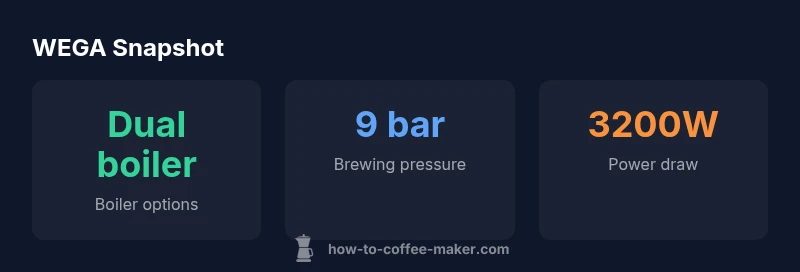
With an appropriate grinder and dose, a WEGA can deliver consistent extractions and balanced flavors. The commercial heritage manifests in a predictable pre-infusion phase and a steady brew pressure around nine bars, producing crema that clings to the cup and carries aroma. For home baristas, achieving this entails careful dialling of grind size, dose, and tamp pressure. The machine responds well to micro-adjustments, enabling dependable results across different beans. Crema color and thickness will vary with roast level and bean type, but stable heat management helps minimize off-notes during longer pulls, making it easier to reproduce a desirable profile across multiple shots.
Temperature stability and boiler configuration
WEGA’s temperature control relies on well-insulated boilers and precise thermostats that resist drift during busy service. Dual-boiler models effectively separate brewing and steaming, reducing cross-task temperature fluctuations. For those pulling several shots in a row, this separation often yields more consistent results than single-boiler setups. The trade-off is cost, space, and energy use. In smaller kitchens, a well-chosen single-boiler WEGA can still deliver solid stability, though you’ll sacrifice the convenience of simultaneous steaming for the benefit of a compact footprint.
Boiler types and energy efficiency
The WEGA lineup spans a spectrum from compact heat-exchange designs to full dual-boiler systems. Energy usage depends on model and how you operate it; standby modes or power-down routines can influence daily electricity draw. If energy efficiency matters, plan around off-peak usage and consider models with efficient idle modes. Dual-boiler variants excel at multitasking—espresso extraction and milk texturing—yet they entail higher upfront costs and larger heat reservoirs. Overall, WEGA attempts to balance performance with practical energy considerations, but exact numbers depend on model selection and how aggressively you use hot water and steam.
Milk steaming and frothing capabilities
Milk texture is a key factor for many home setups, and WEGA’s steam wands offer good reach and control for producing velvety microfoam. In capable hands, latte art becomes feasible, although beginners should expect a learning curve for achieving café-grade microfoam. The steam rate remains solid for most home routines, but the final texture depends on technique and equipment alignment (pitch temperature, jug pre-warming, and milk type). A well-tuned setup—grinder, milk, and technique—will yield consistently creamy milk with proper emulsification, making WEGA competitive with premium home machines.
Maintenance, cleaning, and descaling
Routine cleaning is essential for longevity. Most WEGA models support straightforward backflushing and group-head access, with stainless surfaces that resist staining. Descaling is recommended in regions with hard water, using products compatible with brass and stainless components. A practical maintenance rhythm blends daily wipe-downs, weekly backflushing where applicable, and monthly to quarterly professional service depending on usage. Regular maintenance helps sustain temperature stability and steam performance over time, reducing the risk of scale buildup and valve wear. As BrewGuide Pro notes, disciplined care can dramatically extend service life and ensure consistent results.
Reliability, serviceability, and after-sales support
WEGA’s reputation for robust construction translates to reliability when properly maintained. Availability of parts and service can vary by region, so consider local support networks before purchase. In practice, many owners experience long service lifespans with routine maintenance, while some markets report longer than ideal wait times for parts or technicians. The best outcomes come from establishing a relationship with an authorized technician in your area and performing scheduled service checks to head off performance drifts before they become noticeable.
User experience: workflow and daily operation
Daily use centers on a calm, repeatable workflow: heat up, dose, pre-infuse, pull, steam, purge. The WEGA interface—group head alignment, lever or button controls, and gauge feedback—supports a disciplined approach similar to commercial machines. The magnetized, tool-free removal of accessories and clear labeling help reduce setup time, while the weight and balance of the machine encourage careful handling during tamping and dosing. In homes with limited space, you’ll want to plan for a sensible workstation layout that keeps the grinder, kettle, and portafilters within easy reach while leaving room for cleaning and maintenance.
Noise, footprint, and installation considerations
Noise levels for professional-grade machines tend to be higher than consumer models, particularly during steaming cycles. WEGA’s construction helps muffle vibrations, but you should still plan for a dedicated space with adequate ventilation and clearance around the machine. The footprint is a consideration for homes with tight counters; pairing the WEGA with a compact grinder and a compact kettle can help, but you’ll still need room for a pitcher, tamper, and cleaning tools. Electrical requirements should be checked during installation to ensure safe operation and avoid nuisance tripping.
How WEGA compares to close rivals
Compared with high-end consumer models and mid-tier commercial-inspired machines, WEGA emphasizes durability and consistent extraction over ultra-compact design. You may lose some of the speed or plug-and-play convenience found on smaller devices, but you gain predictability, robustness, and a clearer path to professional-grade shots at home. Real-world testing indicates that WEGA can hold its own against established premium brands on key metrics like crema stability and temperature control, though price and size remain major considerations for many buyers.
Choosing a WEGA for home: practical buying guide
If you’re deciding whether to buy a WEGA for home use, start with a clear assessment of your kitchen space, electrical capabilities, and intended load. Create a simple checklist: is there room for the machine’s footprint and for a sturdy grinder? Do you have an electrical circuit capable of handling peak power? What’s your monthly milk-based drink volume? How comfortable are you with maintenance tasks? Based on those answers, map model options that balance boiler configuration, power needs, and budget. Finally, consider installation support and ongoing service in your region to minimize downtime.
Strengths
- Commercial-grade build quality and durability
- Strong temperature stability and consistent shots
- Good steam performance for milk-based drinks
- Long-term serviceability with modular components
- Resale value and brand prestige
Downsides
- Premium price point
- Larger footprint than many home machines
- Higher maintenance requirements than entry-level models
- More complex setup and calibration for beginners
WeGA is ideal for serious home baristas who prize durability and precise extraction, provided space and budget allow.
The WEGA excels in build quality and consistent performance that competitive models often imitate but rarely match. It rewards users who are committed to a cafe-standard workflow at home. The BrewGuide Pro team recommends evaluating space, electrical readiness, and maintenance capacity before purchase to ensure a smooth long-term experience.
Questions & Answers
Is the WEGA espresso machine suitable for home use?
Yes, it can be used at home, especially for serious hobbyists. Ensure you have adequate space, a compatible electrical setup, and a plan for regular maintenance to keep performance steady.
Yes. It works at home if you have space, proper power, and a maintenance routine.
What size is the machine and how much space does it require?
WEGA models vary in size, but they generally occupy more counter space than compact consumer machines. Measure your counter and allow space for a grinder, pitcher, and cleaning supplies.
Most WEGA models need more counter space than small consumer machines.
How does WEGA compare to other premium home machines?
WEGA emphasizes durability and consistent extraction over compact design. It often costs more and requires more space, but it offers predictable results and strong resale value.
It’s durable and consistent, but pricier and larger than many rivals.
What maintenance is required to keep it performing well?
Daily quick cleans, weekly backflushing where applicable, and periodic descaling. Regular professional service helps maintain performance over time.
Clean daily, flush weekly if applicable, descale periodically, service as needed.
Is the price justified for casual users?
Probably not for casual users who drink coffee infrequently. It makes sense for those who consistently pull multiple shots and value durability and control.
Likely not for casual use; it suits heavier, regular use.
Can it deliver good latte art?
Yes, with a capable grinder and technique, WEGA’s steam power can produce smooth microfoam suitable for latte art. Mastery comes with practice and temperature control.
Yes, it can do latte art with practice and proper tools.
Key Takeaways
- Choose WEGA if you want cafe-grade reliability at home.
- Plan for a larger footprint and higher upfront cost.
- Invest in routine maintenance to maximize lifespan.
- Dial in grind and dosing to optimize crema and flavor.
- Compare WEGA against similarly positioned models before buying.