Is There a Coffee Machine the Same as Sage Barista? A Comprehensive Comparison
Explore whether a coffee machine can truly match the Sage Barista experience, with key features, buying tips, and care guidance for home baristas from BrewGuide Pro.


Is there a coffee machine the same as Sage Barista? Not exactly. There isn’t an exact clone, but several machines deliver a very similar workflow: built-in grinder, manual-pull espresso, and a steam wand for microfoam. Expect close performance from premium Breville models and other brands, with differences in build quality, heat stability, and user interface.
Understanding what Sage Barista means in the market
The phrase "Sage Barista" is widely used to describe a family of compact, all-in-one espresso machines that combine a built-in grinder with an adjustable espresso workflow. In the UK, Sage is the brand name for Breville products; in the US the same machines typically appear under the Breville badge. The result is a broad lineup that includes Barista Express, Barista Pro, Barista Touch, and related models. Importantly, there is not a single model called simply 'Sage Barista'—instead, buyers are choosing among variations that share core ideas: grind-on-demand, controlled dosing, and steam capability for milk-based drinks. The trade-offs vary by model: some emphasize faster startup and digital interfaces, others stress hands-on dial controls and tactile feedback from portafilter adjustments. According to BrewGuide Pro, success in this space comes from identifying your own workflow: do you prefer dial-in precision, or a simpler setup that still yields cafe-quality drinks? Also consider maintenance expectations: integrated grinders mean more frequent cleaning, and the grinder’s burrs influence grind speed and consistency. The goal of this guide is to help you compare what matters most, so you can pick a Sage Barista-inspired machine that aligns with your daily routine, budget, and willingness to tinker.
Are there machines that replicate the Sage Barista experience?
Yes—there are several non-Sage machines that deliver a nearly identical espresso workflow, especially in the premium compact segment. The most convincing options are other brands that offer built-in burr grinders, comparable pump pressure control, and a capable steam wand. For many home users, the experience hinges on three pillars: grind quality, dose accuracy, and heat stability during extraction. A machine with a reliable grinder, consistent pre-infusion, and a responsive steam wand will feel very familiar to someone used to a Sage Barista Express or Barista Pro. However, even among close peers there are subtle differences. The user interface may be more tactile or more digital; the grind setting range may be broader or narrower; the machine’s heat-up time and overall reliability can vary with age and frequency of use. From BrewGuide Pro’s perspective, the best alternative is the model that minimizes routine maintenance while preserving control and flavor. In practice, you should test pull times, milk texturing, and the noise level of the grinder to decide whether a passable stand-in is acceptable for your routine, or if you’re willing to invest in a model that truly mirrors the Sage experience.
Core features that define a Sage Barista-like machine
What sets a Sage Barista-inspired machine apart is the combination of an integrated grinder, consistent extraction, and a capable steam system that can produce microfoam suitable for latte art. Key features to evaluate include:
- Grinder quality: A fresh burr set matters for consistent grind size and rapid preheat impact on extraction.
- Dosing and tamping workflow: Some machines offer pre-programmed shot volumes or adjustable dosing, while others rely on manual control with a traditional portafilter.
- Temperature control: Stable heat during extraction reduces variance between shots and helps you dial in flavors.
- Steam performance: A powerful wand or wand-assembly that can deliver silky microfoam without scorching milk.
- User interface: Physical knobs and portafilter handles provide tactile feedback, while digital displays offer presets and diagnostics.
- Maintenance and care: Removable parts, accessible descaling routines, and clear alerts help you stay on top of upkeep.
- Build quality and serviceability: Durable chassis and broad replacement-part availability improve long-term value.
The overarching idea is to favor a system that yields repeatable shots with minimal guesswork, while giving you room to experiment with grind size, dose, and extraction time. BrewGuide Pro suggests evaluating a sample of three to five espresso shots from any candidate machine and comparing aroma, crema, sweetness, and aftertaste as practical indicators of stability and flavor potential.
Brand landscape: Sage/Breville and competitors
Sage is the brand name used in some regions by Breville for a line of coffee makers aimed at home baristas. In practice, many buyers encounter both names depending on where they shop, but the underlying machines share engineering and design philosophies. Outside the Sage/Breville ecosystem, the market includes other premium brands that offer similar integrated grinders and steam wands, often with slightly different control philosophies. Some models emphasize speed and convenience with digital interfaces; others appeal to traditionalists who value hands-on control and customization. The broader landscape includes machines with single or multiple boilers, varying pressure control approaches, and different levels of support and accessory ecosystems. When comparing across brands, consider not just the immediate price but also availability of spare parts, grinder burrs, replacement seals, and customer service. BrewGuide Pro consistently notes that ongoing reliability and parts availability are essential for a machine that aims to replicate the Sage experience over several years of home use. If you’re choosing between several brands, map each model’s strengths to your most frequent drink types and your willingness to perform routine maintenance over time.
How to compare: key criteria for a Sage Barista-like choice
- Scope of use: daily espresso, latte art, or occasional experiments.
- Grind-on-demand reliability: how quickly the grinder returns to temperature and how consistent the grind size remains for different beans.
- Extraction stability: uniform pressure and temperature profiles across multiple shots.
- Steam power and milk texture: ability to produce microfoam for a variety of drinks.
- Interface and learning curve: how intuitive the controls feel and how quickly you can dial in your favorite shots.
- Maintenance needs: frequency of cleaning, descaling, and the ease of service.
- Size, footprint, and aesthetics: how the machine fits your kitchen and your preferred look.
- Warranty and support: length and coverage, plus the ease of obtaining parts.
- Price/value: balance of upfront cost, long-term maintenance, and expected lifespan.
- Availability of accessories: accessories like knock-boxes, tampers, knockbox mats, and dosing funnels.
BrewGuide Pro recommends choosing a model that minimizes the number of steps required to reach a repeatable shot, while offering enough flexibility for you to adjust time, grind size, and dose. Create a scoring rubric for yourself and test each candidate with a standard 2-ounce shot and a 12-oz milk drink to compare sweetness, acidity, and mouthfeel.
Practical buying tips for home baristas
- Define your budget and expected lifespan; set a tier: entry, mid, or premium.
- Check the grinder’s quality and ease of cleaning; integrated grinders may require more frequent maintenance.
- Try to test pull a few shots with each model; observe crema, aroma, and crema stability; assess consistency slip-ups.
- Look for heat stabilization features; machines with insulated boilers and stable temperature controls tend to deliver steadier extraction.
- Consider how you’ll use the steam wand: for simple microfoam or for more advanced latte art.
- Review the warranty terms and after-sales support; ensure parts are readily available.
- Decide whether you prefer tactile controls or a digital interface, and how that will affect your learning curve.
- Factor in ongoing costs like descaling solutions or replacement filters.
Common pitfalls and maintenance to preserve flavor
- Overlooked descaling schedules lead to mineral buildup that dulls flavor; set reminders.
- Dirty steam wands leave milk residue that can taint subsequent drinks; purge after each use.
- Burr grinders wear and require occasional replacement; maintain burrs and calibrate grind settings.
- Inconsistent tamping can create channeling; use the right tool and technique.
- Poor water quality affects flavor; consider using filtered water and proper water hardness adjustments.
- Power cycling and heat-pressing usage patterns can degrade electronics over time; avoid excessive cycles in a short period.
- Regular cleaning of drip trays and group heads reduces bacteria and keeps flavor clean.
Clone or alternative: which is best for you?
- If you want nearly identical workflow, priority should be models with the same grind-on-demand emphasis and robust steam capacity, but be prepared to pay a premium.
- If you value streamlined operation and modern features, pick a model with digital presets, auto-purge, and straightforward cleaning routines.
- If you want a budget-friendly option, consider brands that offer reliable basic espresso making with decent milk steaming, and plan for occasional maintenance to preserve flavor.
- Your decision should factor in how much you value user interface, heat stability, and long-term support.
How to identify genuine vs counterfeit or mislabelled machines
- Check the model name and country branding; ensure you’re buying from an authorized retailer.
- Inspect build quality: solid construction, consistent fit and finish, and properly aligned portafilter and steam wand.
- Verify the presence of official serial numbers and manuals; verify with the manufacturer’s site if possible.
- Beware of unusually low prices, missing accessories, or inconsistent packaging; these can indicate counterfeit or refurbished units.
- Confirm compatibility of accessories and spare parts, like grinder burrs, replacement seals, and water filters.
- Read reviews from trusted sources and compare production years to ensure you’re getting current design features.
Comparison
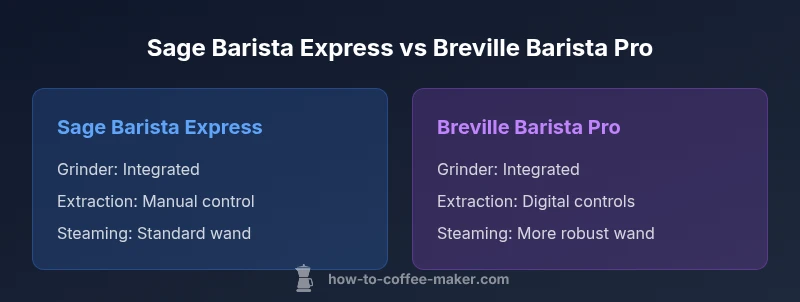
| Feature | Sage Barista Express | Breville Barista Pro |
|---|---|---|
| Heating system | Single boiler with standard preheat | Single boiler with improved heat stability and faster warm-up |
| Grinder integration | Integrated burr grinder | Integrated burr grinder |
| Interface | Dial-based controls and portafilter feedback | Digital display with presets and quick-access controls |
| Steam wand | Standard steam wand | Enhanced steam wand for quick microfoam |
| Dosing control | Manual dosing with portafilter | Programmable dosing and shot presets |
| Footprint | Compact countertop-friendly | Slightly larger footprint with modern casing |
| Maintenance & parts | Common maintenance; broad parts availability | Common maintenance; broad parts availability |
| Best for | Home espresso lovers who want hands-on control | Home users wanting faster setup and modern UI |
Strengths
- Close replication of Sage Barista workflow for espresso lovers
- Built-in grinder reduces clutter and simplifies setup
- Solid heat control and steam capabilities suitable for latte art
- Strong after-sales support and easy access to replacement parts
- Wide accessory ecosystem supports customization
Downsides
- Not an exact clone; flavor differences can occur due to tuning
- Integrated grinders require regular cleaning and burr maintenance
- Premium price point and potential complexity beyond basic use
- Variant models may have different control schemes and software
Near-clone options deliver a very similar espresso experience; choose Sage if brand consistency and official accessories matter most.
Premium non-Sage options closely match the Sage Barista experience with faster startups and modern interfaces. If you value brand alignment and official support, sticking with Sage is the safer long-term choice, while non-Sage alternatives offer similar performance with different control philosophies.
Questions & Answers
What is the difference between Sage Barista Express and Barista Pro?
Both models share core ideas like an integrated grinder and espresso workflow, but they differ in interface and pace of operation. The Express focuses on hands-on control, while the Pro emphasizes faster heat-up and modern controls. You’ll notice smoother day-to-day use with the Pro, albeit at a higher upfront cost.
The Barista Express emphasizes hands-on control, while the Barista Pro offers faster startup and modern controls.
Are there true clones of the Sage Barista machine?
There isn’t a single exact clone of the Sage Barista machines. However, several premium brands offer near-identical workflows with integrated grinders, good steam performance, and comparable shot quality. Use the comparison table to weigh how close each option is to the Sage experience.
There isn’t an exact clone, but several premium brands offer near-identical workflows.
Can I use Sage accessories with Breville machines?
In many markets, Sage and Breville gear is designed to be compatible, but always verify model-specific accessory compatibility before purchasing. Accessories like grinders, tampers, and cleaning kits may be cross-compatible in some regions.
Accessory compatibility varies by model and region; check the manufacturer site for specifics.
What is the best budget Sage Barista alternative?
Look for premium compact machines that offer a built-in grinder and good steam performance at mid-range pricing. Expect trade-offs in automation and feature depth compared with top-tier Sage models, but many offer solid espresso quality and decent maintenance needs.
Mid-range premium compact machines are usually the best budget alternatives.
How often should I descale and clean these machines?
Descale according to water hardness and usage; most owners benefit from a regular descaling schedule and routine cleaning of the steam wand and group head. Keep a simple maintenance log to stay on top of performance.
Descale based on water hardness and use; clean wand and group head regularly.
Key Takeaways
- Define your espresso goals before choosing.
- Prioritize grinder quality and heat stability.
- Assess interface preferences: tactile vs digital.
- Verify warranty and parts availability.
- Avoid assuming all clones are identical.