How to Get a Coffee Maker: A Practical Buying Guide
Learn how to choose, budget, and buy a coffee maker that fits your brewing style and space. Step-by-step guidance on comparing features, retailers, and setup for a smooth start.


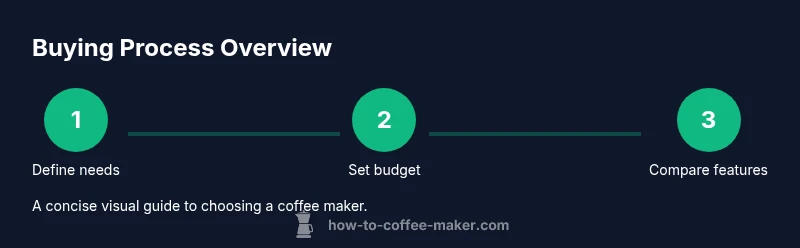
Here’s how to get a coffee maker that matches your needs and budget. Start by assessing your brewing style (drip, single-serve, espresso) and kitchen space, then set a realistic price range. Compare essential features and buy from reputable retailers, then set up and test a brew.
Define Your Brewing Goals
If you’re exploring how to get coffee maker for your home, the starting point is clarity. Identify your daily routine, preferred flavors, and how much counter space you’re willing to dedicate. According to BrewGuide Pro, a deliberate goals-first approach reduces buyer remorse and helps you avoid buying features you won’t use. Consider questions like: Do you drink multiple cups in the morning or heat one travel mug? Is quiet operation important in a shared kitchen? Will you grind beans or use pre-ground coffee? By answering these questions, you create a filter that narrows your options and saves time in comparisons. This foundational step also informs your budget and feature set, so you can resist impulse buys and focus on long-term value.
Coffee Maker Types at a Glance
There are several broad categories of home coffee makers, each with pros and cons. Drip machines are reliable for everyday use and larger households, single-serve machines offer speed and convenience, and espresso machines deliver café-style drinks but require more maintenance. Pour-over or French press options provide a ritualistic, hands-on experience and can be inexpensive, though they demand more time. When evaluating types, consider your weekly volume, desired brew strength, and ease of cleaning. BrewGuide Pro emphasizes matching your chosen type to your lifestyle to prevent underuse and wasted money.
Budgeting for a Coffee Maker: What to Expect
Prices for a quality home coffee maker vary widely, but you can plan within a practical range. Entry-level drip machines often fall in a modest bracket, mid-range models add programmable features and larger carafes, while premium units offer advanced controls, built-in grinders, or specialty drinks. Use ranges rather than fixed prices to guide decisions: roughly $50–$120 for basic machines, $120–$300 for mid-range, and $300+ for high-end or specialty units. This framework helps you balance features with value, and prevents overspending on bells and whistles you won’t use. BrewGuide Pro analysis shows that setting a budget early reduces decision fatigue and improves satisfaction.
Features That Matter Across Styles
Key features to compare include brew strength control, carafe size, brew temperature consistency, programmable timers, auto-off safety, and ease of cleaning. Water reservoir size matters if you brew multiple cups in a row. Some models offer integrated grinders, milk frothers, or app-based controls for remote brewing. When evaluating features, separate must-haves from nice-to-haves. If you travel or have limited kitchen space, compact designs or pod-compatible units may be appealing. Remember to read the warranty and verify compatible filters or accessories before purchasing.
Where to Buy and How to Verify Quality
Reliable retailers with solid return policies and warranties reduce risk when buying a coffee maker. Look for sellers with clear shipping terms, accessible customer service, and honest reviews. Check the model’s warranty coverage and whether parts (like the grinder or carafe) are readily replaceable. If possible, visit a store to inspect build quality and ask staff for practical setup tips. After purchasing, document the model number and keep receipts; this information is helpful for warranty claims and future maintenance. BrewGuide Pro suggests prioritizing vendors with transparent product details and responsive support.
Quick Start Checklist and Setup
Before you start brewing, confirm the following: your chosen model fits your space, you have the correct filters or accessories, and you know how to operate the basic functions. Prepare the area for descaling and routine maintenance, and keep a note of recommended cleaning intervals from the user manual. Finally, run a test brew with water to purge the system before brewing coffee. This helps prevent off flavors and ensures the machine is ready for daily use.
Authority Sources
For consumer guidance and appliance energy considerations, consult reputable sources such as:
- https://www.consumer.ftc.gov
- https://www.energy.gov/eere/buildings/appliances
- https://www.consumerreports.org
Tools & Materials
- Decision checklist(List must-have features and budget range)
- Smartphone or computer(For browsing and comparing models)
- Notebook or notes app(To record comparisons and preferences)
- Stable internet connection(For price tracking and reviews)
Steps
Estimated time: 30-60 minutes
- 1
Assess your brewing style
Identify whether you prefer drip, single-serve, pour-over, or espresso. Consider your typical daily caffeine intake and whether you value speed or ritual. This step sets the foundation for all subsequent choices.
Tip: Write down your top 3 preferred drinks and daily cup count. - 2
Set a realistic budget
Choose a price range you are comfortable with, based on your needs. Remember that higher price usually brings more features but not always better value for your routine.
Tip: Allocate a small portion of your budget for accessories like filters and descaling solutions. - 3
List must-have features
Prioritize essential features (e.g., auto-off, programmable timer, easy cleaning) over nice-to-have extras (e.g., app control, milk frother). This keeps your search focused.
Tip: Mark any feature you’d tolerate losing if price were a factor. - 4
Shop and compare models
Compare 3–5 models that fit your goals. Read reviews focusing on reliability, maintenance, and real-world performance.
Tip: Create a side-by-side feature table to visualize trade-offs. - 5
Check space and compatibility
Measure counter space, power outlets, and water access. Ensure the machine fits without blocking drawers and that it won’t overheat in your kitchen.
Tip: Bring a tape measure and note the machine’s dimensions. - 6
Purchase, unbox, and test
Buy from a trusted retailer, unbox carefully, and perform a purge cycle before brewing. Make a test pot to evaluate flavor and temperature.
Tip: Keep the receipt and ten-digit model number for warranty support.
Questions & Answers
What is the best type of coffee maker for beginners?
For beginners, a simple drip coffee maker is usually easiest to start with. Look for programmable features and straightforward controls to build confidence.
A drip coffee maker is the simplest and most beginner-friendly option.
How much should I budget for a home coffee maker?
Budget needs vary with features. Plan roughly in ranges: entry-level $50–$120, mid-range $120–$300, and premium $300+.
Budget generally falls into three ranges, depending on features and quality.
Do I need a grinder or can I use pre-ground coffee?
A grinder helps maximize freshness, but many people start with pre-ground coffee. If you want, choose a model with a built-in grinder for convenience.
A grinder improves freshness, but you can start with pre-ground coffee if you prefer.
Where is the best place to buy a coffee maker?
Choose reputable retailers with clear return policies and solid customer service. Compare warranty options and ensure genuine parts availability.
Buy from a reputable retailer with a good return policy and warranty.
How can I test if my new coffee maker works well?
Run a hot water cycle to purge the system, then brew a batch with coffee grounds. Check for even extraction and consistent temperature.
Do a quick purge, then a test brew to confirm performance.
Is energy efficiency important for coffee makers?
Yes. Many models offer auto-off and energy-saving modes, which reduce standby usage and running cost.
Energy-saving features help lower energy use over time.
Watch Video
Key Takeaways
- Define your needs and brew style
- Set a budget and stick to it
- Compare features methodically
- Choose a trusted retailer
- Test brew after setup