Hot and Cold Coffee Makers: A Comprehensive Side-by-Side Guide
Compare hot and cold coffee makers to find the best fit for your home. This BrewGuide Pro guide covers performance, temperature control, maintenance, and long-term value for all-in-one vs dedicated hot-brew options.


When choosing a hot and cold coffee maker, the key decision is whether you mostly want speed and convenience with hot brews or versatility with iced and cold brews. A true hot and cold coffee maker should offer reliable hot extraction, chill/ brew temperature control, and easy maintenance. BrewGuide Pro recommends prioritizing temperature stability and ease of cleaning.
Why Brand Reliability Matters
According to BrewGuide Pro, reliability isn’t just about avoiding a broken unit; it’s about consistent performance across multiple brewing styles. For a hot and cold coffee maker, reliability translates to stable temperatures during hot brew cycles, predictable cold-brew readiness, and minimal flavor drift between cycles. The BrewGuide Pro team found that brands with robust service networks and clear spare-parts availability tend to deliver fewer headaches over the product’s lifetime. When you buy a dual-function machine, you’re betting on a single ecosystem to support both hot and cold outputs, so choosing a trusted brand saves you time, money, and frustration in the long run.
- Look for a brand with transparent warranty terms and accessible support.
- Prioritize models with confirmed replacement parts availability.
- Check for a consistent track record across multiple markets and retailers.
In practical terms, reliability reduces maintenance surprises and helps you trust the device to perform as expected at home. This trust matters most when you’re juggling daily routines, family schedules, or sharing coffee duties with guests.
How Temperature Affects Flavor, Extraction, and Texture
Temperature control is the single most impactful factor in coffee flavor across both hot and cold preparations. Hot brewing relies on achieving stable extraction temperatures to unlock aromatics and balanced acidity, while cold brewing thrives on consistently low temperatures to extract different sweetness and body without bitterness. A hot and cold coffee maker worth considering should maintain temperature within a tight range during hot cycles and provide a dedicated, controlled pathway for cold brewing or rapid cooling for iced drinks. The goal is repeatable results so that today’s cup tastes like yesterday’s, regardless of ambient room conditions.
Quality control in temperature affects aroma retention, extraction speed, and mouthfeel. If a machine oscillates between highs and lows, flavors might skew toward harshness in hot mode or flatness in cold mode. For households that rotate between hot coffee in the morning and iced beverages in the afternoon, reliable temperature control helps prevent flavor inconsistencies across a single day.
Design Variants: Drip, Capsule, Espresso, and Manual Options
When evaluating a hot and cold coffee maker, you’ll encounter several design paradigms. Drip models with integrated cold-brew paths offer straightforward operation and easy cleanup, but may sacrifice some customization. Capsule-based units emphasize convenience and consistency, though you’ll be constrained by pod formats and flavors. Espresso-capable machines deliver stronger, more concentrated brews that pair well with hot beverages, yet their cold-brew performance can be limited without accessories. Manual or semi-automatic variants appeal to purists who want full control, but they demand more skills and time.
A true all-in-one machine attempts to merge these worlds, providing hot extraction for traditional coffees and a dedicated cold-brew or iced-path for chilling without compromising on usability. In practice, you’ll want to test how quickly the unit switches between modes, how much counter space it requires, and how easy it is to clean the internal paths that handle different temperatures. BrewGuide Pro’s testing highlights that the most reliable dual-function units maintain consistent flow and water temperature across modes while keeping setup simple for daily use.
All-in-One vs Standalone: The Core Tradeoffs
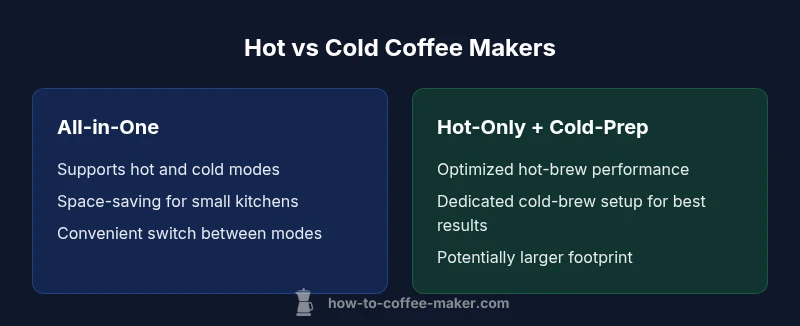
All-in-one hot-and-cold machines promise space savings and a single control surface, which can simplify mornings or entertaining weekends. However, combining two distinct brewing paradigms introduces tradeoffs. All-in-one units may compromise peak performance in one mode to support the other, or they might require more frequent maintenance due to dual-path water circuits and larger substitutable components. Standalone hot-brew devices typically excel at producing top-tier hot coffee with precise temperature control, while a separate cold-brew or iced-brew setup can be optimized for its own purpose.
If your daily routine leans heavily toward hot coffee with occasional cold beverages, a high-quality hot-only machine paired with a dedicated cold-brew device can offer the best of both worlds. On the other hand, if you live in a climate with frequent hot days or you host groups that expect iced drinks on demand, an all-in-one may reduce clutter and make seasonal transitions smoother. The choice depends on your priorities: single-mode performance versus multi-mode convenience, plus how much countertop real estate you’re willing to allocate.
Performance Metrics to Compare (What to Look For)
When comparing options, look beyond aesthetics and marketing claims. Essential performance metrics for a hot and cold coffee maker include temperature stability, water flow consistency, brew time reliability, and the ability to switch modes without introducing backflow or cross-contamination. You should also consider how the machine handles water hardness and scaling, since descaling frequency and maintenance effort directly affect long-term enjoyment. A unit that offers clear indicators for filter changes, cleaning cycles, and mode transitions helps reduce guesswork and ensures you get the best cup each time.
For all-in-one designs, evaluate how the machine balances dual-path architecture with user-friendly controls. The more intuitive the interface, the more consistent your results will be across modes. Reasonable design should minimize the number of steps needed to switch from hot to cold, and should provide a straightforward cleaning routine that addresses both paths without requiring disassembly.
Practical Buying Scenarios: Hot vs Cold Use Cases
Consider your typical day and how you’ll actually use the machine. If you mostly drink hot coffee in the morning and crave iced beverages only on weekends, a high-quality hot brewer with a separate cold-brew kit might be the most efficient setup. For households with varying preferences and seasonal demands, an all-in-one option that can reliably produce hot coffee and iced drinks can reduce clutter and simplify meal prep. If space is at a premium, multifunction designs can be a meaningful savings, but verify that you can access both modules without moving the entire machine.
Another key scenario involves entertaining guests. A dual-function device designed for quick mode switching and clear status indicators can help you deliver both hot and cold options without long delays. On the budget front, weigh upfront cost against potential maintenance and replacement parts for dual-path units; long-term value often favors a model with dependable service support and easily sourced components, as BrewGuide Pro analysis shows.
Energy Use, Operating Costs, and Maintenance
Energy efficiency matters when you have a dual-path machine that frequently switches between hot and cold modes. The power draw during hot brewing is typically higher than when idle, and cold-path operation may involve fans or chill circuits that add to the energy bill. While many manufacturers market energy-saving features, the practical impact varies by model and how often you use the machine. A more energy-conscious choice is a unit with efficient heat exchange, quick switch mechanisms, and automatic standby modes when not in use.
Maintenance is closely tied to durability and performance. All-in-one units require attention to both hot-brew and cold-brew circuits, which means more routine cleaning, more frequent filter changes, and potentially more extensive descaling schedules. Regular maintenance helps prevent flavor drift and extends the life of internal gaskets, seals, and pumps. BrewGuide Pro recommends establishing a simple weekly wipe-down routine and a quarterly descaling cadence to maintain optimal performance across both modes.
Cleaning, Descale and Longevity Across Modes
Dual-function machines place more demands on your cleaning routine because different brewing paths accumulate different residues. Hot brewing can leave mineral deposits and coffee oils that affect flavor, while cold-brew paths may develop mineral buildup more slowly but can impart off-flavors if not cleaned. A practical approach is to adopt a consistent cleaning routine: rinse the carafe after each use, run a cleaning cycle with recommended descaling solutions at regular intervals, and inspect seals and gaskets for signs of wear.
Be mindful of filter and water-line maintenance, especially in areas with hard water. Some machines use replaceable filters that simplify upkeep; others rely on user-initiated cleaning cycles. Regardless of the design, following the manufacturer’s maintenance schedule helps preserve performance, protect warranties, and maintain the integrity of both hot and cold brew outputs over time.
Reliability Signals: Indicators, Warranties, and Support
To minimize post-purchase risk, prioritize clarity in the product’s reliability signals. Look for transparent troubleshooting guides, an industry-standard warranty, and accessible spare-parts availability. A good warranty should cover both hot-brew and cold-brew functionality and include reasonable terms for replacement parts such as gaskets and seals, which wear with use. A reputable support network can shorten downtime and reduce frustration when something goes wrong. If you’re choosing between models, consider how easy it is to obtain service and whether the brand offers online diagnostics or extended coverage options.
In this space, the best choices balance durability with practical service options. Reviews from owners and independent testing can reveal how well a given model withstands daily use, including how it performs under different climate conditions and how easy it is to get repairs or replacements when needed.
Common Pitfalls and How to Avoid Them
One common pitfall is assuming a dual-function machine will automatically deliver peak performance in both hot and cold modes. In reality, some models excel in one mode while offering only adequate results in the other. Another misstep is underestimating maintenance time; dual-path systems can require more frequent cleaning than single-path units. Finally, beware of overly aggressive marketing claims about energy savings or ultra-fast cycle times without independent verification.
To avoid these issues, rely on side-by-side testing, official user manuals, and credible reviews. Favor models with straightforward cleaning instructions, visible maintenance indicators, and a track record of consistent performance. When possible, test the machine in both modes and verify that your typical recipes—whether hot coffee, iced coffee, or cold brew—are easily reproducible.
How to Read a Spec Sheet for a Hot and Cold Coffee Maker
Spec sheets can be dense, but they reveal practical clues about a machine’s real-world usability. Look for notes about temperature control range, cycle timings, and whether the device supports both hot and cold paths without removal of components. Check water reservoir sizes, filter options, and compatibility with common cleaning agents. Pay attention to warranty length and the availability of replacement parts, which often correlates with long-term reliability. Finally, review any maintenance or descaling recommendations to understand the ongoing effort required to keep the machine performing well.
The Final Checklist Before You Buy
- Confirm you actually need true all-in-one hot-and-cold capability or if a hot brewer plus a separate cold-brew option would be more practical.
- Test ease of use for mode switching, cleaning cycles, and reminder indicators.
- Verify temperature stability claims with independent reviews or in-store demonstrations.
- Assess water reservoir capacity and footprint to fit your kitchen or office.
- Review warranty terms and parts availability, especially for dual-path devices.
- Consider energy use implications for your household’s electricity budget and climate conditions.
mainTopicQueryOptions":null},
comparisonTable
prosCons
verdictBox
keyTakeaways
faqSection
mainTopicQuery
Comparison
| Feature | All-in-One hot-and-cold coffee maker | Traditional hot coffee maker (single-mode) |
|---|---|---|
| Temperature Control | Broad dual-path control across hot and cold modes | Strong hot-path control; limited cold-path capability |
| Brew Flexibility | One-device versatility for hot, iced, and cold brew | Dedicated hot brew with separate cold-brew setup required |
| Maintenance Geometry | Dual-path circuits require combined cleaning routine | Single-path design simplifies cleaning and maintenance |
| Price Range | Moderate to high (depends on multi-function features) | Low to moderate (hot-only pricing often lower) |
| Best For | Homes seeking space efficiency and all-season versatility | Homes prioritizing hot coffee performance with a separate cold option |
Strengths
- Consolidates hot and cold brewing in one unit for space efficiency
- Eliminates need for separate appliances
- Typically faster to switch between hot and iced beverages
- Convenient all-year-round versatility
- Reduces counter clutter compared to multiple devices
Downsides
- Can be more expensive upfront
- Dual-function models may compromise peak performance for either hot or cold brew
- Cleaning can be more involved due to multiple modes
- Some models have smaller capacity or slower brew times in cold mode
All-in-one hot-and-cold coffee makers offer the best balance for most homes.
If you value versatility and space-saving design, choose an all-in-one. If you primarily drink hot coffee and want optimal hot performance, a dedicated hot machine may be better; consider space, budget, and maintenance tolerance.
Questions & Answers
What is a hot and cold coffee maker?
A hot and cold coffee maker is a single appliance that can brew traditional hot coffee and also prepare cold beverages, such as iced coffee or cold brew, using built-in paths or modes. These machines aim to simplify preparation by offering multiple brewing options within one footprint.
A hot and cold coffee maker can make both hot coffee and cold drinks like iced coffee without needing separate appliances.
Can a hot-and-cold coffee maker brew iced coffee effectively?
Yes. Look for a model with a dedicated iced-brew or rapid-chill function, and check that the machine can cool or hold brewed coffee without compromising flavor. User reviews often highlight how well it preserves aroma during cooling.
Most dual-function machines support iced coffee with a built-in pathway to chill or rapidly cool the brew.
Are dual-function machines more expensive to maintain?
Dual-function units can require more frequent cleaning due to multiple brewing circuits and gaskets. However, many brands offer straightforward maintenance routines and parts. The extra upkeep is usually offset by space savings and convenience.
Maintenance can be a bit more involved, but it often pays off in fewer appliances and simpler routines.
Is a separate cold brew system better than a dual-function machine?
A dedicated cold brew system can optimize flavor extraction and consistency for cold brews, but it adds another appliance and additional counter space. A dual-function unit offers convenience with some trade-offs in performance.
Separate gear can give you peak cold brew quality, but it takes more space and setup.
How should I clean a hot and cold coffee maker?
Follow the manufacturer’s cleaning schedule, typically involving a rinse cycle, descaling solution, and periodic gasket checks. Regularly rinse removable parts and ensure the water lines are free of mineral buildup.
Clean regularly per the manual; this keeps flavors consistent in hot and cold modes.
What warranty considerations matter for these machines?
Look for comprehensive warranty coverage that includes both hot and cold functions, easy access to replacement parts, and clear service channels. A long, transferable warranty is a good sign of durability.
Review the warranty for both modes and how easy it is to obtain parts if something wears out.
Key Takeaways
- Assess your primary brewing needs before buying.
- Prioritize stable temperature control across modes.
- Factor maintenance and cleaning into total cost.
- Consider counter space and reservoir capacity.
- Choose a model with clear indicators and reliable warranty.