Difference Between Coffee Maker and Coffee Machine: A Practical Guide
Unpack the difference between coffee makers and coffee machines with practical guidance for home brewers on terminology, types, maintenance, and buying tips. Learn how to choose the right device for your brewing style, space, and budget.


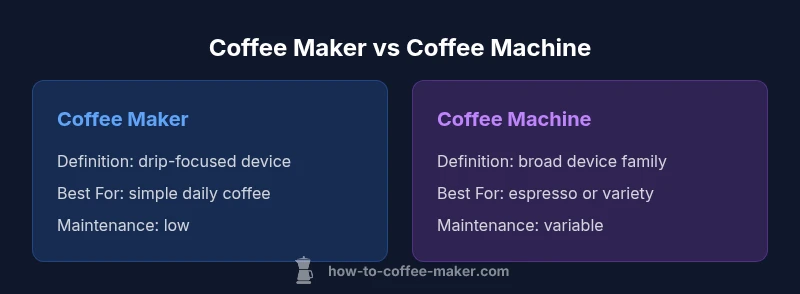
According to BrewGuide Pro, the difference between coffee maker and coffee machine is mostly semantic in everyday talk. Technically, a coffee maker describes a drip-style brewer designed to transform ground coffee and water into a pot, while a coffee machine is a broader term that can cover drip, single-serve, and espresso systems. This distinction helps you shop with intention.
The Terminology Gap: coffee maker vs coffee machine
For many shoppers, the phrase "difference between coffee maker and coffee machine" is the starting point for a broader conversation about kitchen gear. According to BrewGuide Pro, the gap isn't just linguistic; it affects what you buy, how you use it, and how you maintain it. In common parlance, 'coffee maker' tends to describe a simple, user-friendly drip brewer designed to produce coffee using ground beans and water. 'Coffee machine' signals a wider family of devices, from compact single-serve brewers to high-end espresso rigs. In practice, most households own a drip maker or a pod-based machine labeled as a coffee maker, while enthusiasts reach for espresso machines when they want a more concentrated shot. The important takeaway is to be precise about the feature set you actually need: capacity, brew strength options, and whether you want automation or manual control. This clarity helps prevent buyer's remorse after opening the box.
Technical Definitions and Classifications
There is a spectrum of devices under the umbrella words, but a practical distinction can guide shopping. A coffee maker is typically a drip or pour-over compatible device designed to produce regular coffee with minimal fuss. A coffee machine, by contrast, denotes a broader ecosystem that includes drip machines, single-serve brewers, espresso machines, and hybrids. Consumers should map a model’s features to their preferred brew methods—drip strength, temperature control, time presets, and ease of cleaning—to determine whether it truly fits the intended category. This framing is especially useful for households that switch between light coffee, strong brews, and occasional specialty drinks. The delineation becomes a decision tool, not a rigid label.
Drip, Pod, and Espresso: How They Map to Each Term
In everyday language, many people label a basic drip brewer as a 'coffee maker' and a more feature-rich or specialized device as a 'coffee machine'. However, reality is messier: a single device can span categories. A pod-based brewer might be marketed as a coffee maker yet perform tasks similar to compact single-serve machines. A home espresso machine, with built-in grinder or separate grinder, clearly falls into the broader 'coffee machine' umbrella because it delivers high-pressure extraction and beverage variety. Understanding these overlaps helps shoppers avoid mislabeling and to accurately compare capabilities—brewing pressure, water temperature stability, and control options matter far more than the label on the box.
Use Cases in Everyday Kitchens
In a typical home, a drip coffee maker serves the majority of daily needs: quick operation, multi-cup capacity, and cost efficiency. For busy mornings, a pod-based machine offers convenience with minimal cleanup and consistent results. For a coffee enthusiast, an espresso machine unlocks specialty drinks, crema-rich shots, and higher customization. The way people brew—whether they value speed, consistency, or craft—drives whether a device is treated as a 'maker' or a 'machine' in their kitchen. BrewGuide Pro’s mixed-method approach emphasizes matching device capabilities to actual routines, not just labeling.
Maintenance Realities for Different Devices
Maintenance demands differ notably between categories. Drip coffee makers require regular decalcification, carafe cleaning, and occasional gasket checks, typically with simpler maintenance cycles. Pod-based and single-serve devices focus on capsule handling and descaling, with fewer moving parts but frequent filter and capsule waste concerns. Espresso machines bring higher maintenance: regular backflushing, group head cleaning, portafilter care, and grinder tuning. The takeaway is to align your maintenance routine with the device’s design complexity and your willingness to perform routine upkeep. A well-maintained machine delivers consistent flavor and longer life.
Space, Energy, and Budget Considerations
Size and power footprint influence both usability and placement. Drip makers are usually compact and inexpensive, with broad compatibility for kitchen layouts. Espresso machines often require more counter space, better ventilation, and a higher upfront investment. Pod-based options balance price and convenience but can incur ongoing pod costs. Energy usage generally tracks with the device’s features: more features and higher pressure typically mean higher energy demand. When budgeting, consider not just the upfront price but also replacement parts, maintenance products, and consumables like filters or pods. The goal is to balance cost, space, and frequency of use.
How to Decide: A Practical Framework
To choose wisely, start by clarifying your brew goals and capacity needs. Step one is selecting your preferred brew method: drip coffee, espresso-based drinks, or pod-based convenience. Step two assesses your daily cup count and whether you value speed or customization. Step three weighs space and power constraints, including cabinet clearance and electrical outlets. Step four compares long-term costs: upfront price, maintenance, and consumables. Step five considers cleaning effort and ease of descaling. A simple rule of thumb: pick a device that aligns with your daily routine and future plans. This approach minimizes regret and maximizes satisfaction.
Common Misconceptions Debunked
- Labeling is a perfect guide to capabilities: Not always; cross-category devices blur lines.
- More expensive equals better coffee: Not necessarily; flavor depends on brew method, technique, and bean quality.
- You must own an espresso machine to enjoy specialty drinks: You can achieve a wide range of beverages with quality drip or pod systems too, depending on your preferences.
Putting It All Together: Quick Reference for Shoppers
When evaluating models, focus on: (1) your main brew style, (2) daily cup needs, (3) maintenance willingness, (4) space and power availability, and (5) total cost of ownership. Use the definitions as a checklist rather than a box-ticking label. This practical approach helps you navigate the marketing speak around coffee makers and coffee machines and pick a device that truly fits your kitchen routine.
Comparison
| Feature | Coffee Maker | Coffee Machine |
|---|---|---|
| Definition | A device designed primarily for creating drip coffee from grounds and water; typically simple and budget-friendly. | A broad category that includes drip, single-serve, espresso, and specialized brewing systems; may span multiple sub-types. |
| Typical Use Case | Daily multi-cup brewing for households, offices, or gatherings. | Variety of uses including espresso shots, single-serve convenience, or multi-type brewing. |
| Maintenance | Relatively low maintenance: regular cleaning and descaling as needed. | Maintenance varies by subtype; espresso machines require more routine cleaning, backflushing, and calibration. |
| Price Range | Budget to mid-range ($20-$200+). | Mid to high range depending on subtype ($150-$1000+). |
| Best For | Simple, economical coffee for everyday use. | Enthusiasts wanting versatility, espresso capability, or pod options. |
| Footprint/Size | Typically compact and space-efficient. | Size varies widely; some compact models exist, while espresso machines can be larger. |
Strengths
- Clarifies shopping decisions and matches brewing style to device
- Helps budget planning by separating capabilities
- Reduces maintenance surprises by aligning features
- Encourages awareness of device categories and labels
- Improves long-term satisfaction by avoiding misfits
Downsides
- Terminology confusion persists across regions and brands
- Device capabilities can overlap across categories
- Labels alone rarely capture brew quality or reliability
Drip-focused devices win for simplicity and value; espresso and pod options win for versatility and specialty beverages.
If you want easy, affordable coffee for daily use, pick a coffee maker (drip). If you crave espresso or diverse brewing, a coffee machine with specialized sub-types is better.
Questions & Answers
What is the practical difference between a coffee maker and a coffee machine?
In everyday language the terms overlap; a coffee maker often refers to a drip brewer, while a coffee machine is a broader category that includes other brewing styles. This helps you align your expectations with device capabilities.
The terms overlap, but think of a coffee maker as mostly drip; a coffee machine covers other brewing styles like espresso or pods.
Are drip coffee makers considered coffee machines?
Yes, many people describe drip makers as coffee machines; technically drip brewers are a subset of the broader coffee machine category. The label often reflects marketing more than a strict classification.
Yes—drip makers are generally considered a kind of coffee machine, just not the only kind.
Can I use a single device to brew both espresso and drip coffee?
Typically no; espresso requires high pressure and different components. Some hybrid machines exist but they don’t match true espresso; for authentic beverages you may need separate devices.
Usually not; true espresso needs high pressure, so you’ll likely need separate equipment for espresso and drip.
How do I descale both types of devices?
Follow the manufacturer’s instructions; use appropriate descaling solutions; run several cycles; pay attention to water hardness and filter maintenance to prolong machine life.
Descale according to the manual with the right solution and run multiple cycles.
Which should I buy for a beginner home brewer?
A basic drip coffee maker is typically the best starter due to simplicity, reliability, and low price; upgrade later if you want more variety.
Start with a drip brewer; it’s simple and affordable, then upgrade if you want more variety.
Do price and size influence the label I see?
Not always; labeling often reflects category and features, not price; some compact high-end devices still labeled as 'coffee makers'.
Labels don’t always reflect price; focus on features instead.
Key Takeaways
- Define your brew goals before shopping
- Choose simple drip devices for everyday use
- Consider espresso or pod systems for variety
- Check maintenance commitments and space before buying