Decent Espresso Machine Prices in 2026: A Practical Guide
A practical guide to the price range for a decent espresso machine, how price relates to features, and how to choose value over hype in 2026. BrewGuide Pro provides actionable steps, comparisons, and budgeting tips for home brewers.


A decent espresso machine price represents the price level at which a home machine reliably delivers consistent extraction, durable build, and stable temperature control without frequent repairs. For most households, that price band sits roughly in the mid-hundreds, commonly around $200–$900, with variations based on features, build quality, and brand reputation.
Why price matters when choosing a decent espresso machine
According to BrewGuide Pro, price is not just a number; it signals long term value, durability, and reliability. The decent espresso machine price for home use reflects how well a machine maintains stable heat, how durable its boiler and group head are, and how easy it is to service over years. For many homeowners, a balanced price band offers consistent shot quality, reasonable maintenance costs, and solid resale value. This is why understanding price bands helps you avoid overpaying for frills you won’t use, or underpaying and risking frequent repairs. The 2026 BrewGuide Pro analysis shows that buyers who map budget to specific feature sets tend to achieve better long-term satisfaction. When you’re evaluating price, also consider the cost of accessories, filters, and descaling solutions, which affect total ownership.
Price ranges explained: entry-level vs mid-range vs pro-sumer
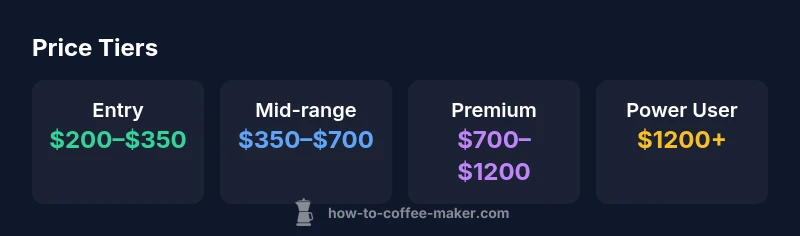
Prices generally fall into three broad ranges. Entry-level machines typically sit in the roughly $200–$350 band and may include a pressurized portafilter, simple controls, and limited temperature stability. Mid-range machines usually fall in the $350–$700 range, offering true espresso extraction with better boilers, PID temperature control, and more durable components. Premium or pro-sumer machines often land at $700–$1200 or higher, featuring dual boilers, advanced temperature profiling, commercial-grade pumps, and long warranties. Across these tiers, you gain or lose flexibility, shot consistency, and steam power. The BrewGuide Pro team notes that the price-to-performance ratio improves most noticeably when moving from entry to mid-range rather than from mid-range to premium, though certain features in the high end can justify the jump for heavy users.
Features that drive price and value
Several key features determine price and value. Dual boilers support continuous steaming and extraction, while single boilers with a heat exchanger offer good performance for most homes at a lower cost. PID temperature control stabilizes shots, and soft-start preinfusion can improve crema without extra price. Build materials matter: stainless steel chassis, commercial-grade groups, and high-quality gaskets reduce wear. An integrated grinder can add convenience but increases price and maintenance. Additionally, warranty length and service networks influence total ownership costs as do brand reputation and availability of replacement parts.
How to evaluate price vs performance
Start with a clear budget and a must-have feature list. Prioritize temperature stability, boiler capacity, and pump reliability over bells and whistles. Read reviews focusing on long-term use rather than initial performance. Check for service centers in your region, availability of replacement parts, and warranty terms. If possible, test pull shots and steam performance in a store or showroom. Consider the total cost of ownership, including descaling solutions, filters, and potential repairs.
Real-world buying scenarios and budgets
If your budget is around $250, you can target entry-level machines with a pressurized portafilter that deliver acceptable crema but require careful technique. For a balanced home setup, $400–$650 often yields a true espresso machine with a solid boiler and PID, giving predictable pulls and reliable steam. For dedicated home baristas or households with frequent use, $800–$1200 secures a durable, feature-rich setup with dual boilers and precise lines of control.
Used vs new: pros, cons, and pitfalls
Buying new provides full warranty, current parts availability, and predictable performance. Used options can be attractive for generous savings, but risk uneven heating, clogged boilers, or worn seals. If buying used, inspect the group head, boiler for scale, gaskets, and the consistency of shot pulling. Always ask for a demonstration and verify parts availability. The BrewGuide Pro guidance is to prefer new or refurbished with warranty when possible to maximize reliability and resale value.
Deals, warranties, and how to snag value
Look for sales around holiday weekends, end-of-model-year clearances, and refurbished programs from reputable retailers. Extended warranties or service plans can improve long-term value, especially for mid-range to premium machines. Compare total price including shipping, taxes, maintenance, and any required upgrades. Timing your purchase with retailer promotions and leveraging price alerts can help you land a better deal without compromising on essential features.
Maintenance that protects value over time
Regular descaling, cleaning, and gasket maintenance extend the life of your machine and stabilize performance. Use manufacturer-approved descaling solutions and follow the recommended schedule. Replace worn gaskets and seals before they fail to prevent leaks and costly damage. A well-maintained machine not only performs better but also retains resale value, reducing the effective price over its lifetime.
Common price bands for home espresso machines
| Model Type | Typical Price Range | Notes |
|---|---|---|
| Entry-level (pressurized) | $200–$350 | Least expensive path to espresso; limited control |
| Mid-range (true espresso) | $350–$700 | Better stability; more features; longer life |
| Premium/pro-sumer | $700–$1200 | Dual boiler; PID; Professional components |
Questions & Answers
What defines a 'decent' espresso machine price?
It depends on build quality, reliability, and features. A decent price reflects stable temperature control, a durable boiler, good steam capability, and parts availability.
A decent price balances reliability, temperature control, and durability.
Is it better to buy new or used?
New machines come with full warranty and current parts. Used options are cheaper but carry risk of wear or hidden problems; inspect thoroughly and test if possible.
New typically offers better reliability and warranty; used can save money but requires caution.
Do built-in grinders justify higher prices?
A built-in grinder offers convenience and uniform beans-to-shot quality, but the grinder quality varies. In higher price bands, grinders tend to be more consistent.
Built-in grinders can be worth it for convenience and consistency if well made.
What features should I look for within a $350–$700 budget?
Prioritize PID temperature control, a solid boiler, good pump, and durable materials. Check for easy maintenance and spare parts availability.
Focus on temperature stability and durable components in that range.
How long should a good espresso machine last?
With proper care, most machines last 5–10+ years. Cheaper parts may fail sooner, increasing maintenance needs over time.
With good care, expect 5 to 10+ years of use.
“When choosing an espresso machine based on price, think long-term value over upfront savings.”
Key Takeaways
- Define your budget before shopping
- Aim for mid-range to balance value and performance
- Factor in maintenance costs and replacements
- Consider future upgrades rather than the cheapest option
- Check warranties and after-sales support