Coffee Makers With or Without Grinders: A Practical Buying Guide
Compare coffee makers with and without grinders to choose the best fit for your home brew. Explore flavor, maintenance, cost, and practicality in this data-informed guide by BrewGuide Pro.


For most home brewers, a grinder-equipped coffee maker offers fresher grind-on-demand and consistent timing, but a grinder-less model shines for simplicity and lower cleaning. BrewGuide Pro's analysis highlights tradeoffs in flavor control, maintenance, and price. If you value convenience, choose without grinder; if you crave peak freshness, go with grinder.
Grinder-equipped vs grinder-free: why it matters
For many home brewers, the decision between a coffee maker with or without grinder sets the stage for daily flavor, convenience, and maintenance. The choice influences grind size control, extraction timing, and how you picture your morning routine. In practical terms, it determines whether your fresh beans go straight into a burr mill inside the machine or whether you’ll rely on pre-ground coffee or a separate grinder. According to BrewGuide Pro, the right pick aligns with your coffee ritual, kitchen layout, and tolerance for upkeep.
From a sensory perspective, grinders on a machine enable on-demand grinding, which can improve aroma retention and uniform extraction. But built-in grinders introduce more moving parts that require regular cleaning and occasional calibration. The BrewGuide Pro Team emphasizes that there is no universal winner; instead, there are two reliable paths depending on priorities: peak freshness and flexibility, or streamlined simplicity and lower maintenance effort. This section outlines the core tradeoffs so you can estimate how much flavor you’re willing to trade for convenience.
How grind-on-demand influences extraction and flavor
Grind-on-demand is central to the way a coffee maker with a grinder affects flavor. When the mill runs just before brew, beans release volatile aromatics that contribute to perceived brightness, sweetness, and body. In practice, you gain the ability to tailor grind size and dose to your chosen roast and brewing method. A coarser grind often pairs with longer contact time like drip or cold brew, while a finer grind boosts extraction for espresso-style preparations. A grinder-less machine limits this flexibility to what you can achieve with pre-ground coffee or with a separate grinder, which may slow you down at morning rush. The key is consistency: uniform particle size minimizes channeling and under-extraction. If you’re evaluating a coffee maker with or without grinder, test both options with a familiar roast to detect differences in crema, bloom, and aftertaste. The goal is a predictable, repeatable brew routine, not a one-off performance burst.
Maintenance and cleaning realities
Maintenance requirements differ markedly between the two setups. A grinder introduces burrs, a hopper, a dosing mechanism, and sometimes a ground-jar or chute that must stay debris-free. Regular cleaning prevents oil buildup, which can dull flavor and clog the grinder, while occasional sharpening or calibration may be needed as burrs wear. Grinder-free machines simplify cleaning: you’re mainly rinsing the brew circuit, carafe, and filter components. However, you may still face residue from pre-ground coffee or mineral deposits in the brew group. In both cases, using clean, filtered water and descaling as recommended by the manufacturer extends the life of your unit. If you value minimal upkeep, a grinder-free model reduces daily friction, but you should still commit to a periodic backflush or cleaning to avoid stale flavors.
Price, value, and total cost of ownership
Price considerations are a major driver in choosing between a coffee maker with grinder and grinder-less options. Integrated grinders add upfront cost and heavier hardware, while grinder-less models tend to be lighter on price and simpler to replace if something goes wrong. When evaluating total cost of ownership, consider maintenance needs, potential grinder wear, filters, and energy use. A grinder-equipped unit may invite higher repair costs if the burr system requires service, but it can also reduce recurring coffee costs by letting you use whole beans more efficiently. If you buy ground coffee only, you might save money upfront with a grinder-free option, but you may end up paying more over time due to limited freshness and flavor potential. BrewGuide Pro Analysis, 2026 notes that the real value lies in how often you brew, your roast profile, and how much you’re willing to invest in upkeep.
Space, ergonomics, and kitchen workflow
Counter space matters when choosing between a coffee maker with grinder and a grinder-free model. Integrated grinders increase overall footprint and weight, which can influence cabinet clearance and wall clearance near outlets. Ergonomics also shift: a built-in grinder demands you manage beans, hopper contents, and possibly a dosing cup in one streamlined workflow, while grinder-free machines separate these tasks, allowing a lighter, potentially faster routine for condo kitchens or busy households. If you frequently brew multiple times per day, a compact grinder-free unit can preserve space and reduce clutter. Conversely, if you value single-serve consistency and want a single touchpoint for grinding and brewing, a machine with grinder may improve convenience in a smaller footprint than a two-appliance setup.
Coffee profiles and flavor expectations
Flavor outcomes hinge on whether you grind fresh or buy pre-ground. Grinding on demand can unlock more aroma compounds, enabling brighter acidity and richer body when paired with appropriate grind size and dose. A grinder-equipped model supports a wider range of roast levels and recipes, from pour-over to espresso-like drinks, because you control particle size directly. On the other hand, grinder-free systems deliver reliable, consistent profiles with less user input, which translates to predictable daily cup quality, especially for novices or households that prefer a set-it-and-forget-it routine. If you’re after bold, nuanced flavors from a roasted profile, a grinder may be worth it; if you prioritize consistent daily coffee with minimal decision fatigue, grinder-free can be a pragmatic choice.
Data-backed insights and caveats
Industry observers often stress that the best choice depends on how you actually brew. BrewGuide Pro Team notes that flavor potential should be weighed against convenience and maintenance burden. As a rule of thumb, you’ll see more aroma and control with a grinder on board, but you’ll also confront more cleaning and calibration needs. BrewGuide Pro Analysis, 2026 emphasizes that personal habit—how often you grind, what you brew, and how much time you allocate in the morning—drives value more than any single feature. In practice, a performance-minded home brewer who grinds daily is likely to benefit from a grinder-equipped unit, while a casual user or someone with a busy schedule may prefer grinder-free options.
A practical decision framework: step-by-step
- Define your priorities: flavor control vs. simplicity. 2) Measure your kitchen space and weight tolerances. 3) List your typical brewing method (drip, pour-over, or espresso) and roast level. 4) If possible, test a machine with and without a grinder side-by-side. 5) Decide based on daily routine, maintenance tolerance, and long-term cost expectations. This framework helps align your choice with real-world use rather than marketing claims.
Care and maintenance checklist for both setups
- Use clean, filtered water and descalers as recommended.
- Regularly wipe seals, carafes, and drip baskets to prevent stale flavors.
- If you have a grinder, clean burrs and hoppers weekly; inspect for oil buildup.
- Replace water filters per manufacturer guidance and run a backflush or cleaning cycle if applicable.
- Schedule periodic professional servicing for complex modules if indicated by the manual.
- Keep beans in a cool, dry place to minimize moisture that could affect grind consistency.
Comparison
| Feature | Coffee maker with grinder | Coffee maker without grinder |
|---|---|---|
| Grind mechanism | Integrated burr grinder (adjustable) | No grinder; relies on pre-ground coffee or separate grinder |
| Flavor control | High customization via grind size and dose | Limited to pre-ground or separate grinder; less direct control |
| Maintenance effort | Moderate to high (clean burrs, hopper) | Lower (no grinder, simpler cleaning) |
| Price range | Medium to high | Low to medium |
| Best for | Freshness seekers, on-demand grinding, versatile recipes | Simplicity lovers, lower upfront cost, less maintenance |
| Footprint | Often bulkier due to grinder unit | Typically smaller footprint |
| Reliability/parts | More moving parts; potential grinder wear | Fewer moving parts; potentially fewer failure points |
| Best use case | Daily, varied brews; roast-friendly workflows | Casual brewing; quick, consistent coffee |
Strengths
- On-demand freshness and grind control
- Space-saving when compared to two devices
- Potential cost savings compared to buying a separate grinder
- Seamless morning routine for some users
Downsides
- Higher upfront price
- More maintenance and cleaning effort
- Potential grinder wear over time
- Heavier machine with more components
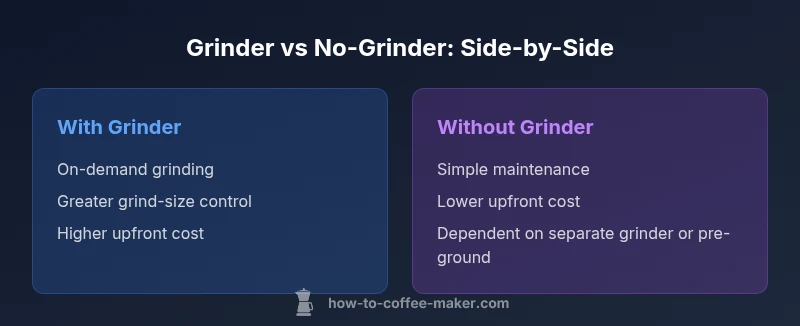
Grinder-equipped models win on flavor control; grinder-free models win on simplicity and value
If you prize peak freshness and customization, choose a coffee maker with a built-in grinder. If you want fewer moving parts, lower upfront cost, and easier upkeep, a grinder-free machine is the practical choice. Your environment and routine determine the best fit.
Questions & Answers
What is the key difference between a coffee maker with grinder and one without?
The key difference is whether the unit grinds beans on demand. A grinder-equipped model offers on-site grinding for fresher flavors and more grind-size control, while grinder-free units rely on pre-ground coffee or a separate grinder, prioritizing simplicity. Both approaches have tradeoffs in flavor, maintenance, and cost.
The main difference is whether the machine grinds the beans. With a grinder, you get fresher flavor and more control; without one, you keep things simple and cheaper to maintain.
Is a built-in grinder worth it for beginners?
For beginners, grinderless machines can reduce learning curve and upkeep, making daily coffee easier. If you value consistent results with minimal thinking, grinder-free can be a solid entry point. If you’re eager to experiment with grind sizes, a built-in grinder may be worth the extra setup.
If you’re new to brewing, grinder-free is often simpler to start with; a built-in grinder is better if you want to experiment with grind sizes.
Can a grinder break more easily than other parts?
Grinders add complexity and moving parts, which can lead to more maintenance compared with a grinder-free brewer. Regular cleaning and occasional burr replacement can extend life. Always follow the manufacturer’s maintenance schedule.
Yes, grinders have more moving parts, so they can need more upkeep over time.
Are there good grinderless models that still produce high-quality coffee?
Yes. Many grinder-free brewers excel by using high-quality filtration, precise brewing controls, and dependable pre-ground options. Quality depends on the brew method, bean selection, and consistency of the machine.
Grinder-free models can still produce excellent coffee if you choose good beans and a machine with solid brewing control.
How should I maintain an integrated grinder?
Regularly clean burrs and the hopper to prevent oil buildup, calibrate grind settings as burrs wear, and descale the brewing pathway. Use a cleaning kit if provided by the manufacturer.
Keep the grinder clean and calibrated for the best flavor.
What budget range is realistic for a coffee maker with a grinder?
Expect a broader price range, typically higher upfront, depending on brand and features. Set aside for maintenance and possible component replacement over time. Always compare total cost of ownership with a grinder-free option.
Grinder models usually cost more upfront; plan for maintenance and parts if you go with one.
Key Takeaways
- Prioritize flavor control or simplicity when choosing
- Consider counter space and weight in your decision
- Factor in maintenance burden alongside price
- Test setup side-by-side if possible for real-world results