Coffee Maker or Keurig: A Practical Buying Guide
Compare traditional coffee makers with Keurig single-serve systems. Learn about cost, convenience, flavor, maintenance, and long-term value to decide which setup best fits your daily routine.


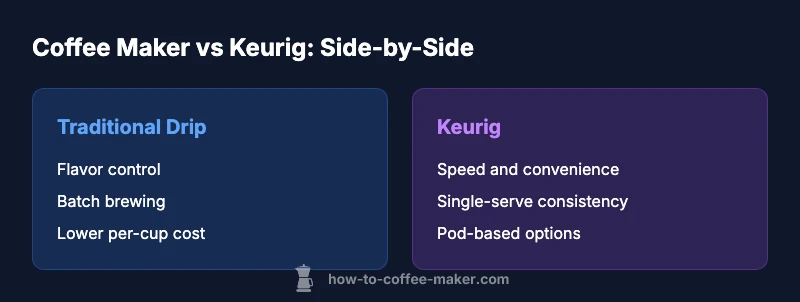
Choosing between coffee maker or keurig depends on your priorities. If speed, minimal cleanup, and consistent one-cup servings matter, Keurig single-serve shines. If you want lower ongoing costs, more control over brew strength, and the option to use ground coffee for full pots, a traditional coffee maker often wins. This comparison breaks down cost, flavor, convenience, and maintenance to help you decide.
Overview: What each system is and how they work
If you are weighing coffee maker or keurig, you’re choosing between two distinct approaches to daily coffee. A traditional coffee maker brews coffee into a carafe in batches, using ground beans and a filter. It rewards you with volume, flavor control, and the ritual of the pot. A Keurig single-serve brewer streams hot water through a pod or refillable pod to produce a cup in under a minute. It emphasizes speed, convenience, and minimal cleanup. According to BrewGuide Pro, the core difference is workflow: a coffee maker is designed for batch brewing with broad flexibility, while Keurig emphasizes quick, consistent results with limited cleanup. Understanding these basics helps set expectations for taste, temperature stability, and maintenance demands. This section also outlines variants such as programmable drip machines and newer pod systems that aim to balance convenience with sustainability. By the end, you’ll have a clear frame for evaluating your routines and space.
Flavor and beverage options: taste, customization, and consistency
Taste quality and beverage versatility are central to the coffee maker or Keurig decision. Traditional drip machines excel at batch flavor stability, especially when you dial in grind size, water temperature, and brew time. You can experiment with different origins, roasts, and grind profiles to build a customized flavor profile for a family pot or a small gathering. Keurig systems prioritize speed and consistency per cup. Pod choices offer a broad spectrum of beans, roasts, and even flavored options, but the beverage is constrained by the pod design. If you value experimentation and full control over strength, extraction, and aroma, a coffee maker stands out. If you want convenience with predictable taste from cup to cup, Keurig provides dependable results with less need for manual calibration. Brew patterns, temperature targets, and cleaning routines influence flavor more than any single feature. According to BrewGuide Pro, most households appreciate a hybrid approach for weekend rituals and weekday quick caffeine.
Convenience and speed: the daily routine factor
In daily routines, convenience is often the deciding factor when choosing between a coffee maker and a Keurig. Keurig wins on speed: a hot cup is ready in under a minute with minimal cleanup—no pots to rinse, no grounds to handle. This makes Keurig ideal for busy households, office kitchens, or scenarios where multiple people drink one cup in rapid succession. A traditional coffee maker, by contrast, requires more setup upfront: grinding, measuring, and waiting for a full pot. However, it shines when you need a crowd-friendly brew in a single carafe without refilling pods repeatedly. For families or roommates who appreciate reduced waste and fewer parts to manage, a single larger brewer can be advantageous. When evaluating convenience, consider how many cups you typically make, how often you desire different strengths, and whether you value a shared pot versus individual servings. BrewGuide Pro notes that the key is aligning equipment with your daily cadence and cleanup tolerance.
Costs and long-term value: upfront and ongoing costs
Cost considerations are central to choosing between coffee maker or keurig. Keurig machines vary in upfront price, but most offer a cost-per-cup advantage only if you consistently drink one cup and use affordable pods. The ongoing cost for pods, especially branded options, can add up over weeks and months. Traditional coffee makers often have a lower cost per cup once you factor in the price of whole beans and filters, and a carafe can serve multiple people with a single brew. Descale frequency, filter replacements, and maintenance products add to the long-term total. BrewGuide Pro Analysis, 2026, suggests that the upfront price gap between these options is driven by features, build quality, and inclusions like grinders or built-in grinders for certain drip machines. In practice, the choice comes down to how many cups you plan to drink, the price you’re comfortable paying per cup, and how important long-term savings are to you.
Maintenance and cleaning routines: care for your brewer
Maintenance is a practical differentiator between a coffee maker and a Keurig. Traditional coffee makers require periodic descaling, filter changes (for some models), and regular carafe cleaning to prevent residue buildup that can affect flavor. The complexity of cleaning increases with features like programmable clocks, thermal carafes, and built-in grinders. Keurig machines demand attention to pod-path cleanliness and occasional descaling as well, especially with mineral-rich water. Some Keurig models support reusable pods, which can mitigate waste and cost while still offering convenience. Regardless of the choice, routine cleaning—descaling, water reservoir care, and gasket inspection—extends the life of the machine and preserves flavor. BrewGuide Pro emphasizes building a simple maintenance schedule you can follow weekly or monthly to avoid surprises down the line.
Space, footprint, and aesthetics: how they fit in kitchen
Kitchen space and visual design influence the decision between coffee maker or keurig. A traditional drip coffee maker often requires more counter space and a larger footprint, especially when a carafe sits on a hot plate or a thermal carafe’s shape dominates the counter. Keurig machines typically have a smaller footprint and a cleaner, more compact silhouette, which can be advantageous in small apartments or shared kitchens. Aesthetic considerations matter too: a sleek single-serve machine may blend better with modern kitchen decor, while a classic drip brewer offers a traditional look that suits more rustic or retro styles. If you value a tidy counter and flexible placement, consider models with compact dimensions, deep water reservoirs, or under-cabinet mounting options. Brand diversity means you can balance form with function without sacrificing performance.
Environmental impact and waste considerations: sustainability in practice
Sustainability weighs into the coffee maker or Keurig decision, especially when waste is a concern. Keurig systems generate used pods, which adds to landfill volume unless you opt for recyclable or compostable pods and participate in recycling programs. Reusable pods and ground-bean options are available on several Keurig models, which can reduce waste with careful use. Traditional drip brewers produce less packaging waste per cup when you purchase whole beans or grounds in bulk, and many users prefer using reusable filters. Water waste is generally similar across both systems, but the per-cup waste footprint varies with the number of cups brewed. When considering the environmental impact, evaluate pod options, recycling infrastructure in your area, and your willingness to invest in reusable pods or bulk coffee purchases.
Price ranges and value: market options for every budget
The market for coffee maker or keurig spans a wide range of prices and configurations. Entry-level drip coffee makers can be found in a relatively lower price band, with more feature-rich models pushing higher into the range. Keurig machines also cover a broad spectrum, from compact budget units to high-end brewers with stronger temperature control and larger reservoirs. Beyond the machine, ongoing costs include coffee beans or pods, filters, and replacement parts such as gaskets or carafes. For households seeking a balance of cost and capability, consider mid-range drip machines with programmable features and a straightforward pod-compatible Keurig for single-serve days. Remember that the per-cup cost of coffee and the frequency of brewing will largely drive annual spending more than sticker price alone.
Setup, installation, and integration with existing routines: quick-start guidance
Getting started with either system involves a straightforward setup process. For coffee makers, you typically rinse the system, place a filter, and run a test brew to calibrate grind and water temperature. For Keurig machines, initial setup focuses on water calibration, pod compatibility checks, and brewers’ cleaning routines. Consider your current coffee ritual: if you routinely brew multiple cups, a drip machine with a programmable timer can replicate your morning routine, while a Keurig can act as a quick additive to your routine for guests or occasional extra cups. The goal is to minimize friction during morning prep and to keep your preferred system simple and reliable. If you routinely switch between different drink types, you may appreciate features like adjustable brew strength, temperature control, and accessible cleaning indicators.
Decision workflow: a practical 3-question test
To decide whether coffee maker or Keurig best fits your home, run through a quick three-question test. Question one: Do you typically brew for multiple people at once, or is your daily cup primarily for you? Question two: Is minimizing waste and cleanup a higher priority than customization? Question three: Do you want to explore a wide range of beans and origins or prefer the consistency of pod flavors? Answering these questions helps you align your choice with your daily routine, kitchen space, and environmental preferences. If you want flexibility and batch flavor, a traditional coffee maker often wins; if you want speed and simplicity, a Keurig can be a smarter fit.
Comparison
| Feature | Traditional drip coffee maker | Keurig single-serve system |
|---|---|---|
| Beverage options | Broad customization with grounds and carafe brewing | Wide variety of pod-based cups with quick prep |
| Brew speed | Batch brewing in minutes; multiple cups per cycle | Single-cup prep in under a minute per cup |
| Upfront price range | Lower to mid-range depending on features | Mid-range to premium depending on features |
| Ongoing costs | Beans/filters cost per cup; generally lower | |
| Waste and sustainability | Lower packaging waste; reusable filters common | Pod waste; recycling or compostable pods help mitigation |
| Maintenance | Descale, filter changes, and possible grinder care | Descale and occasional pod-path maintenance |
| Best for | households needing batch servings and versatility | individuals with fast, convenient caffeine needs |
Strengths
- Low ongoing cost per cup for many drip setups
- Greater brew control and flavor customization
- Larger capacity options for families or offices
- Wewer maintenance complexity when equipment is simple
- Quiet operation with minimal maintenance
Downsides
- Pod systems can have higher per-cup costs
- Pod waste adds environmental considerations
- Better flavor extraction requires skill and beans
- Descaling remains necessary for hard-water areas
Traditional drip coffee maker generally wins for long-term value and flavor versatility, while Keurig shines for speed and convenience in busy households.
If your priority is cost-per-cup and flavor customization, a standard coffee maker is typically the better long-term bet. If your priority is speed, simplicity, and minimal cleanup, a Keurig may be the smarter fit. The right choice depends on your daily routine and values.
Questions & Answers
What is the main difference between a coffee maker and a Keurig?
A traditional coffee maker brews ground coffee in batches for a carafe, offering flavor customization and larger cups. A Keurig uses pods to produce one cup at a time quickly, emphasizing convenience and clean-up. The decision hinges on your priorities for flavor, speed, and waste.
Traditional brewers offer batch flavor and control; single-serve machines prioritize speed and convenience.
Is a Keurig more expensive to run than a traditional coffee maker?
Pod costs can add up, especially with branded pods, making per-cup costs appear higher. If you use reusable pods or opt for affordable grounds, the gap narrows. Actual costs vary with daily usage and pod choices.
Pods can raise per-cup costs, but reusable pods help reduce expenses.
Can I use my own coffee grounds in a Keurig?
Many Keurig models support refillable pods or compatible ground coffee adapters, allowing you to use your own beans. Availability and performance depend on the model.
Yes, with refillable pods you can use your own grounds.
Are Keurig pods environmentally friendly?
Pods generate more waste than loose grounds, but some brands offer recyclable or compostable options. Recycling programs and reusable pods help offset environmental impact.
Pods create more waste, but recycling and reusable pods can help.
What should I consider for an office setup?
For offices, a Keurig can support many users with quick cups and minimal cleanup, while a drip machine suits teams who value economy and batch coffee. Consider space, noise, and maintenance routines.
Keurig is great for busy offices; drip machines suit teams needing bulk coffee.
How hard is cleaning and descaling?
Descaling is a routine task for both types. Drip brewers may require more frequent filter handling, while Keurig units need pod-path cleanliness and occasional component checks.
Descaling is part of regular care for both, with slightly different routines.
Key Takeaways
- Choose coffee maker for batch brewing and flexibility
- Opt for Keurig for quick single-serve sessions
- Consider ongoing pod costs versus bean purchases
- Factor in waste and recycling options
- Protect flavor quality with proper cleaning and descaling