How Much Coffee Should You Use When Making Cold Brew?
Learn how to calculate the right coffee amount for cold brew, adjust strength, and scale recipes with practical tips, step-by-step methods, and common pitfalls.


For cold brew, start with 1:4 to 1:8 coffee-to-water by weight, depending on strength (strong concentrate vs. ready-to-drink). A typical batch uses 60 g coffee per 1 liter water for a medium strength, or 125–150 g per liter for a stronger concentrate. Allow 12–24 hours of steeping, then filter and dilute to taste.
Understanding Cold Brew Ratios and Why They Matter
When people ask how much coffee when making cold brew, the answer must be tailored to strength, yield, and method. The core idea is a coffee-to-water ratio by weight, not volume, because grounds trap water differently than liquids. For cold brew, most home brewers start with a range: a lighter concentrate around 1:8 to 1:12, a medium concentrate around 1:6 to 1:8, and a strong concentrate around 1:4 to 1:5. Remember that density and grind size affect extraction, so you may need to adjust by 10–20% after the first batch. In practice, many brewers aim for roughly 60 g of coffee per liter of water for a standard batch, then brew longer or shorter to adjust strength. This quick framework helps answer the common question of how much coffee when making cold brew and sets the stage for more precise calculations later.
Calculating for Strength and Yield
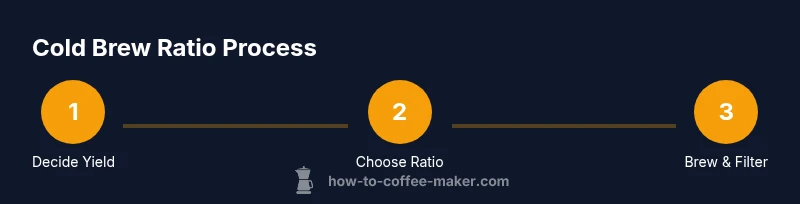
To hit your target strength while knowing exactly how much coffee you used, start with the math, then test and tweak. A simple approach is to fix the desired final volume (the yield) and the desired concentration (the strength of the brew). Use weight-based measurements: coffee mass (g) divided by water mass (g) equals the ratio. For example, brewers often choose 1 liter of final liquid. If you want a medium-strength batch in that liter, you might use 60–80 g of coffee, knowing the concentrate can be diluted 1:1 with water or milk after brewing. If you prefer a concentrate, you can push toward 100–125 g per liter. The key is consistency—use a kitchen scale, not guessing with measuring cups. Also, consider the beverage goal: a ready-to-drink cold brew is typically lighter; a concentrate is designed for dilution.
Methods and Their Coffee-to-Water Implications
Different brewing setups yield different practical ratios. In a Mason jar or pitcher, a common starting point is 1:6 to 1:8 for a balanced, drinkable cup when diluted after brewing. A French press demands a coarser grind and slightly different extraction dynamics, commonly 1:7 to 1:8. Cold-drip systems naturally produce cleaner flavors and may operate around 1:6 to 1:8. The main idea is to stay within a consistent ratio family, then adjust based on taste. Practical note: always weigh both coffee and water for accuracy rather than relying on volume estimates; temperature matters less in cold brew, but starting with cold water and a refrigerated environment helps consistency.
Grinding, Freshness, and Bean Choice
The grind should be coarse—earthy, chunky sand texture—to prevent over-extraction and clogging of filters. Freshly roasted beans dramatically improve flavor, but pre-ground coffee loses aroma quickly. For best results, grind just before brewing and keep grounds away from light, air, and moisture. Choose beans with chocolate, nutty, or berry-like notes that hold up to long extraction. If you use a grinder with dial settings, aim for a consistency similar to raw sugar or kosher salt. For larger yields, you can batch grind in groups to maintain uniform particle size across the batch.
Timing, Temperature, and Dilution
Steeping time ranges from 12 to 24 hours, depending on desired strength and grind size. Households often brew at room temperature for the first 12 hours, then refrigerate the brew for the remaining 12 hours to maximize flavor while keeping safety in mind. Once done, strain through a fine-mesh or a coffee filter, or use a dedicated cold-brew filter. If the brew tastes too strong, dilute with cold water or dairy until you reach the desired profile. Remember, temperature stability helps with consistent extraction; keep the brew in a closed container to minimize contamination and odors from fridge shelves.
Scaling Up or Down: Batch Brewing Tips
When scaling, keep the same ratios and adjust only the total weight. For a 2-liter batch at 1:6, you’ll use about 320 g of coffee. For a 2-liter batch at 1:8, use 250 g. To simplify, compute the coffee mass as yield (in liters) times desired grams per liter. If you’re sharing cold brew with guests or planning weekly batches, consider investing in a dedicated cold brew carafe or a large, airtight jar with an integrated filter. Label batches with brew date and strength to avoid confusion over time.
Practical Brewing Checklist and Common Pitfalls
Pro tip: use a scale for every batch; even small errors compound over long steep times. Warning: avoid over-extraction by limiting the steep time and keeping grind coarse. Note: always filter well to prevent sediment from passing into the final beverage. Common mistakes include using hot water, using a too-fine grind, and stirring too aggressively, which can introduce bitterness and cloudiness. Use a consistent method and document your ratios so future batches are repeatable.
Tools & Materials
- Whole bean coffee or cold brew-ready grounds(Prefer beans roasted within 2–3 weeks; grind to coarse texture just before brewing.)
- Digital kitchen scale(Measure coffee and water in grams for accuracy.)
- Burr grinder (coarse setting)(If using pre-ground, skip grinding step.)
- Large glass jar or pitcher with lid(Capacity at least 1 liter; a wide mouth helps stirring and filtration.)
- Cold, filtered water(Use clean water; water quality affects overall flavor.)
- Fine-mesh sieve or coffee filters(Two-stage filtration reduces sediment in the final drink.)
- Stirring utensil (non-metal preferred)(Helpful for ensuring even saturation of grounds.)
- Refrigerator or cool storage(Keep the brew between 2–7°C (36–45°F) during steeping for best results.)
- Storage bottle or carafe(Optional for serving and beverages on the go.)
Steps
Estimated time: 12-24 hours of steeping; ~20-30 minutes active prep and cleanup
- 1
Define yield and target strength
Decide the final volume you want and the strength level (concentrate vs ready-to-drink). This determines your coffee-to-water ratio and sets the foundation for the batch.
Tip: Write down the target ratio you’ll use and stick to it for repeatable results. - 2
Weigh coffee and water precisely
Place the scale under your container and tare it. Weigh the coffee first, then the water to reach your chosen ratio.
Tip: Avoid guessing with measuring cups; grams are more accurate for long steep times. - 3
Grind coffee to a coarse consistency
Grind should resemble coarse sea salt. Too-fine grounds can over-extract and clog filters.
Tip: Grind just before brewing to preserve aroma and flavor. - 4
Combine grounds with water and stir
Add grounds to the water in your jar, then gently stir to saturate all grounds evenly.
Tip: Stir slowly to avoid creating channels where water bypasses grounds. - 5
Cover and steep for 12–24 hours
Seal the container and place it in a cool area or the refrigerator depending on your schedule. The longer the steep, the stronger the concentrate (to a point).
Tip: Keep a consistent environment to avoid temperature fluctuations that alter extraction. - 6
Filter the concentrate
Pour through a fine mesh sieve or filter, then pass through a clean coffee filter for a crisper finish.
Tip: Two-stage filtration minimizes sediment and mouthfeel grit. - 7
Dilute and serve or store
Dilute the concentrate to taste with water, milk, or ice. If storing, keep in a sealed container in the fridge.
Tip: Label batches with date and dilution ratio for easy reuse. - 8
Clean equipment thoroughly
Rinse all components after brewing to prevent residual oils and odors from affecting future batches.
Tip: A quick rinse with warm water followed by air-drying is usually enough.
Questions & Answers
What is the best starting ratio for cold brew?
A common starting point is 1:6 to 1:8 coffee-to-water for a balanced batch. Adjust toward 1:4–1:5 for a concentrate or 1:8–1:12 for a lighter, ready-to-drink brew.
Start with 1 to 6 to 1 to 8, then tweak toward concentrate or lighter brew as you taste.
How long should cold brew steep?
Most cold brews steep for 12–24 hours. Shorter times yield lighter flavors; longer times amplify body and aroma, but risk over-extraction if too long.
Steep for 12 to 24 hours depending on strength you want.
Can I reuse coffee grounds for a second batch?
Reuse generally leads to weak, flat flavors. Fresh grounds produce the best taste and aroma.
Reusing grounds usually tastes dull; use fresh grounds for best results.
Should I dilute concentrate before drinking?
Yes. Dilute concentrate with water, milk, or ice to reach your preferred strength.
Dilute to taste with water or milk.
Is cold brew safe to store in the fridge?
Store in the refrigerator in a sealed container for up to about a week. Keep it cold and covered.
Kept cold in the fridge, it stays good for about a week.
What equipment is essential for cold brew?
At minimum, a scale, a coarse grinder, a filter, and a suitable container are essential. Optional gear can streamline filtration and storage.
Scale, coarse grind, filter, and a container are essential.
Watch Video
Key Takeaways
- Start with a clear target ratio and batch size.
- Weigh coffee and water precisely; flavor quality depends on accuracy.
- Coarse grind and slow, clean filtration improve clarity.
- Cold brew strength can be tuned by dilution after brewing.
- Document your results for repeatable excellence.